

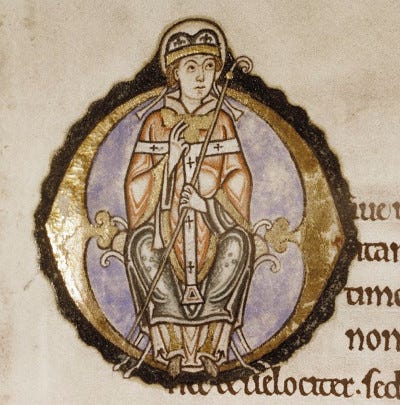
About the Text: Anselm of Canterbury (1033–1109) was a Benedictine monk from Italy who became the abbot of the monastery of Bec in France, before spending sixteen years as the Archbishop of Canterbury. On account of the method taken up in his numerous philosophical writings, Anselm is credited as the founder of Scholasticism. One such writing is the text, Cur Deus Homo, “Why God Became Man,” a section of which we present here. Written as a dialogue, Anselm explains to “Boso” the reasons for the Incarnation.
—
Anselm. It ought not to be disputed that rational nature was made holy by God, in order to be happy in enjoying Him. For to this end is it rational, in order to discern justice and injustice, good and evil, and between the greater and the lesser good. Otherwise it was made rational in vain. But God made it not rational in vain. Wherefore, doubtless, it was made rational for this end.
In like manner is it proved that the intelligent creature received the power of discernment for this purpose, that he might hate and shun evil, and love and choose good, and especially the greater good. For else in vain would God have given him that power of discernment, since man’s discretion would be useless unless he loved and avoided according to it. But it does not befit God to give such power in vain. It is, therefore, established that rational nature was created for this end, viz., to love and choose the highest good supremely, for its own sake and nothing else; for if the highest good were chosen for any other reason, then something else and not itself would be the thing loved. But intelligent nature cannot fulfil this purpose without being holy. Therefore that it might not in vain be made rational, it was made, in order to fulfil this purpose, both rational and holy.
Now, if it was made holy in order to choose and love the highest good, then it was made such in order to follow sometimes what it loved and chose, or else it was not. But if it were not made holy for this end, that it might follow what it loves and chooses, then in vain was it made to love and choose holiness; and there can be no reason why it should be ever bound to follow holiness. Therefore, as long as it will be holy in loving and choosing the supreme good, for which it was made, it will be miserable; because it will be impotent despite of its will, inasmuch as it does not have what it desires. But this is utterly absurd. Wherefore rational nature was made holy, in order to be happy in enjoying the supreme good, which is God. Therefore man, whose nature is rational, was made holy for this end, that he might be happy in enjoying God.
Moreover, it is easily proved that man was so made as not to be necessarily subject to death; for, as we have already said, it is inconsistent with God’s wisdom and justice to compel man to suffer death without fault, when he made him holy to enjoy eternal blessedness. It therefore follows that had man never sinned he never would have died.
From this the future resurrection of the dead is clearly proved. For if man is to be perfectly restored, the restoration should make him such as he would have been had he never sinned.
Boso. It must be so.
Anselm. Therefore, as man, had he not sinned, was to have been transferred with the same body to an immortal state, so when he shall be restored, it must properly be with his own body as he lived in this world.
Boso. But what shall we say to one who tells us that this is right enough with regard to those in whom humanity shall be perfectly restored, but is not necessary as respects the reprobate?
Anselm. We know of nothing more just or proper than this, that as man, had he continued in holiness, would have been perfectly happy for eternity, both in body and in soul; so, if he persevere in wickedness, he shall be likewise completely miserable forever.
Boso. You have promptly satisfied me in these matters.
Anselm. From these things, we can easily see that God will either complete what he has begun with regard to human nature, or else he has made to no end so lofty a nature, capable of so great good. Now if it be understood that God has made nothing more valuable than rational existence capable of enjoying him; it is altogether foreign from his character to suppose that he will suffer that rational existence utterly to perish.
Boso. No reasonable being can think otherwise.
Anselm. Therefore is it necessary for him to perfect in human nature what he has begun. But this, as we have already said, cannot be accomplished save by a complete expiation of sin, which no sinner can effect for himself.
Boso. I now understand it to be necessary for God to complete what he has begun, lest there be an unseemly falling off from his design. But if it be so, then God seems as it were compelled, for the sake of avoiding what is unbecoming, to secure the salvation of man. How, then, can it be denied that he does it more on his own account than on ours? But if it be so, what thanks do we owe him for what he does for himself? How shall we attribute our salvation to his grace, if he saves us from necessity?
Anselm. There is a necessity which takes away or lessens our gratitude to a benefactor, and there is also a necessity by which the favor deserves still greater thanks. For when one does a benefit from a necessity to which he is unwillingly subjected, less thanks are due him, or none at all. But when he freely places himself under the necessity of benefiting another, and sustains that necessity without reluctance, then he certainly deserves greater thanks for the favor. For this should not be called necessity but grace, inasmuch as he undertook or maintains it, not with any constraint, but freely.
For if that which to‑day you promise of your own accord you will give to‑morrow, you do give to‑morrow with the same willingness; though it be necessary for you, if possible, to redeem your promise, or make yourself a liar; notwithstanding, the recipient of your favor is as much indebted for your precious gift as if you had not promised it, for you were not obliged to make yourself his debtor before the time of giving it: just so is it when one undertakes, by a vow, a design of holy living. For though after his vow he ought necessarily to perform, lest he suffer the judgment of an apostate, and, although he may be compelled to keep it even unwillingly, yet, if he keep his vow cheerfully, he is not less but more pleasing to God than if he had not vowed. For he has not only given up the life of the world, but also his personal liberty, for the sake of God; and he cannot be said to live a holy life of necessity, but with the same freedom with which he took the vow.
Much more, therefore, do we owe all thanks to God for completing his intended favor to man; though, indeed, it would not be proper for him to fail in his good design, because wanting nothing in himself he begun it for our sake and not his own. For what man was about to do was not hidden from God at his creation; and yet by freely creating man, God as it were bound himself to complete the good which he had begun.
In fine, God does nothing by necessity, since he is not compelled or restrained in anything. And when we say that God does anything to avoid dishonor, which he certainly does not fear, we must mean that God does this from the necessity of maintaining his honor; which necessity is after all no more than this, viz., the immutability of his honor, which belongs to him in himself, and is not derived from another; and therefore it is not properly called necessity. Yet we may say, although the whole work which God does for man is of grace, that it is necessary for God, on account of his unchangeable goodness, to complete the work which he has begun.
Boso. I grant it.
Anselm. But this cannot be effected, except the price paid to God for the sin of man be something greater than all the universe besides God.
Boso. So it appears.
Anselm. Moreover, it is necessary that he who can give God anything of his own which is more valuable than all things in the possession of God, must be greater than all else but God himself.
Boso. I cannot deny it.
Anselm. Therefore none but God can make this satisfaction.
Boso. So it appears.
Anselm. But none but a man ought to do this, other wise man does not make the satisfaction.
Boso. Nothing seems more just.
Anselm. If it be necessary, therefore, as it appears, that the heavenly kingdom be made up of men, and this cannot be effected unless the aforesaid satisfaction be made, which none but God can make and none but man ought to make, it is necessary for the God‑man to make it.
Boso. Now blessed be God! we have made a great discovery with regard to our question. Go on, therefore, as you have begun. For I hope that God will assist you.
Anselm. Now must we inquire how God can become man. The Divine and human natures cannot alternate, so that the Divine should become human or the human Divine; nor can they be so commingled as that a third should be produced from the two which is neither wholly Divine nor wholly human. For, granting that it were possible for either to be changed into the other, it would in that case be only God and not man, or man only and not God. Or, if they were so commingled that a third nature sprung from the combination of the two (as from two animals, a male and a female of different species, a third is produced, which does not preserve entire the species of either parent, but has a mixed nature derived from both), it would neither be God nor man. Therefore the God‑man, whom we require to be of a nature both human and Divine, cannot be produced by a change from one into the other, nor by an imperfect commingling of both in a third; since these things cannot be, or, if they could be, would avail nothing to our purpose.
Moreover, if these two complete natures are said to be joined somehow, in such a way that one may be Divine while the other is human, and yet that which is God not be the same with that which is man, it is impossible for both to do the work necessary to be accomplished. For God will not do it, because he has no debt to pay; and man will not do it, because he cannot. Therefore, in order that the God‑man may perform this, it is necessary that the same being should be perfect God and perfect man, in order to make this atonement. For he cannot and ought not to do it, unless he be very God and very man.
Since, then, it is necessary that the God‑man preserve the completeness of each nature, it is no less necessary that these two natures be united entire in one person, just as a body and a reasonable soul exist together in every human being; for otherwise it is impossible that the same being should be very God and very man.
Boso. All that you say is satisfactory to me.
Anselm. It now remains to inquire whence and how God shall assume human nature. For he will either take it from Adam, or else he will make a new man, as he made Adam originally. But, if he makes a new man, not of Adam’s race, then this man will not belong to the human family, which descended from Adam, and therefore ought not to make atonement for it, because he never belonged to it. For, as it is right for man to make atonement for the sin of man, it is also necessary that he who makes the atonement should be the very being who has sinned, or else one of the same race. Otherwise, neither Adam nor his race would make satisfaction for themselves. Therefore, as through Adam and Eve sin was propagated among all men, so none but themselves, or one born of them, ought to make atonement for the sin of men. And, since they cannot, one born of them must fulfil this work.
Moreover, as Adam and his whole race, had he not sinned, would have stood firm without the support of any other being, so, after the fall, the same race must rise and be exalted by means of itself. For, whoever restores the race to its place, it will certainly stand by that being who has made this restoration. Also, when God created human nature in Adam alone, and would only make woman out of man, that by the union of both sexes there might be increase, in this he showed plainly that he wished to produce all that he intended with regard to human nature from man alone. Wherefore, if the race of Adam be reinstated by any being not of the same race, it will not be restored to that dignity which it would have had, had not Adam sinned, and so will not be completely restored; and, besides, God will seem to have failed of his purpose, both which suppositions are incongruous: It is, therefore, necessary that the man by whom Adam’s race shall be restored be taken from Adam.
Boso. If we follow reason, as we proposed to do, this is the necessary result.
Anselm. Let us now examine the question, whether the human nature taken by God must be produced from a father and mother, as other men are, or from man alone, or from woman alone. For, in whichever of these three modes it be, it will be produced from Adam and Eve, for from these two is every person of either sex descended. And of these three modes, no one is easier for God than another, that it should be selected on this account.
Boso. So far, it is well.
Anselm. It is no great toil to show that that man will be brought into existence in a nobler and purer manner, if produced from man alone, or woman alone, than if springing from the union of both, as do all other men.
Boso. I agree with you.
Anselm. Therefore must he be taken either from man alone, or woman alone.
Boso. There is no other source.
Anselm. In four ways can God create man, viz., either of man and woman, in the common way; or neither of man nor woman, as he created Adam; or of man without woman, as he made Eve; or of woman without man, which thus far he has never done. Wherefore, in order to show that this last mode also under his power, and was reserved for this very purpose, what more fitting than that he should take that man whose origin we are seeking from a woman without a man?
Now whether it be more worthy that he be born of a virgin, or one not a virgin, we need not discuss, but must affirm, beyond all doubt, that the God‑man should be born of a virgin.
Boso. Your speech gratifies my heart.
Anselm. Does what we have said appear sound, or is it unsubstantial as a cloud, as you have said infidels declare?
Boso. Nothing can be more sound.
Anselm. Paint not, therefore, upon baseless emptiness, but upon solid truth, and tell how clearly fitting it is that, as man’s sin and the cause of our condemnation sprung from a woman, so the cure of sin and the source of our salvation should also be found in a woman. And that women may not despair of attaining the inheritance of the blessed, because that so dire an evil arose from woman, it is proper that from woman also so great a blessing should arise, that their hopes may be revived.
Take also this view. If it was a virgin which brought all evil upon the race, it is much more appropriate that a virgin should be the occasion of all good. And this also. If woman, whom God made from man alone, was made of a virgin, it is peculiarly fitting for that man also, who shall spring from a woman, to be born of a woman without man.
Of the pictures which can be superadded to this, showing that the God‑man ought to be born of a virgin, we will say nothing. These are sufficient.
Boso. They are certainly very beautiful and reasonable.
Anselm. Now must we inquire further, in what person God, who exists in three persons, shall take upon himself the nature of man. For a plurality of persons cannot take one and the same man into a unity of person. Wherefore in one person only can this be done. But, as respects this personal unity of God and man, and in which of the Divine persons this ought to be effected, I have expressed myself, as far as I think needful for the present inquiry, in a letter on the Incarnation of the Word, addressed to my lord, the Pope Urban.
Boso. Yet briefly glance at this matter, why the person of the Son should be incarnated rather than that of the Father or the Holy Spirit.
Anselm. If one of the other persons be incarnated, there will be two sons in the Trinity, viz., the Son of God, who is the Son before the incarnation, and he also who, by the incarnation, will be the son of the virgin; and among the persons which ought always to be equal there will be an inequality as respects the dignity of birth. For the one born of God will have a nobler birth than he who is born of the virgin.
Likewise, if the Father become incarnate, there will be two grandsons in the Trinity; for the Father, by assuming humanity, will be the grandson of the parents of the virgin, and the Word, though having nothing to do with man, will yet be the grandson of the virgin, since he will be the son of her son. But all these things are incongruous and do not pertain to the incarnation of the Word.
And there is yet another reason which renders it more fitting for the Son to become incarnate than the other persons. It is, that for the Son to pray to the Father is more proper than for any other person of the Trinity to supplicate his fellow. Moreover, man, for whom he was to pray, and the devil, whom he was to vanquish, have both put on a false likeness to God by their own will. Wherefore they have sinned, as it were, especially against the person of the Son, who is believed to be the very image of God. Wherefore the punishment or pardon of guilt is with peculiar propriety ascribed to him upon whom chiefly the injury was inflicted.
Since, therefore, infallible reason has brought us to this necessary conclusion, that the Divine and human natures must unite in one person, and that this is evidently more fitting in respect to the person of the Word than the other persons, we determine that God the Word must unite with man in one person.
Boso. The way by which you lead me is so guarded by reason that I cannot deviate from it to the right or left.
Anselm. It is not I who lead you, but he of whom we are speaking, without whose guidance we have no power to keep the way of truth.
—
From Works of St. Anselm, trans. Sidney Norton Deane, book 2, caps. 1–9 (1903).