

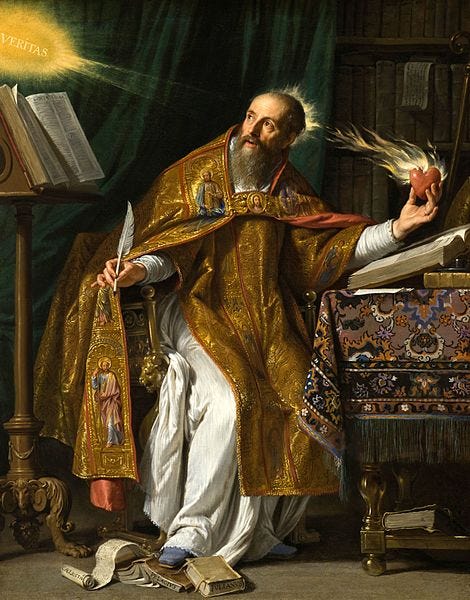
About the Author: Augustine of Hippo (354–430) was the greatest preacher to be produced by the Roman provinces of North Africa. A most prolific writer, Augustine single-handedly took on the Manichaeans, Donatists, and Pelagians, while still finding time to write his masterpiece On the Trinity. The present text is taken from book four of that treatise and serves as an example of Augustine’s rhetorical skill as he contrasts the devil’s pride that casts down with Christ’s humility that raises up.
13. Therein is our true peace and firm bond of union with our Creator, that we should be purified and reconciled through the Mediator of life, as we had been polluted and alienated, and so had departed from Him, through the mediator of death. For as the devil through pride led man through pride to death; so Christ through lowliness led back man through obedience to life. Since, as the one fell through being lifted up, and cast down [man] also who consented to him; so the other was raised up through being abased, and lifted up [man] also who believed in Him. For because the devil had not himself come there whither he had led the way (inasmuch as he bare indeed in his ungodliness the death of the spirit, but had not undergone the death of the flesh, because he had not assumed the covering of the flesh), he appeared to man to be a mighty chief among the legions of devils, through whom he exercises his reign of deceits; so puffing up man the more, who is eager for power more than righteousness, through the pride of elation, or through false philosophy; or else entangling him through sacrilegious rites, in which, while casting down headlong by deceit and illusion the minds of the more curious and prouder sort, he holds him captive also to magical trickery; promising too the cleansing of the soul, through those initiations which they call τελεταί [teletai], by transforming himself into an angel of light, through various machinations in signs and prodigies of lying.
14. For it is easy for the most worthless spirits to do many things by means of aerial bodies, such as to cause wonder to souls which are weighed down by earthly bodies, even though they be of the better inclined. For if earthly bodies themselves, when trained by a certain skill and practice, exhibit to men so great marvels in theatrical spectacles, that they who never saw such things scarcely believe them when told; why should it be hard for the devil and his angels to make out of corporeal elements, through their own aerial bodies, things at which the flesh marvels; or even by hidden inspirations to contrive fantastic appearances to the deluding of men’s senses, whereby to deceive them, whether awake or asleep, or to drive them into frenzy? But just as it may happen that one who is better than they in life and character may gaze at the most worthless of men, either walking on a rope, or doing by various motions of the body many things difficult of belief, and yet he may not at all desire to do such things, nor think those men on that account to be preferred to himself; so the faithful and pious soul, not only if it sees, but even if on account of the frailty of the flesh it shudders at, the miracles of demons; yet will not for that either deplore its own want of power to do such things, or judge them on this account to be better than itself; especially since it is in the company of the holy, who, whether they are men or good angels, accomplish, through the power of God, to whom all things are subject, wonders which are far greater and the very reverse of deceptive.
15. In no wise therefore are souls cleansed and reconciled to God by sacrilegious imitations, or curious arts that are impious, or magical incantations; since the false mediator does not translate them to higher things, but rather blocks and cuts off the way there through the affections, malignant in proportion as they are proud, which he inspires into those of his own company; which are not able to nourish the wings of virtues so as to fly upwards, but rather to heap up the weight of vices so as to press downwards; since the soul will fall down the more heavily, the more it seems to itself to have been carried upwards. Accordingly, as the Magi did when warned of God, whom the star led to adore the low estate of the Lord; so we also ought to return to our country, not by the way by which we came, but by another way which the lowly King has taught, and which the proud king, the adversary of that lowly King, cannot block up. For to us, too, that we may adore the lowly Christ, the “heavens have declared the glory of God, when their sound went into all the earth, and their words to the ends of the world.” A way was made for us to death through sin in Adam. For, “By one man sin entered into the world, and death by sin; and so death passed upon all men, in whom all have sinned.” Of this way the devil was the mediator, the persuader to sin, and the caster down into death. For he, too, applied his one death to work out our double death. Since he indeed died in the spirit through ungodliness, but certainly did not die in the flesh: yet both persuaded us to ungodliness, and thereby brought it to pass that we deserved to come into the death of the flesh. We desired therefore the one through wicked persuasion, the other followed us by a just condemnation; and therefore it is written, “God made not death,” since He was not Himself the cause of death; but yet death was inflicted on the sinner, through His most just retribution. Just as the judge inflicts punishment on the guilty; yet it is not the justice of the judge, but the desert of the crime, which is the cause of the punishment. Whither, then, the mediator of death caused us to pass, yet did not come himself, that is, to the death of the flesh, there our Lord God introduced for us the medicine of correction, which He deserved not, by a hidden and exceeding mysterious decree of divine and profound justice. In order, therefore, that as by one man came death, so by one man might come also the resurrection of the dead; because men strove more to shun that which they could not shun, viz. the death of the flesh, than the death of the spirit, i.e. punishment more than the desert of punishment (for not to sin is a thing about which either men are not solicitous or are too little solicitous; but not to die, although it be not within reach of attainment, is yet eagerly sought after); the Mediator of life, making it plain that death is not to be feared, which by the condition of humanity cannot now be escaped, but rather ungodliness, which can be guarded against through faith, meets us at the end to which we have come, but not by the way by which we came. For we, indeed, came to death through sin; He through righteousness: and, therefore, as our death is the punishment of sin, so His death was made a sacrifice for sin.
16. Wherefore, since the spirit is to be preferred to the body, and the death of the spirit means that God has left it, but the death of the body that the spirit has left it; and since herein lies the punishment in the death of the body, that the spirit leaves the body against its will, because it left God willingly; so that, whereas the spirit left God because it would, it leaves the body although it would not; nor leaves it when it would, unless it has offered violence to itself, whereby the body itself is slain: the spirit of the Mediator showed how it was through no punishment of sin that He came to the death of the flesh, because He did not leave it against His will, but because He willed, when He willed, as He willed. For because He is so commingled [with the flesh] by the Word of God as to be one, He says: “I have power to lay down my life, and I have power to take it again. No man takes it from me, but I lay down my life that I might take it again.” And, as the Gospel tells us, they who were present were most astonished at this, that after that [last] word, in which He set forth the figure of our sin, He immediately gave up His spirit. For they who are hung on the cross are commonly tortured by a prolonged death. Whence it was that the legs of the thieves were broken, in order that they might die directly, and be taken down from the cross before the Sabbath. And that He was found to be dead already, caused wonder. And it was this also, at which, as we read, Pilate marvelled, when the body of the Lord was asked of him for burial.
17. Because that deceiver then — who was a mediator to death for man, and feignedly puts himself forward as to life, under the name of cleansing by sacrilegious rites and sacrifices, by which the proud are led away — can neither share in our death, nor rise again from his own: he has indeed been able to apply his single death to our double one; but he certainly has not been able to apply a single resurrection, which should be at once a mystery of our renewal, and a type of that waking up which is to be in the end. He then who being alive in the spirit raised again His own flesh that was dead, the true Mediator of life, has cast out him, who is dead in the spirit and the mediator of death, from the spirits of those who believe in Himself, so that he should not reign within, but should assault from without, and yet not prevail. And to him, too, He offered Himself to be tempted, in order that He might be also a mediator to overcome his temptations, not only by succor, but also by example. But when the devil, from the first, although striving through every entrance to creep into His inward parts, was thrust out, having finished all his alluring temptation in the wilderness after the baptism; because, being dead in the spirit, he forced no entrance into Him who was alive in the spirit, he betook himself, through eagerness for the death of man in any way whatsoever, to effecting that death which he could, and was permitted to effect it upon that mortal element which the living Mediator had received from us. And where he could do anything, there in every respect he was conquered; and wherein he received outwardly the power of slaying the Lord in the flesh, therein his inward power, by which he held ourselves, was slain. For it was brought to pass that the bonds of many sins in many deaths were loosed, through the one death of One which no sin had preceded. Which death, though not due, the Lord therefore rendered for us, that the death which was due might work us no hurt. For He was not stripped of the flesh by obligation of any authority, but He stripped Himself. For doubtless He who was able not to die, if He would not, did die because He would: and so He made a show of principalities and powers, openly triumphing over them in Himself. For whereas by His death the one and most real sacrifice was offered up for us, whatever fault there was, whence principalities and powers held us fast as of right to pay its penalty, He cleansed, abolished, extinguished; and by His own resurrection He also called us whom He predestinated to a new life; and whom He called, them He justified; and whom He justified, them He glorified. And so the devil, in that very death of the flesh, lost man, whom he was possessing as by an absolute right, seduced as he was by his own consent, and over whom he ruled, himself impeded by no corruption of flesh and blood, through that frailty of man’s mortal body, whence he was both too poor and too weak; he who was proud in proportion as he was, as it were, both richer and stronger, ruling over him who was, as it were, both clothed in rags and full of troubles. For whither he drove the sinner to fall, himself not following, there by following he compelled the Redeemer to descend. And so the Son of God deigned to become our friend in the fellowship of death, to which because he came not, the enemy thought himself to be better and greater than ourselves. For our Redeemer says, “Greater love has no man than this, that a man lay down his life for his friends.” Wherefore also the devil thought himself superior to the Lord Himself, inasmuch as the Lord in His sufferings yielded to him; for of Him, too, is understood what is read in the Psalm, “For You have made Him a little lower than the angels:” so that He, being Himself put to death, although innocent, by the unjust one acting against us as it were by just right, might by a most just right overcome him, and so might lead captive the captivity wrought through sin, and free us from a captivity that was just on account of sin, by blotting out the handwriting, and redeeming us who were to be justified although sinners, through His own righteous blood unrighteously poured out.
18. Hence also the devil mocks those who are his own until this very day, to whom he presents himself as a false mediator, as though they would be cleansed or rather entangled and drowned by his rites, in that he very easily persuades the proud to ridicule and despise the death of Christ, from which the more he himself is estranged, the more is he believed by them to be the holier and more divine. Yet those who have remained with him are very few, since the nations acknowledge and with pious humility imbibe the price paid for themselves, and in trust upon it abandon their enemy, and gather together to their Redeemer. For the devil does not know how the most excellent wisdom of God makes use of both his snares and his fury to bring about the salvation of His own faithful ones, beginning from the former end, which is the beginning of the spiritual creature, even to the latter end, which is the death of the body, and so “reaching from the one end to the other, mightily and sweetly ordering all things.” For wisdom “passes and goes through all things by reason of her pureness, and no defiled thing can fall into her.” And since the devil has nothing to do with the death of the flesh, whence comes his exceeding pride, a death of another kind is prepared in the eternal fire of hell, by which not only the spirits that have earthly, but also those who have aerial bodies, can be tormented. But proud men, by whom Christ is despised, because He died, wherein He bought us with so great a price, both bring back the former death, and also men, to that miserable condition of nature, which is derived from the first sin, and will be cast down into the latter death with the devil. And they on this account preferred the devil to Christ, because the former cast them into that former death, whither he himself fell not through the difference of his nature, and whither on account of them Christ descended through His great mercy: and yet they do not hesitate to believe themselves better than the devils, and do not cease to assail and denounce them with every sort of malediction, while they know them at any rate to have nothing to do with the suffering of this kind of death, on account of which they despise Christ. Neither will they take into account that the case may possibly be, that the Word of God, remaining in Himself, and in Himself in no way changeable, may yet, through the taking upon Him of a lower nature, be able to suffer somewhat of a lower kind, which the unclean spirit cannot suffer, because he has not an earthly body. And so, whereas they themselves are better than the devils, yet, because they bear a body of flesh, they can so die, as the devils certainly cannot die, who do not bear such a body. They presume much on the deaths of their own sacrifices, which they do not perceive that they sacrifice to deceitful and proud spirits; or if they have come to perceive it, think their friendship to be of some good to themselves, treacherous and envious although they are, whose purpose is bent upon nothing else except to hinder our return.
19. They do not understand, that not even the proudest of spirits themselves could rejoice in the honor of sacrifices, unless a true sacrifice was due to the one true God, in whose stead they desire to be worshipped: and that this cannot be rightly offered except by a holy and righteous priest; nor unless that which is offered be received from those for whom it is offered; and unless also it be without fault, so that it may be offered for cleansing the faulty. This at least all desire who wish sacrifice to be offered for themselves to God. Who then is so righteous and holy a priest as the only Son of God, who had no need to purge His own sins by sacrifice, neither original sins, nor those which are added by human life? And what could be so fitly chosen by men to be offered for them as human flesh? And what so fit for this immolation as mortal flesh? And what so clean for cleansing the faults of mortal men as the flesh born in and from the womb of a virgin, without any infection of carnal concupiscence? And what could be so acceptably offered and taken, as the flesh of our sacrifice, made the body of our priest? In such wise that, whereas four things are to be considered in every sacrifice — to whom it is offered, by whom it is offered, what is offered, for whom it is offered, — the same One and true Mediator Himself, reconciling us to God by the sacrifice of peace, might remain one with Him to whom He offered, might make those one in Himself for whom He offered, Himself might be in one both the offerer and the offering.
20. There are, however, some who think themselves capable of being cleansed by their own righteousness, so as to contemplate God, and to dwell in God; whom their very pride itself stains above all others. For there is no sin to which the divine law is more opposed, and over which that proudest of spirits, who is a mediator to things below, but a barrier against things above, receives a greater right of mastery: unless either his secret snares be avoided by going another way, or if he rage openly by means of a sinful people (which Amalek, being interpreted, means), and forbid by fighting the passage to the land of promise, he be overcome by the cross of the Lord, which is prefigured by the holding out of the hands of Moses. For these persons promise themselves cleansing by their own righteousness for this reason, because some of them have been able to penetrate with the eye of the mind beyond the whole creature, and to touch, though it be in ever so small a part, the light of the unchangeable truth; a thing which they deride many Christians for being not yet able to do, who, in the meantime, live by faith alone. But of what use is it for the proud man, who on that account is ashamed to embark upon the ship of wood, to behold from afar his country beyond the sea? Or how can it hurt the humble man not to behold it from so great a distance, when he is actually coming to it by that wood upon which the other disdains to be borne?
From De Trinitate, trans. Arthur West Haddan, Nicene and Post-Nicene Fathers, series I, vol. 3 (1887).