

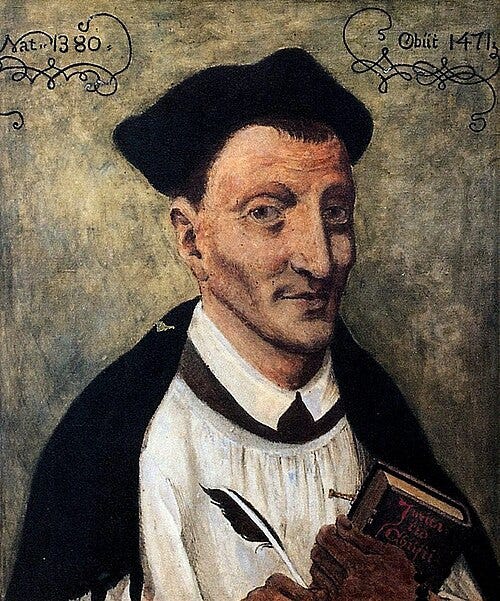
About the Author: Thomas à Kempis (c. 1380–1471) was a canon regular—a priest living in community with other priests and following a rule—and a member of the Brethren of the Common Life, founded by Gerard de Groote in the Lowlands. Little is known of his life, but we have a number of his sermons and writings. His best-known work is the Imitation of Christ, written in the early-fifteenth century, which was a favourite of several saints including Thomas More, Ignatius of Loyola, and Thérèse of Lisieux. In these passages taken from books one, two, and three, Thomas provides meditations on the importance of having a low regard for oneself.
I. Of thinking humbly of oneself.
There is naturally in every man a desire to know, but what profiteth knowledge without the fear of God? Better of a surety is a lowly peasant who serveth God, than a proud philosopher who watcheth the stars, and neglecteth the knowledge of himself. He who knoweth himself well is vile in his own sight, neither regardeth he the praises of men. If I knew all the things that are in the world and were not in charity, what should it help me before God, who is to judge me according to my deeds ?
2. Rest from inordinate desire of knowledge, for therein is found much distraction and deceit. Those who have knowledge desire to appear learned and to be called wise. Many things there are, to know which profiteth little or nothing to the soul. And foolish out of measure is he who attendeth upon other things rather than those which serve to his soul’s health. Many words satisfy not the soul, but a good life refresheth the mind, and a pure conscience giveth great confidence towards God.
3. The greater and more complete thy knowledge, the more severely shalt thou be judged, unless thou hast lived holily. Therefore be not lifted up by any skill or knowledge that thou hast; but rather fear concerning the knowledge which is given to thee. If it seemeth to thee that thou knowest many things, and understandest them well, know also that there are many more things which thou knowest not. Be not high-minded, but rather confess thine ignorance. Why desirest thou to lift thyself above another, when there are found many more learned and more skilled in the Scripture than thou? If thou wilt know and learn anything with profit, love to be thyself unknown and to be counted for nothing.
4. That is the highest and most profitable lesson, when a man truly knoweth, and judgeth lowly of himself. To account nothing of one’s self, and to think always kindly and highly of others, this is great and perfect wisdom. Even shouldest thou see thy neighbour sin openly or grievously, yet thou oughtest not to reckon thyself better than he, for thou knowest not how long thou shalt keep thine integrity. All of us are weak and frail; hold thou no man more frail than thyself.
II. Of lowly submission.
Make no great account who is for thee or against thee, but mind only the present duty and take care that God be with thee in whatsoever thou doest. Have a good conscience and God will defend thee, for he whom God will help no man’s perverseness shall be able to hurt. If thou knowest how to hold thy peace and to suffer, without doubt thou shalt see the help of the Lord. He knoweth the time and the way to deliver thee, therefore must thou resign thyself to Him. To God it belongeth to help and to deliver from all confusion. Oftentimes it is very profitable for keeping us in greater humility, that others know and rebuke our faults.
2. When a man humbleth himself for his defects, he then easily pacifieth others and quickly satisfieth those that are angered against him. God protecteth and delivereth the humble man, He loveth and comforteth the humble man, to the humble man He inclineth Himself, on the humble He bestoweth great grace, and when he is cast down He raiseth him to glory: to the humble He revealeth His secrets, and sweetly draweth and inviteth him to Himself. The humble man having received reproach, is yet in sufficient peace, because he resteth on God and not on the world. Reckon not thyself to have profited in anywise unless thou feel thyself to be inferior to all.
III. Of hiding our grace under the guard of humility.
My son, it is better and safer for thee to hide the grace of devotion, and not to lift thyself up on high, nor to speak much thereof, nor to value it greatly; but rather to despise thyself, and to fear as though this grace were given to one unworthy thereof. Nor must thou depend too much upon this feeling, for it can very quickly be turned into its opposite. Think when thou art in a state of grace, how miserable and poor thou art wont to be without grace. Nor is there advance in spiritual life in this alone, that thou hast the grace of consolation, but that thou humbly and unselfishly and patiently takest the withdrawal thereof; so that thou cease not from the exercise of prayer, nor suffer thy other common duties to be in anywise neglected; rather do thy task more readily, as though thou hadst gained more strength and knowledge; and do not altogether neglect thyself because of the dearth and anxiety of spirit which thou feelest.
2. “For there are many, who when things have not gone prosperously with them, become forthwith impatient or slothful. For the way of a man is not in himself, but it is God’s to give and to console, when He will, and as much as He will, and whom He will, as it shall please Him, and no further. Some who were presumptuous because of the grace of devotion within them, have destroyed themselves, because they would do more than they were able, not considering the measure of their own littleness, but rather following the impulse of the heart, than the judgment of the reason. And because they presumed beyond what was wellpleasing unto God, therefore they quickly lost grace. They became poor and were left vile, who had built for themselves their nest in heaven; so that being humbled and stricken with poverty, they might learn not to fly with their own wings, but to put their trust under My feathers. They who are as yet new and unskilled in the way of the Lord, unless they rule themselves after the counsel of the wise, may easily be deceived and led away.
3. “But if they wish to follow their own fancies rather than trust the experience of others, the result will be very dangerous to them, if they still refuse to be drawn away from their own notion. Those who are wise in their own conceits seldom patiently endure to be ruled by others. It is better to have a small portion of wisdom with humility and a slender understanding, than great treasures of sciences with vain self-esteem. It is better for thee to have less than much of what may make thee proud. He doeth not very discreetly who giveth himself entirely to joy, forgetting his former helplessness and the chaste fear of the Lord which feareth to lose the grace offered. Nor is he very wise after a manly sort, who in time of adversity, or any trouble whatsoever, beareth himself too. despairingly, and feeleth concerning Me less trustfully than he ought.
4. “He who in time of peace willeth to be over-secure shall be often found in time of war over-dispirited and full of fears. If thou knewest always how to continue humble and moderate in thyself, and to guide and rule thine own spirit well, thou wouldest not so quickly fall into danger and mischief. It is good counsel that when fervour of spirit is kindled thou shouldest meditate how it will be with thee when the light is taken away. Which when it doth happen, remember that still the light may return again, which I have taken away for a time for a warning to thee, and also for mine own glory. Such a trial is often more useful than if thou hadst always things prosperous according to thine own will.
5. “For merits are not to be reckoned by this, that a man hath many visions or consolations, or that he is skilled in the Scriptures, or that he is placed in a high situation; but that he is grounded upon true humility and filled with divine charity, that he always purely and uprightly seeketh the honour of God, that he setteth not by himself, but unfeignedly despiseth himself, and even rejoiceth to be despised and humbled by others more than to be honoured.”
IV. Of a low estimation of self in the sight of God.
I will speak unto my Lord who am but dust and ashes. If I count myself more, behold Thou standest against me, and my iniquities bear true testimony and I cannot gainsay it. But if I abase myself and bring myself to nought, and shrink from all self-esteem, and grind myself to dust which I am, Thy grace will be favourable unto me, and Thy light will be near unto my heart; and all self-esteem, how little soever it be, shall be swallowed up in the depth of my nothingness and shall perish for ever. There Thou showest to me myself, what I am, what I was, and whither I have come: so foolish was I and ignorant. If I am left to myself, behold I am nothing, I am all weakness; but if suddenly Thou look upon me, immediately I am made strong and filled with new joy and it is great marvel that I am so suddenly lifted up and so graciously embraced by Thee, since I am always being carried to the deep by my own weight.
2. This is the doing of Thy love which freely goeth before me and succoureth me in so many necessities, which guardeth me also in great dangers and snatcheth me, as I may truly say, from innumerable evils. For verily, by loving myself amiss, I lost myself, and by seeking and sincerely loving Thee alone, I found both myself and Thee, and through love I have brought myself to yet deeper nothingness: because Thou, O most sweet Lord, dealest with me beyond all merit, and above all which I dare ask or think.
3. Blessed be Thou, O my God, because though I be unworthy of all Thy benefits, Thy bountiful and infinite goodness never ceaseth to do good even to ingrates and to those who are turned far from Thee. Turn Thou us unto Thyself, that we may be grateful, humble, and godly, for Thou art our salvation, our courage, and our strength.
From The Imitation of Christ I.2, II.2, III.7–8, trans. W. Benham (1886).