

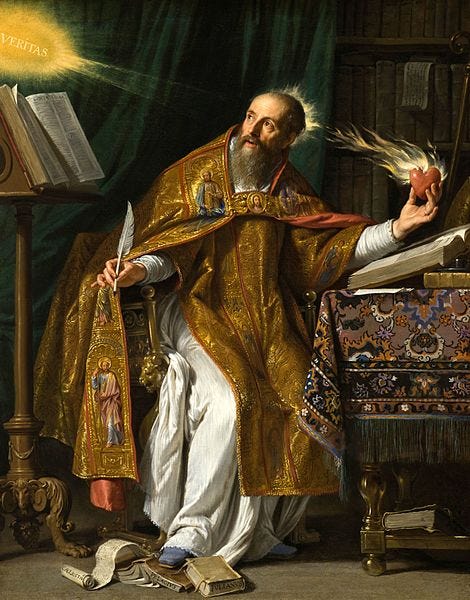
About the text: Anyone who is well versed in the writings of St. Augustine can tell you that two virtues are central to his thought. The first is charity, the greatest of all the virtues; the second is humility, the foundation of all the virtues. This sermon preached to his congregation in Hippo Regius describes the importance of practising humility, for if one does not have humility, he cannot have charity; and without charity, I am nothing.
David, the Royal Prophet and Psalmist, who, as the Scriptures testify, being a man after God’s own heart, performed His every will; this holy Prophet, I say, dearly beloved brethren, in a certain passage pointeth out to us what it is that our Creator desireth and loveth, crying out in these words: “Who is as the Lord our God, Who dwelleth on high, and looketh down upon the low things in heaven and in earth” (Ps 112:5).
If, therefore, the Lord Most High, of Whose perfection and greatness there is no end, regardeth and welcometh humility in all His creatures—be they the most exalted or the most lowly, angels or men—how necessary, therefore, must it be that we should continually look to humility and practise it always in everything, in order thus to give pleasure to our Creator.
How great a virtue, then, true humility is, may be gathered easily from those words of our Saviour, Who, to condemn the pride of the Pharisees, saith: “Everyone that exalteth himself shall be humbled, and he that humbleth himself shall be exalted” (Lk 14:11).
It is only by the steps of humility that the heights of heaven can be reached, for not by means of pride do we mount to God on high, but in truth by humility, according to that which is written: “God resisteth the proud, and giveth grace to the humble” (Jam 4:6). And it is written in the Psalms: “The Lord is high and looketh on the low, and the high He knoweth afar off” (Ps 137:6)! Here the high signify the proud. He looketh upon the low to exalt them, and knoweth the high afar off, that is the proud, to cast them down. Let us learn humility in order to enable us to approach the Lord, as He Himself saith in the Gospel: “Learn of Me, because I am meek and humble of heart, and you shall find rest to your souls” (Mt 11:29).
By pride the once admirable and angelic creature was cast down headlong from heaven, and by the humility of God human nature ascended thither. Beautiful, even in the sight of men, is the practice of humility, as Solomon declareth: “Where pride is, there also shall be reproach, but where humility is, there also is wisdom” (Pr 11:2). Again, another wise man saith: “The greater thou art, the more humble thyself in all things, and thou shalt find grace before God” (Ecclus 3:20). And God Himself saith by the mouth of His prophet: “To whom shall I have respect but to him that is poor and little and of contrite heart, and that trembleth at my words” (Is 66:2).
In one who is not humble and meek the grace of the Holy Spirit can never dwell. God humbled Himself in order to save us. Let man blush to be proud. As profoundly as the heart abaseth itself in humility, so high does it rise in perfection: for he who is humble shall be exalted in glory. The first degree of humility is, to hearken humbly to the words of truth, to keep them in memory, to practise them willingly. Truth, certainly, ever fleeth from a mind which is not humble. The less thou art in thine own estimation the greater wilt thou be in the sight of God. But the proud man, the more illustrious he appears to be to the world, the more contemptible will he be before God. He who practiseth all virtues, but with no humility, is like a man who carries dust before the wind. Furthermore, the Scripture crieth out: “And why dost thou exalt thyself, dust and ashes!” (Ecclus 10:9) whilst the wind of pride carries away and scatters all that thou imaginest thyself to have amassed by fasts and alms.
Be well on thy guard, O man, lest thou make a boast of thy virtue; for thou shalt not thyself be thine own judge, but Another, before Whom, strive to keep thyself lowly of heart, in order that He may exalt thee in the day of recompense. Descend, therefore, in order to ascend. Humble thyself that thou mayest be exalted, lest having exalted thyself thou shouldst be humbled. For he who is unsightly in his own eyes, is beautiful before God. He who is displeasing to himself, is pleasing unto God. Be therefore little in thine own eyes, so as to be great in the eyes of God; for the more vile thou art in thine own estimation, the more precious shalt thou be in the sight of God. In the highest honours, have the deepest humility. Honour deriveth its greatest glory from the virtue of humility.
But this virtue of humility no man can have without the fear of God, because the one cannot exist without the other.
Now with regard to the effect of the fear of God, hearken to me, my brethren: “The beginning of wisdom is the fear of the Lord” (Ps 110:9). The fear of the presence of God is a great preservative against sin. He who perfectly feareth God, taketh great care to avoid sin. “With him who feareth the Lord, it shall be well in the latter end” (Ecclus 1:13), and his recompense shall endure for ever. If a person be ashamed to transgress before men, how much more commendable and requisite, then, is it that he should be ashamed to commit iniquity in the sight of God, Who looketh not only to the deed, but, likewise, to the heart.
Those who fear God with a holy fear seek the things that are pleasing to Him. There is the fear of children and there is the fear of servants. Servants fear their masters for the dread of punishment, but children fear for the love of their father. If we be children of God, let us fear Him for the sweetness of charity, not out of the bitterness of fear. The wise man in all his actions feareth God, because he knoweth it is impossible to hide from His presence, according to the words of the Psalmist when addressing God: “Whither shall I go from Thy spirit, or whither shall I flee from Thy face” (Ps 138:7); to which is added, in another place: “From the east even unto the west there is no hiding-place for him who fleeth from God.” He who feareth the Lord will accept His doctrine, and he who shall be careful to keep His commandments, shall find everlasting benediction. “The soul of him that feareth the Lord is blessed” (Ecclus 34:15), he abideth secure from the temptations of the Evil One. “Blessed is the man who is always fearful” (Pr 28:14), and to whom it is given to have ever before his eyes the fear of God. He who feareth the Lord turneth aside from the crooked way and directeth his steps in the path of virtue. “The fear of the Lord driveth out sin” (Ecclus 1:27), and induceth virtue. The fear of God rendereth man careful and anxious not to sin.
But where there is no fear of God there is dissoluteness of life. He who feareth not God in prosperity, let him at least fear Him in adversity, and let him fly for succour to Him Who scourgeth and healeth, for: “Blessed is the man that feareth the Lord, and who endeavours with all the desires of his heart to keep His commandments” (Ps 111:1). The fear of God driveth out the fear of hell, because it maketh a man avoid sin and multiply his works of justice. After this, he will arrive at that fear which, being founded upon love, is called “holy, enduring for ever and ever” (Ps 18:10). Thus, therefore, brethren, thus let us fear God that we may love Him, for perfect charity casteth out servile fear, and by this means we shall acquire abundant security and the plenitude of every good. Wherefore the Royal Prophet saith: “Fear the Lord all ye His saints, for there is no want to them that fear Him. The rich have wanted and suffered hunger, but they that seek the Lord shall not be deprived of any good” (Ps 33:10–11).
I implore you, therefore, dearly beloved, to keep in view the fear of God; ever in your minds, to strive at all cost not to be unmindful of His precepts, and to consider seriously, that whereas he who feareth God and keepeth His commandments entereth into life everlasting, he who despiseth Him and rejecteth His precepts, will go into everlasting torments.
Once more, I beseech you, to nourish interiorly within your hearts true humility, and by its unfeigned practice, to instil it into your neighbours, so that they also, being edified by your good example, may glorify God, and in union with you, strive to obtain an eternal reward in heaven, through the help and grace of our Lord Jesus Christ, Who liveth and reigneth for ever and ever. Amen.
Augustine, Sermon 212, trans. Joseph Jerome Vaughan (1898)