

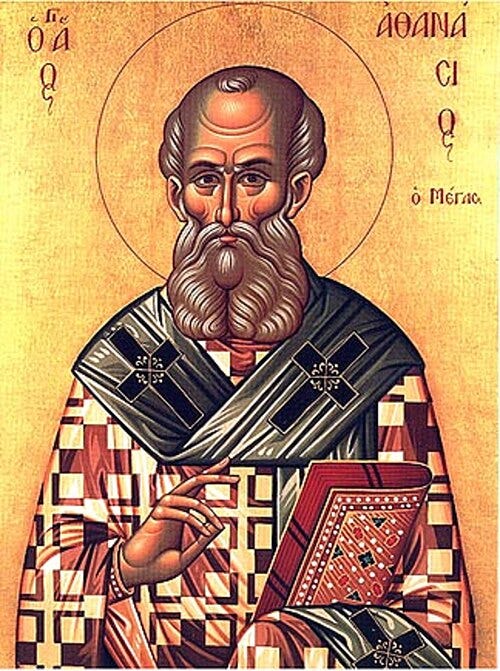
About the Text: Athanasius of Alexandria (c. 297–373) was the Patriarch of Alexandria during the mid-fourth century when the Arian crisis was at its height. Known as the arch-enemy of Arianism, Athanasius seemed at one time to be alone in his fight against the heresy. One of his best-known works is On the Incarnation, which presents the reason for the Word’s taking on a human nature, largely in response to the Arian claims that Christ was not himself divine but a creature. Here is the majority of part 1 of his treatise.
—
II. Of the making of the universe and the creation of all things many have taken different views, and each man has laid down the law just as he pleased. For some say that all things have come into being of themselves, and in a chance fashion; as, for example, the Epicureans, who tell us in their self-contempt, that universal providence does not exist, speaking right in the face of obvious fact and experience. For if, as they say, everything has had its beginning of itself, and independently of purpose, it would follow that everything had come into mere being, so as to be alike and not distinct. For it would follow in virtue of the unity of body that everything must be sun or moon, and in the case of men it would follow that the whole must be hand, or eye, or foot. But as it is this is not so. On the contrary, we see a distinction of sun, moon, and earth; and again, in the case of human bodies, of foot, hand, and head. Now, such separate arrangement as this tells us not of their having come into being of themselves, but shews that a cause preceded them; from which cause it is possible to apprehend God also as the Maker and Orderer of all.
But others, including Plato, who is in such repute among the Greeks, argue that God has made the world out of matter previously existing and without beginning. For God could have made nothing had not the material existed already; just as the wood must exist ready at hand for the carpenter, to enable him to work at all. But in so saying they know not that they are investing God with weakness. For if He is not Himself the cause of the material, but makes things only of previously existing material, He proves to be weak, because unable to produce anything He makes without the material; just as it is without doubt a weakness of the carpenter not to be able to make anything required without his timber. For, ex hypothesi, had not the material existed, God would not have made anything. And how could He in that case be called Maker and Artificer, if He owes His ability to make to some other source—namely, to the material? So that if this be so, God will be on their theory a Mechanic only, and not a Creator out of nothing; if, that is, He works at existing material, but is not Himself the cause of the material. For He could not in any sense be called Creator unless He is Creator of the material of which the things created have in their turn been made. But the sectaries imagine to themselves a different artificer of all things, other than the Father of our Lord Jesus Christ, in deep blindness even as to the words they use. For whereas the Lord says to the Jews (Mt 19:4): “Have ye not read that from the beginning He which created them made them male and female, and said, For this cause shall a man leave his father and mother, and shall cleave to his wife, and they twain shall become one flesh?” and then, referring to the Creator, says, “What, therefore, God hath joined together let not man put asunder:” how come these men to assert that the creation is independent of the Father? Or if, in the words of John, who says, making no exception, “All things were made by Him,” and “without Him was not anything made” (Jn 1:3), how could the artificer be another, distinct from the Father of Christ?
III. Thus do they vainly speculate. But the godly teaching and the faith according to Christ brands their foolish language as godlessness. For it knows that it was not spontaneously, because forethought is not absent; nor of existing matter, because God is not weak; but that out of nothing, and without its having any previous existence, God made the universe to exist through His word, as He says firstly through Moses: “In the beginning God created the heaven and the earth” (Gn 1:1); secondly, in the most edifying book of the Shepherd, “First of all believe that God is one, which created and framed all things, and made them to exist out of nothing.” To which also Paul refers when he says, “By faith we understand that the worlds have been framed by the Word of God, so that what is seen hath not been made out of things which do appear” (Heb 11:3).
For God is good, or rather is essentially the source of goodness: nor could one that is good be niggardly of anything: whence, grudging existence to none, He has made all things out of nothing by His own Word, Jesus Christ our Lord. And among these, having taken especial pity, above all things on earth, upon the race of men, and having perceived its inability, by virtue of the condition of its origin, to continue in one stay, He gave them a further gift, and He did not barely create man, as He did all the irrational creatures on the earth, but made them after His own image, giving them a portion even of the power of His own Word; so that having as it were a kind of reflexion of the Word, and being made rational, they might be able to abide ever in blessedness, living the true life which belongs to the saints in paradise.
But knowing once more how the will of man could sway to either side, in anticipation He secured the grace given them by a law and by the spot where He placed them. For He brought them into His own garden, and gave them a law: so that, if they kept the grace and remained good, they might still keep the life in paradise without sorrow or pain or care besides having the promise of incorruption in heaven; but that if they transgressed and turned back, and became evil, they might know that they were incurring that corruption in death which was theirs by nature: no longer to live in paradise, but cast out of it from that time forth to die and to abide in death and in corruption. Now this is that of which Holy Writ also gives warning, saying in the Person of God: “Of every tree that is in the garden, eating thou shalt eat: but of the tree of the knowledge of good and evil, ye shall not eat of it, but on the day that ye eat, dying ye shall die” (Gn 2:16). But by “dying ye shall die,” what else could be meant than not dying merely, but also abiding ever in the corruption of death?
IV. You are wondering, perhaps, for what possible reason, having proposed to speak of the Incarnation of the Word, we are at present treating of the origin of mankind. But this, too, properly belongs to the aim of our treatise. For in speaking of the appearance of the Saviour amongst us, we must needs speak also of the origin of men, that you may know that the reason of His coming down was because of us, and that our transgression called forth the loving-kindness of the Word, that the Lord should both make haste to help us and appear among men. For of His becoming Incarnate we were the object, and for our salvation He dealt so lovingly as to appear and be born even in a human body.
Thus, then, God has made man, and willed that he should abide in incorruption; but men, having despised and rejected the contemplation of God, and devised and contrived evil for themselves (as was said in the former treatise), received the condemnation of death with which they had been threatened; and from thenceforth no longer remained as they were made, but were being corrupted according to their devices (Eccles 7:29; Rm 1:21–22); and death had the mastery over them as king (Rm 5:14). For transgression of the commandment was turning them back to their natural state, so that just as they have had their being out of nothing, so also, as might be expected, they might look for corruption into nothing in the course of time.
For if, out of a former normal state of non-existence, they were called into being by the Presence and loving-kindness of the Word, it followed naturally that when men were bereft of the knowledge of God and were turned back to what was not (for what is evil is not, but what is good is), they should, since they derive their being from God who IS, be everlastingly bereft even of being; in other words, that they should be disintegrated and abide in death and corruption. For man is by nature mortal, inasmuch as he is made out of what is not; but by reason of his likeness to Him that is (and if he still preserved this likeness by keeping Him in his knowledge) he would stay his natural corruption, and remain incorrupt; as Wisdom says: “The taking heed to His laws is the assurance of immortality” (Ws 6:18); but being incorrupt, he would live henceforth as God, to which I suppose the divine Scripture refers, when it says: “I have said ye are gods, and ye are all sons of the most High; but ye die like men, and fall as one of the princes” (Ps 82:6).
V. For God has not only made us out of nothing; but He gave us freely, by the Grace of the Word, a life in correspondence with God. But men, having rejected things eternal, and, by counsel of the devil, turned to the things of corruption, became the cause of their own corruption in death, being, as I said before, by nature corruptible, but destined, by the grace following from partaking of the Word, to have escaped their natural state, had they remained good. For because of the Word dwelling with them, even their natural corruption did not come near them, as Wisdom also says: “God made man for incorruption, and as an image of His own eternity; but by envy of the devil death came into the world” (Ws 2:23f). But when this was come to pass, men began to die, while corruption thence-forward prevailed against them, gaining even more than its natural power over the whole race, inasmuch as it had, owing to the transgression of the commandment, the threat of the Deity as a further advantage against them.
For even in their misdeeds men had not stopped short at any set limits; but gradually pressing forward, have passed on beyond all measure: having to begin with been inventors of wickedness and called down upon themselves death and corruption; while later on, having turned aside to wrong and exceeding all lawlessness, and stopping at no one evil but devising all manner of new evils in succession, they have become insatiable in sinning. For there were adulteries everywhere and thefts, and the whole earth was full of murders and plunderings. And as to corruption and wrong, no heed was paid to law, but all crimes were being practised everywhere, both individually and jointly. Cities were at war with cities, and nations were rising up against nations; and the whole earth was rent with civil commotions and battles; each man vying with his fellows in lawless deeds. Nor were even crimes against nature far from them, but, as the Apostle and witness of Christ says: “For their women changed the natural use into that which is against nature: and likewise also the men, leaving the natural use of the women, burned in their lust one toward another, men with men working unseemliness, and receiving in themselves that recompense of their error which was meet” (Rm 1:26f).
VI. For this cause, then, death having gained upon men, and corruption abiding upon them, the race of man was perishing; the rational man made in God’s image was disappearing, and the handiwork of God was in process of dissolution. For death, as I said above, gained from that time forth a legal hold over us (Gn 2:15), and it was impossible to evade the law, since it had been laid down by God because of the transgression (Gal 3:19), and the result was in truth at once monstrous and unseemly. For it were monstrous, firstly, that God, having spoken, should prove false—that, when once He had ordained that man, if he transgressed the commandment, should die the death, after the transgression man should not die, but God’s word should be broken. For God would not be true, if, when He had said we should die, man died not. Again, it were unseemly that creatures once made rational, and having partaken of the Word, should go to ruin, and turn again toward non-existence by the way of corruption. For it were not worthy of God’s goodness that the things He had made should waste away, because of the deceit practised on men by the devil. Especially it was unseemly to the last degree that God’s handicraft among men should be done away, either because of their own carelessness, or because of the deceitfulness of evil spirits.
So, as the rational creatures were wasting and such works in course of ruin, what was God in His goodness to do? Suffer corruption to prevail against them and death to hold them fast? And where were the profit of their having been made, to begin with? For better were they not made, than once made, left to neglect and ruin. For neglect reveals weakness, and not goodness on God’s part—if, that is, He allows His own work to be ruined when once He had made it—more so than if He had never made man at all. For if He had not made them, none could impute weakness; but once He had made them, and created them out of nothing, it were most monstrous for the work to be ruined, and that before the eyes of the Maker. It was, then, out of the question to leave men to the current of corruption; because this would be unseemly, and unworthy of God’s goodness.
VII. But just as this consequence must needs hold, so, too, on the other side the just claims of God lie against it: that God should appear true to the law He had laid down concerning death. For it were monstrous for God, the Father of truth, to appear a liar for our profit and preservation. So here, once more, what possible course was God to take? To demand repentance of men for their transgression? For this one might pronounce worthy of God; as though, just as from transgression men have become set towards corruption, so from repentance they may once more be set in the way of incorruption. But repentance would, firstly, fail to guard the just claim of God. For He would still be none the more true, if men did not remain in the grasp of death; nor, secondly, does repentance call men back from what is their nature—it merely stays them from acts of sin. Now, if there were merely a misdemeanour in question, and not a consequent corruption, repentance were well enough. But if, when transgression had once gained a start, men became involved in that corruption which was their nature, and were deprived of the grace which they had, being in the image of God, what further step was needed? or what was required for such grace and such recall, but the Word of God, which had also at the beginning made everything out of nought? For His it was once more both to bring the corruptible to incorruption, and to maintain intact the just claim of the Father upon all. For being Word of the Father, and above all, He alone of natural fitness was both able to recreate everything, and worthy to suffer on behalf of all and to be ambassador for all with the Father.
VIII. For this purpose, then, the incorporeal and incorruptible and immaterial Word of God comes to our realm, howbeit he was not far from us before (Ac 17:27). For no part of Creation is left void of Him: He has filled all things everywhere, remaining present with His own Father. But He comes in condescension to shew loving-kindness upon us, and to visit us. And seeing the race of rational creatures in the way to perish, and death reigning over them by corruption; seeing, too, that the threat against transgression gave a firm hold to the corruption which was upon us, and that it was monstrous that before the law was fulfilled it should fall through: seeing, once more, the unseemliness of what was come to pass: that the things whereof He Himself was Artificer were passing away: seeing, further, the exceeding wickedness of men, and how by little and little they had increased it to an intolerable pitch against themselves: and seeing, lastly, how all men were under penalty of death: He took pity on our race, and had mercy on our infirmity, and condescended to our corruption, and, unable to bear that death should have the mastery—lest the creature should perish, and His Father’s handiwork in men be spent for nought—He takes unto Himself a body, and that of no different sort from ours.
For He did not simply will to become embodied, or will merely to appear. For if He willed merely to appear, He was able to effect His divine appearance by some other and higher means as well. But He takes a body of our kind, and not merely so, but from a spotless and stainless virgin, knowing not a man, a body clean and in very truth pure from intercourse of men. For being Himself mighty, and Artificer of everything, He prepares the body in the Virgin as a temple unto Himself, and makes it His very own as an instrument, in it manifested, and in it dwelling. And thus taking from our bodies one of like nature, because all were under penalty of the corruption of death He gave it over to death in the stead of all, and offered it to the Father—doing this, moreover, of His loving-kindness, to the end that, firstly, all being held to have died in Him, the law involving the ruin of men might be undone (inasmuch as its power was fully spent in the Lord’s body, and had no longer holding-ground against men, his peers), and that, secondly, whereas men had turned toward corruption, He might turn them again toward incorruption, and quicken them from death by the appropriation of His body and by the grace of the Resurrection, banishing death from them like straw from the fire.
IX. For the Word, perceiving that no otherwise could the corruption of men be undone save by death as a necessary condition, while it was impossible for the Word to suffer death, being immortal, and Son of the Father; to this end He takes to Himself a body capable of death, that it, by partaking of the Word Who is above all, might be worthy to die in the stead of all, and might, because of the Word which was come to dwell in it, remain incorruptible, and that thenceforth corruption might be stayed from all by the Grace of the Resurrection. Whence, by offering unto death the body He Himself had taken, as an offering and sacrifice free from any stain, straightway He put away death from all His peers by the offering of an equivalent. For being over all, the Word of God naturally by offering His own temple and corporeal instrument for the life of all satisfied the debt by His death. And thus He, the incorruptible Son of God, being conjoined with all by a like nature, naturally clothed all with incorruption, by the promise of the resurrection. For the actual corruption in death has no longer holding-ground against men, by reason of the Word, which by His one body has come to dwell among them.
And like as when a great king has entered into some large city and taken up his abode in one of the houses there, such city is at all events held worthy of high honour, nor does any enemy or bandit any longer descend upon it and subject it; but, on the contrary, it is thought entitled to all care, because of the king’s having taken up his residence in a single house there: so, too, has it been with the Monarch of all. For now that He has come to our realm, and taken up his abode in one body among His peers, henceforth the whole conspiracy of the enemy against mankind is checked, and the corruption of death which before was prevailing against them is done away. For the race of men had gone to ruin, had not the Lord and Saviour of all, the Son of God, come among us to meet the end of death.
X. Now in truth this great work was peculiarly suited to God’s goodness. For if a king, having founded a house or city, if it be beset by bandits from the carelessness of its inmates, does not by any means neglect it, but avenges and reclaims it as his own work, having regard not to the carelessness of the inhabitants, but to what beseems himself; much more did God the Word of the all-good Father not neglect the race of men, His work, going to corruption: but, while He blotted out the death which had ensued by the offering of His own body, He corrected their neglect by His own teaching, restoring all that was man’s by His own power. And of this one may be assured at the hands of the Saviour’s own inspired writers, if one happen upon their writings, where they say: “For the love of Christ constraineth us; because we thus judge, that if one died for all, then all died, and He died for all that we should no longer live unto ourselves, but unto Him Who for our sakes died and rose again,” our Lord Jesus Christ (2 Cor 5:14). And, again: “But we behold Him, Who hath been made a little lower than the angels, even Jesus, because of the suffering of death crowned with glory and honour, that by the grace of God He should taste of death for every man” (Heb 2:9f).
Then He also points out the reason why it was necessary for none other than God the Word Himself to become incarnate; as follows: “For it became Him, for Whom are all things, and through Whom are all things, in bringing many sons unto glory, to make the Captain of their salvation perfect through suffering;” by which words He means, that it belonged to none other to bring man back from the corruption which had begun, than the Word of God, Who had also made them from the beginning. And that it was in order to the sacrifice for bodies such as His own that the Word Himself also assumed a body, to this, also, they refer in these words: “Forasmuch then as the children are the sharers in blood and flesh, He also Himself in like manner partook of the same, that through death He might bring to naught Him that had the power of death, that is, the devil; and might deliver them who, through fear of death, were all their lifetime subject to bondage” (Heb 2:14f).
For by the sacrifice of His own body, He both put an end to the law which was against us, and made a new beginning of life for us, by the hope of resurrection which He has given us. For since from man it was that death prevailed over men, for this cause conversely, by the Word of God being made man has come about the destruction of death and the resurrection of life; as the man which bore Christ (Gal 6:17) saith: “For since by man came death, by man came also the resurrection of the dead. For as in Adam all die, so also in Christ shall all be made alive:” and so forth (1 Cor 15:21f). For no longer now do we die as subject to condemnation; but as men who rise from the dead we await the general resurrection of all, “which232in its own times He shall show” (1 Tm 6:15), even God, Who has also wrought it, and bestowed it upon us. This then is the first cause of the Saviour’s being made man. But one might see from the following reasons also, that His gracious coming amongst us was fitting to have taken place.
XI. God, Who has the power over all things, when He was making the race of men through His own Word, seeing the weakness of their nature, that it was not sufficient of itself to know its Maker, nor to get any idea at all of God; because while He was uncreate, the creatures had been made of nought, and while He was incorporeal, men had been fashioned in a lower way in the body, and because in every way the things made fell far short of being able to comprehend and know their Maker—taking pity, I say, on the race of men, inasmuch as He is good, He did not leave them destitute of the knowledge of Himself, lest they should find no profit in existing at all. For what profit to the creatures if they knew not their Maker? or how could they be rational without knowing the Word (and Reason) of the Father, in Whom they received their very being? For there would be nothing to distinguish them even from brute creatures if they had knowledge of nothing but earthly things. Nay, why did God make them at all, as He did not wish to be known by them?
Whence, lest this should be so, being good, He gives them a share in His own Image, our Lord Jesus Christ, and makes them after His own Image and after His likeness: so that by such grace perceiving the Image, that is, the Word of the Father, they may be able through Him to get an idea of the Father, and knowing their Maker, live the happy and truly blessed life. But men once more in their perversity having set at nought, in spite of all this, the grace given them, so wholly rejected God, and so darkened their soul, as not merely to forget their idea of God, but also to fashion for themselves one invention after another. For not only did they grave idols for themselves, instead of the truth, and honour things that were not before the living God, “and serve the creature rather than the Creator” (Rm 1:25), but, worst of all, they transferred the honour of God even to stocks and stones and to every material object and to men, and went even further than this, as we have said in the former treatise.
So far indeed did their impiety go, that they proceeded to worship devils, and proclaimed them as gods, fulfilling their own lusts. For they performed, as was said above, offerings of brute animals, and sacrifices of men, as was meet for them, binding themselves down all the faster under their maddening inspirations. For this reason it was also that magic arts were taught among them, and oracles in divers places led men astray, and all men ascribed the influences of their birth and existence to the stars and to all the heavenly bodies, having no thought of anything beyond what was visible. And, in a word, everything was full of irreligion and lawlessness, and God alone, and His Word, was unknown, albeit He had not hidden Himself out of men’s sight, nor given the knowledge of Himself in one way only; but had, on the contrary, unfolded it to them in many forms and by many ways.
XII. For whereas the grace of the Divine Image was in itself sufficient to make known God the Word, and through Him the Father; still God, knowing the weakness of men, made provision even for their carelessness: so that if they cared not to know God of themselves, they might be enabled through the works of creation to avoid ignorance of the Maker. But since men’s carelessness, by little and little, descends to lower things, God made provision, once more, even for this weakness of theirs, by sending a law, and prophets, men such as they knew, so that even if they were not ready to look up to heaven and know their Creator, they might have their instruction from those near at hand. For men are able to learn from men more directly about higher things.
So it was open to them, by looking into the height of heaven, and perceiving the harmony of creation, to know its Ruler, the Word of the Father, Who, by His own providence over all things makes known the Father to all, and to this end moves all things, that through Him all may know God. Or, if this were too much for them, it was possible for them to meet at least the holy men, and through them to learn of God, the Maker of all things, the Father of Christ; and that the worship of idols is godlessness, and full of all impiety. Or it was open to them, by knowing the law even, to cease from all lawlessness and live a virtuous life. For neither was the law for the Jews alone, nor were the Prophets sent for them only, but, though sent to the Jews and persecuted by the Jews, they were for all the world a holy school of the knowledge of God and the conduct of the soul. God’s goodness then and loving-kindness being so great—men nevertheless, overcome by the pleasures of the moment and by the illusions and deceits sent by demons, did not raise their heads toward the truth, but loaded themselves the more with evils and sins, so as no longer to seem rational, but from their ways to be reckoned void of reason.
XIII. So then, men having thus become brutalized, and demoniacal deceit thus clouding every place, and hiding the knowledge of the true God, what was God to do? To keep still silence at so great a thing, and suffer men to be led astray by demons and not to know God? And what was the use of man having been originally made in God’s image? For it had been better for him to have been made simply like a brute animal, than, once made rational, for him to live the life of the brutes. Or where was any necessity at all for his receiving the idea of God to begin with? For if he be not fit to receive it even now, it were better it had not been given him at first. Or what profit to God Who has made them, or what glory to Him could it be, if men, made by Him, do not worship Him, but think that others are their makers? For God thus proves to have made these for others instead of for Himself.
Once again, a merely human king does not let the lands he has colonized pass to others to serve them, nor go over to other men; but he warns them by letters, and often sends to them by friends, or, if need be, he comes in person, to put them to rebuke in the last resort by his presence, only that they may not serve others and his own work be spent for naught. Shall not God much more spare His own creatures, that they be not led astray from Him and serve things of nought? especially since such going astray proves the cause of their ruin and undoing, and since it was unfitting that they should perish which had once been partakers of God’s image.
What then was God to do? or what was to be done save the renewing of that which was in God’s image, so that by it men might once more be able to know Him? But how could this have come to pass save by the presence of the very Image of God, our Lord Jesus Christ? For by men’s means it was impossible, since they are but made after an image; nor by angels either, for not even they are (God’s) images. Whence the Word of God came in His own person, that, as He was the Image of the Father, He might be able to create afresh the man after the image. But, again, it could not else have taken place had not death and corruption been done away. Whence He took, in natural fitness, a mortal body, that while death might in it be once for all done away, men made after His Image might once more be renewed. None other then was sufficient for this need, save the Image of the Father.
XIV. For as, when the likeness painted on a panel has been effaced by stains from without, he whose likeness it is must needs come once more to enable the portrait to be renewed on the same wood: for, for the sake of his picture, even the mere wood on which it is painted is not thrown away, but the outline is renewed upon it; in the same way also the most holy Son of the Father, being the Image of the Father, came to our region to renew man once made in His likeness, and find him, as one lost, by the remission of sins; as He says Himself in the Gospels: “I came to find and to save the lost” (Lk 19:10). Whence He said to the Jews also: “Except a man be born again” (Jn 3:3, 5), not meaning, as they thought, birth from woman, but speaking of the soul born and created anew in the likeness of God’s image.
But since wild idolatry and godlessness occupied the world, and the knowledge of God was hid, whose part was it to teach the world concerning the Father? Man’s, might one say? But it was not in man’s power to penetrate everywhere beneath the sun; for neither had they the physical strength to run so far, nor would they be able to claim credence in this matter, nor were they sufficient by themselves to withstand the deceit and impositions of evil spirits. For where all were smitten and confused in soul from demoniacal deceit, and the vanity of idols, how was it possible for them to win over man’s soul and man’s mind—whereas they cannot even see them? Or how can a man convert what he does not see?
But perhaps one might say creation was enough; but if creation were enough, these great evils would never have come to pass. For creation was there already, and all the same, men were grovelling in the same error concerning God. Who, then, was needed, save the Word of God, that sees both soul and mind, and that gives movement to all things in creation, and by them makes known the Father? For He who by His own Providence and ordering of all things was teaching men concerning the Father, He it was that could renew this same teaching as well.
How, then, could this have been done? Perhaps one might say, that the same means were open as before, for Him to shew forth the truth about the Father once more by means of the work of creation. But this was no longer a sure means. Quite the contrary; for men missed seeing this before, and have turned their eyes no longer upward but downward. Whence, naturally, willing to profit men, He sojourns here as man, taking to Himself a body like the others, and from things of earth, that is by the works of His body [He teaches them], so that they who would not know Him from His Providence and rule over all things, may even from the works done by His actual body know the Word of God which is in the body, and through Him the Father.
XV. For as a kind teacher who cares for His disciples, if some of them cannot profit by higher subjects, comes down to their level, and teaches them at any rate by simpler courses; so also did the Word of God. As Paul also says: “For seeing that in the wisdom of God the world through its wisdom knew not God, it was God’s good pleasure through the foolishness of the word preached to save them that believe” (1 Cor 1:21). For seeing that men, having rejected the contemplation of God, and with their eyes downward, as though sunk in the deep, were seeking about for God in nature and in the world of sense, feigning gods for themselves of mortal men and demons; to this end the loving and general Saviour of all, the Word of God, takes to Himself a body, and as Man walks among men and meets the senses of all men half-way, to the end, I say, that they who think that God is corporeal may from what the Lord effects by His body perceive the truth, and through Him recognize the Father.
So, men as they were, and human in all their thoughts, on whatever objects they fixed their senses, there they saw themselves met half-way, and taught the truth from every side. For if they looked with awe upon the Creation, yet they saw how she confessed Christ as Lord; or if their mind was swayed toward men, so as to think them gods, yet from the Saviour’s works, supposing they compared them, the Saviour alone among men appeared Son of God; for there were no such works done among the rest as have been done by the Word of God.
Or if they were biassed toward evil spirits, even, yet seeing them cast out by the Word, they were to know that He alone, the Word of God, was God, and that the spirits were none. Or if their mind had already sunk even to the dead, so as to worship heroes, and the gods spoken of in the poets, yet, seeing the Saviour’s resurrection, they were to confess them to be false gods, and that the Lord alone is true, the Word of the Father, that was Lord even of death. For this cause He was both born and appeared as Man, and died, and rose again, dulling and casting into the shade the works of all former men by His own, that in whatever direction the bias of men might be, from thence He might recall them, and teach them of His own true Father, as He Himself says: “I came to save and to find that which was lost.”
XVI. For men’s mind having finally fallen to things of sense, the Word disguised Himself by appearing in a body, that He might, as Man, transfer men to Himself, and centre their senses on Himself, and, men seeing Him thenceforth as Man, persuade them by the works He did that He is not Man only, but also God, and the Word and Wisdom of the true God. This, too, is what Paul means to point out when he says: “That ye being rooted and grounded in love, may be strong to apprehend with all the saints what is the breadth and length, and height and depth, and to know the love of Christ which passeth knowledge, that ye may be filled unto all the fulness of God” (Eph 3:18f). For by the Word revealing Himself everywhere, both above and beneath, and in the depth and in the breadth—above, in the creation; beneath, in becoming man; in the depth, in Hades; and in the breadth, in the world—all things have been filled with the knowledge of God.
Now for this cause, also, He did not immediately upon His coming accomplish His sacrifice on behalf of all, by offering His body to death and raising it again, for by this means He would have made Himself invisible. But He made Himself visible enough by what He did, abiding in it, and doing such works, and shewing such signs, as made Him known no longer as Man, but as God the Word. For by His becoming Man, the Saviour was to accomplish both works of love; first, in putting away death from us and renewing us again; secondly, being unseen and invisible, in manifesting and making Himself known by His works to be the Word of the Father, and the Ruler and King of the universe.
—
From Athanasius, On the Incarnation II–XVI, trans. John Henry Newman, Nicene and Post-Nicene Fathers, series 2, vol. 4.