

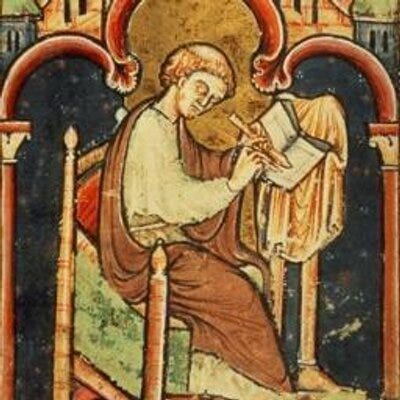
About the Text: In this Christmas sermon, Aelfric reflects on the two births of the Son of God and His two natures. Christ freely came to save us, giving himself up to suffering by being born of a virgin. Both his coming by the virgin and his second coming on the Last Day, the “Great Doom,” were foretold by the prophets. By his virgin birth, Christ not only redeemed human generation but consecrated virginity as the highest state of life.
—
My dearest brethren, on this day we celebrate our Saviour’s birth according to humanity. He was to-day born of the holy maiden Mary, with body and with soul, who was ever existing with the Father in the Godhead. He is twice born, and each birth is wonderful and unspeakable. He was ever born of the Father, for he is the Wisdom of the Father, through whom he wrought and created all creatures. Now this birth is without beginning, because the Father was ever God, and his Wisdom, that is, his Son, was ever born of him, without any mother.
This birth, that we now to-day celebrate, was of an earthly mother, without any earthly father. The Father created us through him, and afterwards, when we were fordone, he sent the same Son to this life for our redemption; because that Adam, the first man, sinned against God, and brake his Creator’s commandment, and obeyed the devil’s teaching, and was delivered to the devil, he and all mankind, into helltorment. Then God ever meditated from the beginning of the world, how he might help mankind, and rescue them from the power of the devil. Then he would not send to our redemption either angel, or archangel, or prophets, or apostles; but the Father sent his only-begotten Son to suffering and to death for the redemption of mankind. Then God manifested how great love he had and hath for us, when he sent his own Child to be slain for us. Who durst desire that the Almighty King should urge to death his only-begotten Prince, and so save the servant? The Son was not forced to become man, and afterwards to suffer for us, but he was ever obedient to his Father unto death. He was only-begotten with his Father in heaven; then would he not be alone, but would have brothers, and came to us, because be would bring us to his kingdom, to which we had been created. But if he had come in the Godhead without humanity, then could our weakness not have endured his might. The Godhead could suffer nothing, because it is impossible’. The Almighty Son of God assumed humanity of a maiden, and became a visible and passible man; and very fitting it was, when he would become man, that he chose not a woman for his mother, but chose a pure maiden; and also, when a maiden should bear, that she bare God Almighty; who is both God and man, one Christ. He began being what he was not, but he continued what he before had been. He began in humanity, who ever was and ever will be God. Yet are the Godhead and the humanity not mingled together, but the Godhead is invested with the humanity, so that there is neither admixture nor separation.
The maidenhood of Mary was manifoldly betokened in the old law. God bade Moses, the leader, take twelve dry rods from the twelve tribes of the people of Israel, and lay them before the holy ark within the great tabernacle: and he would by those rods declare whom he had chosen for bishop. Then, on the second day, Aaron’s rod was found growing with boughs, and blowing, and bearing nuts. Verily the dry rod, which was not planted in the earth, nor clothed with any rind, nor with sap quickened, and yet grew, and blew, and bare nuts, betokened the blessed Mary, who had no society of man, and yet bare the Living Fruit, who is the true Bishop and the Redeemer of our souls.
Human creation is in four ways. The first-created man, Adam, was not begotten nor born, but God created him. The second creation was so that God created Eve from her husband’s side. These two creations are like to none other. The third creation is, that men are begotten by man and by woman, as we see daily, and this creation is alone common. The fourth creation was so that Christ was born of a maiden without man. This creation is like to none other. The first two creations fell into perdition, and the third was in perdition born; but the fourth redeemed the three. The same Son of God, who created all things, created also his own mother, and came himself into her womb, and therein wrought his own body, and of her was born, a true man in soul and in body; and the mother was not defiled through that child, but was hallowed. Maiden she was before the birth, and maiden in the birth, and maiden after the birth. No maidenhood is lost in birth, but is lost in intercourse. When any maiden with desire associates with man, then is her maidenhood destroyed for ever after, whether she have a child or not. But the pure maiden Mary had promised her maidenhood to God, and was filled with the Holy Ghost, and shielded against every temptation. No evil desire came into her mind, nor had she intercourse of man; therefore was she a maiden, though she had a Child. There is no woman like unto her, for, neither before nor since, was there any maiden that bare a child and afterwards continued a maiden, save her alone. There are, nevertheless, some creatures that teem without intercourse, and both the mother is maiden as also the daughter; such are bees: they bring forth their offspring in purity, from the honey they nourish their brood, and the young are brought forth with maidenhood, and the elder continue in maidenhood. Also the holy church of God, that is, all christian people, is consecrated to one maiden, as the apostle Paul said to the people whom he converted to God, “I have betrothed you to one man, that ye might prepare a pure maiden for Christ” (2 Cor 11:2). John the Baptist also thus spake of Christ, “He who hath a bride is a bridegroom” (Jn 3:29). And the psalmist David sang of Christ, thus saying, “As a bridegroom he goeth forth from his bride-bed” (Ps 18:6).
All churches in the world are reckoned as one church, and it is called the congregation of God, because we are all called together to God’s kingdom. Now this congregation is God’s bride, and continues a maiden like the holy Mary. The congregation is the mother of christian men in ghostly birth, as Christ himself said in his gospel, “Unless every one be twice born, he cannot go into the kingdom of heaven” (Jn 3:3). How is a man twice born? Every man is born bodily of father and of mother, but he is not a child of God, unless he be born again of the ghostly mother, of Christ’s bride, as he himself said, “Unless every one be born again of water and of the Holy Ghost, he cannot go into God’s kingdom” (Jn 3:5). Everyman is begotten and born with sins, through Adam’s transgression; but he is again born to Christ in the holy congregation, that is, in God’s church, through baptism. The water washes the body, and the Holy Ghost washes the soul from all sins; and the baptized man is then a child of God, if he rightly hold to father and mother, that is, to Christ and his bride, who daily bears ghostly children, and yet continues in pure maidenhood.
Our old father, Adam, begat us to death, and Christ begets us spiritually to eternal life, if we eschew the precepts of the devil, and be obedient to our Lord in his commandments. All the things that Christ has done for us, they were all prophesied long before, that men might believe that he is true, when he has so many witnesses who declared his advent, and how he was born, and how he suffered death of his own free will, and how he arose from death and ascended to heaven, and how he will come again to the great doom, to judge all mankind, each according to his works.
The Almighty God promised in the time of old to the patriarch Abraham, that in his race all mankind should be blessed, and also fulfilled his promise. Of Abraham’s race came the great king David, and of that royal race came the holy Mary, and of Mary Christ was born, and through Christ all mankind is blessed, those who rightly believe. Again, the prophet Jeremiah said of Jesus, “This is our God, and there is none other accounted with him. He hath raised and established direction and discipline to his people Israel. He was afterwards seen upon earth, and with men he dwelt” (Bar 3:36–38). Again, another prophet, Micah, prophesied of Christ’s advent, thus saying, “Then shall peace be on earth, when our Lord cometh to our land, and when he goeth into our houses” (Mic 5:5). Again, Isaiah the prophet wrote in his prophecy, and thus said, “Behold a maiden shall conceive, and bear a Son, and his name shall be Emanuel,” which is interpreted, “God is with us” (Is 7:14). Again, Ezekiel prophesied of the city of Jerusalem and of Christ, thus saying, “Thy King cometh to thee humble, and shall re-establish thee.” Daniel the prophet set also in his prophecy, that the archangel Gabriel came to him flying, and thus spake to him, “I am come to thee, Daniel, in order to teach thee, and do thou understand my speech, and understand this vision. Four hundred and ninety years are reckoned from this day over thee, and over thy people, and over the city of Jerusalem; and then shall the old transgression be ended, and sin shall have an end, and unrighteousness shall be rooted out, and everlasting righteousness shall be brought, and vision and prophecies shall be fulfilled, and the Holy of all holies shall be anointed” (Dn 9:21–24). All these things are fulfilled through Christ’s humanity.
After that space and term, which the archangel Gabriel announced to Daniel, Adam’s transgression and his sin are ended through Christ; and Christ has rooted out every unrighteousness, and established everlasting righteousness, and he fulfilled all prophecies through himself, and he is the Holy of all holies, for he is the head of all holy men. How is he anointed? A king is anointed with hallowed oil, when he is hallowed for king; and in every ordination, as well in deaconhood as in priesthood and in bishophood, he who is invested therewith is anointed with hallowed oil. But Christ is Bishop of all bishops, and of all kings King. He is not anointed with earthly oil, but with the sevenfold grace of the Holy Ghost; for in Christ dwells bodily all perfection of the Godhead.
Again, David the psalmist sang of Christ’s birth, and said, that he heard the voice of Christ thus saying, “God said unto me, Thou art my Son, now to-day have I begotten thee” (Ps 2:7). Again, the voice of the Father cried concerning his Son, and said, “He himself called to me, Thou art my Father” (Ps 88:27). And again, the Father said of him, “I will be to him a Father, and he shall be to me a Son, and I will set him first-born and exalted before all earthly kings” (2 Sm 7:14). Isaiah again prophesied of Christ’s birth, “To us a Child is born, and to us a Son is given, and his authority shall be on his shoulders, and he shall be called Wonderful, Counsellor, Powerful God, and Father of the world to come, and Prince of peace; his empire and his power shall be multiplied, and of his peace there shall be no end” (Is 9:6–7).
Of the wonders which Christ wrought, the prophet Jeremiah prophesied to the city of Jerusalem, thus saying, “To thee Cometh thy Redeemer, and this is his token. He shall open the eyes of blind men, and to the deaf he shall give hearing, and with his voice he shall raise the dead from their sepulchres” And of the same said Isaiah, “Say unto the weak-minded, that they be heartened, and nothing fearful: here cometh God himself and healeth us. Then shall be opened the eyes of blind men, and the ears of deaf men shall hear; then shall the halt leap as a hart, and the tongues of dumb men shall be very eloquent” (Is 35:4–6) Of his passion Isaiah said, “He is led to slaying as a sheep, and he held silence, and undid not his mouth, as a lamb doeth when it is shorn” (Is 53:7). And again said David, “They pierced my hands and my feet, and they parted my garment among them” (Ps 21:17–19). The same David prophesied of Christ’s death, and said of Christ’s body, “My body rests in hope, for thou wilt not leave my soul in hell, nor wilt thou permit my body to decay” (Ps 15:9–10). These words Christ cried to his Father; and afterwards he said of his resurrection, “I have arisen from death, and I am again with thee.” Of his ascension the same David said, “Sing to God who ascended above the heavens to the east part” (Ps 67:5). Of Christ’s sitting on the right of his Father, the same prophet said, “God said to my Lord, Sit here at my right” (Ps 109:1). Of Christ’s ruling over all things, the same David prophesied, “All kings shall bow to him, and all nations shall serve him” (Ps 71:11). Again, of his coming to the great doom, the same said, “God cometh manifestly, and he will not be silent; fire burns in his sight, and a raging storm is about him” (Ps 49:3). Of the resurrection of mankind, Isaiah prophesied, “The dead shall arise, and those who lie in sepulchres shall be requickened” (Is 26:19). Of the doom David said to God, “Thou, Lord, wilt requite every one according to his works” (Ps 61:13).
If we will recount all the testimonies that are written concerning Christ, a very great time will be passed therein; yet can we not reckon them all, because not only have holy prophets prophesied of him, but heathen men also have set in their books concerning all these things which we have now read before you. One of these was Sibylla, who wrote in song-craft wise of Christ’s birth, and of his passion, and of his resurrection, and of his ascension, and of his coming to the great doom, very manifestly, and yet was a heathen. In like manner also the heathen king Nebuchadnezzar, he saw ocularly the Son of the Living God, and knew him. It was when Nebuchadnezzar warred on God’s people, and led away a great part of the people to his kingdom. Then raised he an idol, and commanded all his people, on their life, to fall down and worship the image which he had raised: if any one refused, that he should be burned in a hot oven. Then were there three young men who firmly believed in the true God: they were called Hananiah, Azariah, Mishael. They said that they would not incline to an idol from their Creator. Then said the king to them, “Who is the God that may deliver you from my hands?” Then said Hananiah, Azariah, Mishael to the king, “The Almighty God, whom we worship, is so mighty, that he may easily deliver us from thy burning oven, and from thy hands. And know thou for certain, that we will never bow to thy heathenship.” He was then filled with anger, and commanded the oven to be heated very intensely, and commanded the youths to be bound hands and feet, and cast into the burning oven. Then was the king’s behest straightways fulfilled, and they were cast into the burning oven, and the flame struck out of the oven far up, and burned to death those who had cast them in; and the fire injured naught the three youths who believed in God; but they were straightways unbound, and went fearlessly in the fire, and praised God. Then went the king to the oven, and looked earnestly; and he saw there four men going within the fire, and he said to his attendants, “How is this, cast we not three youths into the fire?” They said to him, “The sooth thou sayest, king.” Then said the king, “I see there four men going amid the fire unhurt and unburned, and the fourth is like unto the Child of God.” Then the heathen king saw the Son of the Living God, and he knew him through God’s revelation; and he then drew near to the oven, and said to the three servants of God. “Ye men of God, Hananiah, Azariah, Mishael, go out of the oven, and come to me.” They straightways went out of the burning oven before all the people. They beheld their hair and their bodies, and greatly wondered that they as whole and as sound went out of the fire as they were when they were cast in. Then said the king, “Blessed be your God, who hath delivered you so powerfully from the fire. I now make this decree among all my people, that no man be so daring that he speak any word or any blasphemy against your God: if any one then so do, he shall forfeit his possessions, and his own life.”
Christ would that many prophets, and also the heathen should announce his advent, and make known his course, that mankind might be the more believing, and the more certain in whom they should believe, and all say, both with mouth and with mind, as the psalmist sang of God, “Thou art glorious and great who workest wonders; thou alone art God” (Ps 76:15). We should both believe God’s wonders, and also with great love thank the Heavenly Father, God Almighty, for having sent his only-begotten Son to this life for our redemption, when we were fordone. We should also honour Christ’s nativity and his birth-tide with ghostly joy, and adorn ourselves with good works, and busy ourselves with songs of praise to God, and shun the things which Christ forbids, which are sins and the works of the devil; and love, those things which God has enjoined, that is, lowliness and mercy, righteousness and truth, alms-deeds and temperance, patience and chastity. These things God loves, and especially chastity, which he himself through himself and through the chaste maiden his mother established. So also all his companions who followed him, they were all living in chastity; and the greatest part of those men who thrive to God thrive through chastity. Guard yourselves against excess in eating and drinking, as Christ himself said in his gospel, “Be wary, that your hearts be not oppressed with excess of eating and drinking, and with worldly cares, and sudden death come over you” (Lk 21:34).
Let us also be mindful of how great dignity is the holy maiden Mary, the mother of Christ: she is blessed above all women; she is the heavenly queen, and the comfort and support of all christian men. Our old mother Eve shut to us the gate of heaven’s kingdom, and the holy Mary opened it again to us, if we ourselves by evil works shut it not against us. Much may she obtain of her Child, if she be fervently thereof reminded. Let us, therefore, with great fervour, pray to her, that she mediate for us to her own Child, who is both her Creator and her Son, true God and true man, one Christ, who liveth and reigneth with Father and with Holy Ghost, those three one God to all eternity. Amen.
—
From Homilies of Aelfric, trans. Benjamin Thorpe, vol. 2 (1846), 5–23.