

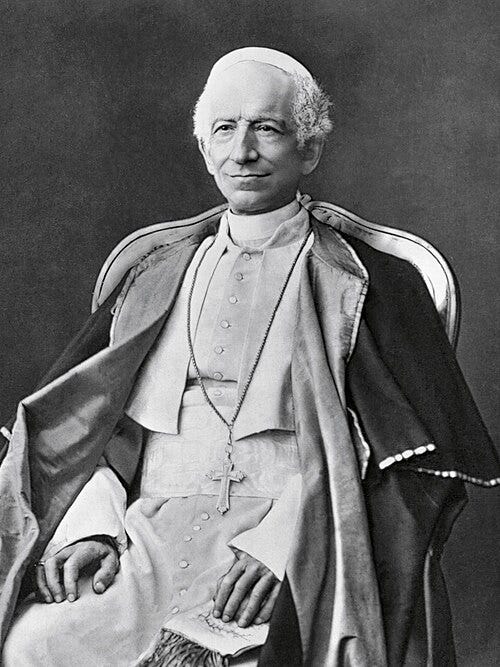
About the Author: Pope Leo XIII (r. 1878–1903) had the fourth longest reign as Bishop of Rome, after St. Peter, Pius IX, and John Paul II. Known for his excellent pastoral sense and love for the flock of Christ, Leo is now remembered for his affection for coca-wine and his staunch support for the rights of the worker in what were the ongoing aftershocks of the Industrial Revolution and the early tremblings of Communism. The encyclical Rerum Novarum condemns aspects of both capitalism and socialism, providing principles for what might be termed a “third way.”
—
1. It is not surprising that the spirit of revolutionary change, which has so long been predominant in the nations of the world, should have passed beyond politics and made its influence felt in the cognate field of practical economy. The elements of a conflict are unmistakable: the growth of industry, and the surprising discoveries of science; the changed relations of masters and workmen; the enormous fortunes of individuals, and the poverty of the masses; the increased self-reliance and the closer mutual combination of the working population; and, finally, a general moral deterioration. The momentous seriousness of the present state of things just now fills every mind with painful apprehension; wise men discuss it; practical men propose schemes; popular meetings, legislatures, and sovereign princes, all are occupied with it—and there is nothing which has a deeper hold on public attention.
2. Therefore, Venerable Brethren, as on former occasions, when it seemed opportune to refute false teaching, We have addressed you in the interests of the Church and of the common weal, and have issued Letters on Political Power, on Human Liberty, on the Christian Constitution of the State, and on similar subjects, so now We have thought it useful to speak on the Condition of Labour. It is a matter on which We have touched once or twice already. But in this Letter the responsibility of the Apostolic office urges Us to treat the question expressly and at length, in order that there may be no mistake as to the principles which truth and justice dictate for its settlement. The discussion is not easy, nor is it free from danger. It is not easy to define the relative rights and the mutual duties of the wealthy and of the poor, of capital and of labor. And the danger lies in this, that crafty agitators constantly make use of these disputes to pervert men’s judgments and to stir up the people to sedition.
3. But all agree, and there can be no question whatever, that some remedy must be found, and quickly found, for the misery and wretchedness which press so heavily at this moment on the large majority of the very poor. The ancient workmen’s Guilds were destroyed in the last century, and no other organization took their place. Public institutions and the laws have repudiated the ancient religion. Hence by degrees it has come to pass that Working Men have been given over, isolated and defenceless, to the callousness of employers and the greed of unrestrained competition. The evil has been increased by rapacious Usury, which, although more than once condemned by the Church, is nevertheless, under a different form but with the same guilt, still practised by avaricious and grasping men. And to this must be added the custom of working by contract, and the concentration of so many branches of trade in the hands of a few individuals, so that a small number of very rich men have been able to lay upon the masses of the poor a yoke little better than slavery itself.
4. To remedy these evils the Socialists, working on the poor man’s envy of the rich, endeavor to destroy private property, and maintain that individual possessions should become the common property of all, to be administered by the State or by municipal bodies. They hold that, by thus transferring property from private persons to the community, the present evil state of things will be set to rights, because each citizen will then have his equal share of whatever there is to enjoy. But their proposals are so clearly futile for all practical purposes, that if they were carried out the workingman himself would be among the first to suffer. Moreover they are emphatically unjust, because they would rob the lawful possessor, bring the State into a sphere that is not its own, and cause complete confusion in the community.
5. It is surely undeniable that, when a man engages in remunerative labor, the very reason and motive of his work is to obtain property, and to hold it as his own private possession. If one man hires out to another his strength or his industry, he does this for the purpose of receiving in return what is necessary for food and living; he thereby expressly proposes to acquire a full and real right, not only to the remuneration, but also to the disposal of that remuneration as he pleases. Thus, if he lives sparingly, saves money, and invests his savings, for greater security, in land, the land in such a case is only his wages in another form; and, consequently, a working man’s little estate thus purchased should be as completely at his own disposal as the wages he receives for his labor. But it is precisely in this power of disposal that ownership consists, whether the property be land or movable goods. The Socialists, therefore, in endeavoring to transfer the possessions of individuals to the community, strike at the interest of every wage-earner, for they deprive him of the liberty of disposing of his wages, and thus of all hope and possibility of increasing his stock and of bettering his condition in life.
6. What is of still greater importance, however, is that the remedy they propose is manifestly against justice. For every man has by nature the right to possess property as his own. This is one of the chief points of distinction between man and the animal creation. For the brute has no power of self-direction, but is governed by two chief instincts, which keep his powers alert, move him to use his strength, and determine him to action without the power of choice. These instincts are self-preservation, and the propagation of the species. Both can attain their purpose by means of things which are close at hand; beyond their surroundings the brute creation cannot go, for they are moved to action by sensibility alone, and by the things which sense perceives. But with man it is different indeed. He possesses, on the one hand, the full perfection of animal nature, and therefore he enjoys, at least as much as the rest of the animal race, the fruition of the things of the body. But animality, however perfect, is far from being the whole of humanity, and is indeed humanity’s humble handmaid, made to serve and obey. It is the mind, or the reason, which is the chief thing in us who are human beings; it is this which makes a human being human, and distinguishes him essentially and completely from the brute. And on this account, viz.—that man alone among animals possesses reason—it must be within his right to have things not merely for temporary and momentary use, as other living beings have them, but in stable and permanent possession; he must have not only things which perish in the using, but also those which, though used, remain for use in the future.
7. This becomes still more clearly evident if we consider man’s nature a little more deeply. For man, comprehending by the power of his reason things innumerable, and joining the future with the present—being, moreover, the master of his own acts—governs himself by the foresight of his counsel, under the eternal law and the power of God, Whose Providence governs all things. Wherefore it is in his power to exercise his choice not only on things which regard his present welfare, but also on those which will be for his advantage in time to come. Hence man not only can possess the fruits of the earth, but also the earth itself; for of the products of the earth he can make provision for the future. Man’s needs do not die out, but recur; satisfied to-day, they demand new supplies to-morrow. Nature, therefore, owes to man a storehouse that shall never fail, the daily supply of his daily wants. And this he finds only in the inexhaustible fertility of the earth.
8. Nor must we, at this stage, have recourse to the State. Man is older than the State; and he holds the right of providing for the life of his body prior to the formation of any State. And to say that God has given the earth to the use and enjoyment of the universal human race is not to deny that there can be private property. For God has granted the earth to mankind in general; not in the sense that all without distinction can deal with it as they please, but rather that no part of it has been assigned to any one in particular, and that the limits of private possession have been left to be fixed by man’s own industry and the laws of individual peoples. Moreover the earth, though divided among private owners, ceases not thereby to minister to the needs of all; for there is no one who does not live on what the land brings forth. Those who do not possess the soil, contribute their labor; so that it may be truly said that all human subsistence is derived either from labor on one’s own land, or from some laborious industry which is paid for either in the produce of the land itself or in that which is exchanged for what the land brings forth.
9. Here, again, we have another proof that private ownership is according to nature’s law. For that which is required for the preservation of life, and for life’s well-being, is produced in great abundance by the earth, but not until man has brought it into cultivation and lavished upon it his care and skill. Now, when man thus spends the industry of his mind and the strength of his body in procuring the fruits of nature, by that act he makes his own that portion of nature’s field which he cultivates—that portion on which he leaves, as it were, the impress of his own personality; and it cannot but be just that he should possess that portion as his own, and should have a right to keep it without molestation.
10. These arguments are so strong and convincing that it seems surprising that certain obsolete opinions should now be revived in opposition to what is here laid down. We are told that it is right for private persons to have the use of the soil and the fruits of their land, but that it is unjust for any one to possess as owner either the land on which he has built or the estate which he has cultivated. But those who assert this do not perceive that they are robbing man of what his own labor has produced. For the soil which is tilled and cultivated with toil and skill utterly changes its condition; it was wild before, it is now fruitful; it was barren, and now it brings forth in abundance. That which has thus altered and improved it becomes so truly part of itself as to be in great measure indistinguishable and inseparable from it. Is it just that the fruit of a man’s sweat and labor should be enjoyed by another? As effects follow their cause, so it is just and right that the results of labor should belong to him who has labored.
11. With reason, therefore, the common opinion of mankind, little affected by the few dissentients who have maintained the opposite view, has found in the study of nature, and in the law of Nature herself, the foundations of the division of property, and has consecrated by the practice of all ages the principle of private ownership, as being preëminently in conformity with human nature, and as conducing in the most unmistakable manner to the peace and tranquillity of human life. The same principle is confirmed and enforced by the civil laws—laws which, as long as they are just, derive their binding force from the law of nature. The authority of the Divine Law adds its sanction, forbidding us in the gravest terms even to covet that which is another’s: Thow shalt not covet thy neighbor’s wife; nor his house, nor his field, nor his man servant, nor his maid servant, nor his ox, nor his ass, nor anything which is his.
12. The rights here spoken of, belonging to each individual man, are seen in a much stronger light if they are considered in relation to man’s social and domestic obligations.
In choosing a state of life, it is indisputable that all are at full liberty either to follow the counsel of Jesus Christ as to virginity, or to enter into the bonds of marriage. No human law can abolish the natural and primitive right of marriage, or in any way limit the chief and principal purpose of marriage, ordained by God’s authority from the beginning: Increase and multiply. Thus we have the family; the ‘‘society” of a man’s own household; a society limited indeed in numbers, but a true ‘‘society,” anterior to every kind of State or nation, with rights and duties of its own, totally independent of the commonwealth.
13. That right of property, therefore, which has been proved to belong naturally to individual persons, must also belong to a man in his capacity of head of a family; nay, such a person must possess this right so much the more clearly in proportion as his position multiplies his duties. For it is a most sacred law of nature that a father must provide food and all necessaries for those whom he has begotten; and, similarly, nature dictates that a man’s children, who carry on, as it were, and continue his own personality, should be provided by him with all that is needful to enable them honorably to keep themselves from want and misery in the uncertainties of this mortal life. Now in no other way can a father effect this except by the ownership of profitable property, which he can transmit to his children by inheritance. A family, no less than a State, is, as We have said, a true society, governed by a power within itself, that is to say, by the father. Wherefore, provided the limits be not transgressed which are prescribed by the very purposes for which it exists, the family has at least equal rights with the State in the choice and pursuit of those things which are needful to its preservation and its just liberty.
We say, at least equal rights; for since the domestic household is anterior both in idea and in fact to the gathering of men into a commonwealth, the former must necessarily have rights and duties which are prior to those of the latter, and which rest more immediately on nature. If the citizens of a State—that is to say, the Families—on entering into association and fellowship, experienced at the hands of the State hindrance instead of help, and found their rights attacked instead of being protected, such association were rather to be repudiated than sought after.
14. The idea, then, that the civil government should, at its own discretion, penetrate and pervade the family and the household, is a great and pernicious mistake. True, if a family finds itself in great difficulty, utterly friendless, and without prospect of help, it is right that extreme necessity be met by public aid; for each family is a part of the commonwealth. In like manner, if within the walls of the household there occur grave disturbance of mutual rights, the public power must interfere to force each party to give the other what is due; for this is not to rob citizens of their rights, but justly and properly to safeguard and strengthen them. But the rulers of the State must go no further: nature bids them stop here. Paternal authority can neither be abolished by the State, nor absorbed; for it has the same source as human life itself. ‘‘The child belongs to the father,” and is, as it were, the continuation of the father’s personality; and, to speak with strictness, the child takes its place in civil society not in its own right, but in its quality as a member of the family in which it is begotten. And it is for the very reason that “the child belongs to the father” that, as St. Thomas of Aquin says, “before it attains the use of free will, it is in the power and care of its parents” (STh II-II, q. 10, a. 12). The Socialists, therefore, in setting aside the parent and introducing the providence of the State, act against natural justice, and threaten the very existence of family life.
15. And such interference is not only unjust, but is quite certain to harass and disturb all classes of citizens and to subject them to odious and intolerable slavery. It would open the door to envy, to evil speaking, and to quarrelling; the sources of wealth would themselves run dry, for no one would have any interest in exerting his talents or his industry; and that ideal equality of which so much is said would in reality be the levelling down of all to the same condition of misery and dishonor.
Thus it is clear that the main tenet of Socialism, the community of goods, must be utterly rejected; for it would injure those whom it is intended to benefit, it would be contrary to the natural rights of mankind, and it would introduce confusion and disorder into the commonwealth. Our first and most fundamental principle, therefore, when we undertake to alleviate the condition of the masses, must be the inviolability of private property. This laid down, We go on to show where we must find the remedy that we seek.
* * *
37. Rights must be religiously respected wherever they are found; and it is the duty of the public authority to prevent and punish injury, and to protect each one in the possession of his own. Still, when there is question of protecting the rights of individuals, the poor and helpless have a claim to special consideration. The richer population have many ways of protecting themselves, and stand less in need of help from the State; those who are badly off have no resources of their own to fall back upon, and must chiefly rely upon the assistance of the State. And it is for this reason that wage earners, who are undoubtedly among the weak and necessitous, should be specially cared for and protected by the commonwealth.
38. Here, however, it will be advisable to advert expressly to one or two of the more important details. It must be borne in mind that the chief thing to be secured is the safeguarding, by legal enactment and policy, of private property. Most of all is it essential in these times of covetous greed, to keep the multitude within the line of duty; for if all may justly strive to better their condition, yet neither justice nor the common good allows any one to seize that which belongs to another, or, under the pretext of futile and ridiculous equality, to lay hands on other peoples’ fortunes. It is most true that by far the larger part of the people who work prefer to improve themselves by honest labor rather than by doing wrong to others. But there are not a few who are imbued with bad principles and are anxious for revolutionary change, and whose great purpose it is to stir up tumult and bring about a policy of violence. The authority of the State should intervene to put restraint upon these disturbers, to save the workmen from their seditious arts, and to protect lawful owners from spoliation.
39. When work-people have recourse to a strike, it is frequently because the hours of labor are too long, or the work too hard, or because they consider their wages insufficient. The grave inconvenience of this not uncommon occurrence should be obviated by public remedial measures; for such paralysis of labor not only affects the masters and their work-people, but is extremely injurious to trade, and to the general interests of the public; moreover, on such occasions, violence and disorder are generally not far off, and thus it frequently happens that the public peace is threatened. The laws should be beforehand, and prevent these troubles from arising; they should lend their influence and authority to the removal in good time of the causes which lead to conflicts between masters and those whom they employ.
40. But if the owners of property must be made secure, the Workman, too, has property and possessions in which he must be protected; and, first of all, there are his spiritual and mental interests. Life on earth, however good and desirable in itself, is not the final purpose for which man is created; it is only the way and the means to that attainment of truth, and that practice of goodness, in which the full life of the soul consists. It is the soul which is made after the image and likeness of God; it is in the soul that sovereignty resides, in virtue of which man is commanded to rule the creatures below him, and to use all the earth and the ocean for his profit and advantage. “Fill the earth and subdue it; and rule over the fishes of the sea, and the fowls of the air, and all living creatures which move upon the earth.” In this respect all men are equal; there is no difference between rich and poor, master and servant, ruler and ruled, for the same is Lord over all. No man may outrage with impunity that human dignity which God Himself treats with reverence, nor stand in the way of that higher life which is the preparation for the eternal life of Heaven. Nay, more: a man has here no power over himself. To consent to any treatment which is calculated to defeat the end and purpose of his being is beyond his right; he cannot give up his soul to servitude: for it is not man’s own rights which are here in question, but the rights of God, most sacred and inviolable.
41. From this follows the obligation of the cessation of work and labor on Sundays and certain festivals. This rest from labor is not to be understood as mere idleness; much less must it be an occasion of spending money and of vicious excess, as many would desire it to be; but it should be rest from labor consecrated by Religion. Repose united with religious observance disposes man to forget for a while the business of this daily life, and to turn his thoughts to heavenly things and to the worship which he so strictly owes to the Eternal Deity. It is this, above all, which is the reason and motive of the Sunday rest; a rest sanctioned by God’s great law of the ancient covenant, “Remember thou keep holy the Sabbath Day,” and taught to the world by His own mysterious ‘‘rest” after the creation of man: “He rested on the seventh day from all His work which He had done.”
42. If we turn now to things exterior and corporeal, the first concern of all is to save the poor workers from the cruelty of grasping speculators, who use human beings as mere instruments for making money. It is neither justice nor humanity so to grind men down with excessive labor as to stupefy their minds and wear out their bodies. Man’s powers, like his general nature, are limited, and beyond these limits he cannot go. His strength is developed and increased by use and exercise, but only on condition of due intermission and proper rest. Daily labor, therefore, must be so regulated that it may not be protracted during longer hours than strength admits. How many and how long the intervals of rest should be, will depend on the nature of the work, on circumstances of time and place, and on the health and strength of the workman. Those who labor in mines and quarries, and in work within the bowels of the earth, should have shorter hours in proportion as their labor is more severe and more trying to health. Then again, the season of the year must be taken into account; for not unfrequently a kind of labor is easy at one time which at another is intolerable or very difficult. Finally, work which is suitable for a strong man cannot reasonably be required from a woman or a child. And, in regard to children, great care should be taken not to place them in workshops and factories until their bodies and minds are sufficiently mature. For just as rough weather destroys the buds of spring, so too early an experience of life’s hard work blights the young promise of a child’s powers, and makes any real education impossible. Women, again, are not suited to certain trades; for a woman is by nature fitted for home work, and it is that which is best adopted at once to preserve her modesty and to promote the good bringing up of children and the well-being of the family. As a general principle it may be laid down that a workman ought to have leisure and rest in proportion to the wear and tear of his strength; for the waste of strength must be repaired by the cessation of work.
In all agreements between masters and work-people, there is always the condition, expressed or understood, that there be allowed proper rest for soul and body. To agree in any other sense would be against what is right and just; for it can never be right or just to require on the one side, or to promise on the other, the giving up of those duties which a man owes to his God and to himself.
43. We now approach a subject of very great importance, and one on which, if extremes are to be avoided, right ideas are absolutely necessary. Wages, we are told, are fixed by free consent; and therefore the employer, when he pays what was agreed upon, has done his part, and is not called upon for anything further. The only way, it is said, in which injustice could happen would be if the master refused to pay the whole of the wages, or the workman would not complete the work undertaken; when this happens the State should intervene, to see that each obtains his own—but not under any other circumstances.
44. This mode of reasoning is by no means convincing to a fair-minded man, for there are important considerations which it leaves out of view altogether. To labor is to exert one’s self for the sake of procuring what is necessary for the purposes of life, and most of all for self-preservation. “In the sweat of thy brow thou shalt eat bread.” Therefore a man’s labor has two notes or characters. First of all, it is personal; for the exertion of individual power belongs to the individual who puts it forth, employing this power for that personal profit for which it was given. Secondly, man’s labor is necessary; for without the results of labor a man cannot live; and self-conservation is a law of Nature, which it is wrong to disobey. Now, if we were to consider labor merely so far as it is personal, doubtless it would be within the workman’s right to accept any rate of wages whatever; for in the same way as he is free to work or not, so he is free to accept a small remuneration or even none at all. But this is a mere abstract supposition; the labor of the workingman is not only his personal attribute, but it is necessary; and this makes all the difference. The preservation of life is the bounden duty of each and all, and to fail therein is a crime. It follows that each one has a right to procure what is required in order to live; and the poor can procure it in no other way than by work and wages.
45. Let it be granted, then, that, as a rule, workman and employer should make free agreements, and in particular should freely agree as to wages; nevertheless, there is a dictate of nature more imperious and more ancient than any bargain between man and man, that the remuneration must be enough to support the wage earner in reasonable and frugal comfort. If through necessity or fear of a worse evil the workman accepts harder conditions because an employer or a contractor will give him no better, he is the victim of force and injustice. In these and similar questions, however—such as, for example, the hours of labor in different trades, the sanitary precautions to be observed in factories and workshops, etc.—in order to supersede undue interferences on the part of the State, especially as circumstances, times, and localities differ so widely, it is advisable that recourse be had to Societies or Boards such as We shall mention presently, or to some other method of safe-guarding the interests of wage earners, the State to be asked for approval and protection.
46. If a workman’s wages be sufficient to enable him to maintain himself, his wife, and his children in reasonable comfort, he will not find it difficult, if he is a sensible man, to study economy; and he will not fail, by cutting down expenses, to put by a little property: nature and reason would urge him to do this. We have seen that this great Labor question cannot be solved except by assuming as a principle that private ownership must be held sacred and inviolable. The law, therefore, should favor ownership, and its policy should be to induce as many of the people as possible to become owners.
47. Many excellent results will follow from this; and, first of all, property will certainly become more equitably divided. For the effect of civil change and revolution has been to divide society into two widely differing castes. On the one side there is the party which holds the power because it holds the wealth; which has in its grasp all labor and all trade, which manipulates for its own benefit and its own purposes all the sources of supply, and which is powerfully represented in the councils of the State itself. On the other side there is the needy and powerless multitude, sore and suffering, and always ready for disturbance. If working people can be encouraged to look forward to obtaining a share in the land, the result will be that the gulf between vast wealth and deep poverty will be bridged over, and the two orders will be brought nearer together.
Another consequence will be the greater abundance of the fruits of the earth. Men always work harder and more readily when they work on that which is their own; nay, they learn to love the very soil which yields in response to the labor of their hands, not only food to eat, but an abundance of good things for themselves and those that are dear to them. It is evident how such a spirit of willing labor would add to the produce of the earth and to the wealth of the community.
And a third advantage would arise from this: men would cling to the country in which they were born; for no one would exchange his country for a foreign land if his own afforded him the means of living a tolerable and happy life. These three important benefits, however, can only be expected on the condition that a man’s means be not drained and exhausted by excessive taxation. The right to possess private property is from nature, not from man; and the State has only the right to regulate its use in the interests of the public good, but by no means to abolish it altogether. The State is therefore unjust and cruel if, in the name of taxation, it deprives the private owner of more than is just.
* * *
62. We have now laid before you, Venerable Brethren, who are the persons, and what are the means, by which this most difficult question must be solved. Every one must put his hand to the work which falls to his share, and that at once and immediately, lest the evil which is already so great may by delay become absolutely beyond remedy. Those who rule the State must use the law and the institutions of the country; masters and rich men must remember their duty; the poor, whose interests are at stake, must make every lawful and proper effort; and since Religion alone, as We said at the beginning, can destroy the evil at its root, all men must be persuaded that the primary thing needful is to return to real Christianity, in the absence of which all the plans and devices of the wisest will be of little avail.
63. As far as regards the Church, its assistance will never be wanting, be the time or the occasion what it may; and it will intervene with the greater effect in proportion as its liberty of action is the more unfettered; let this be carefully noted by those whose office it is to provide for the public welfare. Every minister of holy Religion must throw into the conflict all the energy of his mind and all the strength of his endurance; with your authority, Venerable Brethren, and by your example, they must never cease to urge upon all men of every class, upon the high as well as the lowly, the Gospel doctrines of Christian life; by every means in their power they must strive for the good of the people; and above all they must earnestly cherish in themselves, and try to arouse in others, charity, the mistress and queen of virtues. For the happy results we all long for must be chiefly brought about by the plenteous outpouring of Charity; of that true Christian Charity which is the fulfilling of the whole Gospel law, which is always ready to sacrifice itself for others’ sake, and which is man’s surest antidote against worldly pride and immoderate love of self; that Charity, whose office is described and whose Godlike features are drawn by the Apostle St. Paul in these words: “Charity is patient, is kind . . . seeketh not her own . . . suffereth all things . . . endureth all things.”
On each one of you, Venerable Brethren, and on your Clergy and people, as an earnest of God’s mercy and a mark of our affection, We lovingly in the Lord bestow the Apostolic benediction.
Given at St. Peter’s in Rome, the fifteenth day of May, 1891, the fourteenth year of Our Pontificate.
—
From Leo XIII, “Encyclical Letter on the Condition of Labour Rerum Novarum [15 May 1891] (New York: Benzinger Brothers, 1891), 20-22. https://archive.org/details/onconditionoflab00leox/mode/2up?view=theater.