

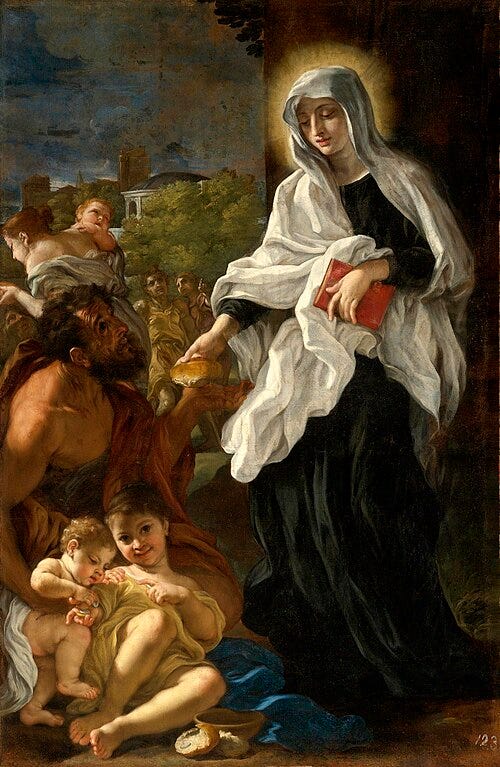
About the texts: Perhaps the most common complaint of the prophets against the people of Israel after their neglect of God is their neglect of the poor, the widows and the orphans. Time and time again the chosen people are admonished to care for the needy, to share from their abundance with those who have not. The same admonitions carry over into the New Testament. Jesus and the Apostles are clear that it is our duty to care for the poor, the principal means of which is the giving of alms.
—
Matthew 6:1–4
“Beware of practicing your piety before men in order to be seen by them; for then you will have no reward from your Father who is in heaven.
“Thus, when you give alms, sound no trumpet before you, as the hypocrites do in the synagogues and in the streets, that they may be praised by men. Truly, I say to you, they have their reward. But when you give alms, do not let your left hand know what your right hand is doing, so that your alms may be in secret; and your Father who sees in secret will reward you.”
Luke 16:19–31
“There was a rich man, who was clothed in purple and fine linen and who feasted sumptuously every day. And at his gate lay a poor man named Lazarus, full of sores, who desired to be fed with what fell from the rich man’s table; moreover the dogs came and licked his sores. The poor man died and was carried by the angels to Abraham’s bosom. The rich man also died and was buried; and in Hades, being in torment, he lifted up his eyes, and saw Abraham far off and Lazarus in his bosom. And he called out, ‘Father Abraham, have mercy upon me, and send Lazarus to dip the end of his finger in water and cool my tongue; for I am in anguish in this flame.’ But Abraham said, ‘Son, remember that you in your lifetime received your good things, and Lazarus in like manner evil things; but now he is comforted here, and you are in anguish. And besides all this, between us and you a great chasm has been fixed, in order that those who would pass from here to you may not be able, and none may cross from there to us.’ And he said, ‘Then I beg you, father, to send him to my father’s house, for I have five brothers, so that he may warn them, lest they also come into this place of torment.’ But Abraham said, ‘They have Moses and the prophets; let them hear them.’ And he said, ‘No, father Abraham; but if some one goes to them from the dead, they will repent.’ He said to him, ‘If they do not hear Moses and the prophets, neither will they be convinced if some one should rise from the dead.’”
James 2:1–17
My brethren, show no partiality as you hold the faith of our Lord Jesus Christ, the Lord of glory. For if a man with gold rings and in fine clothing comes into your assembly, and a poor man in shabby clothing also comes in, and you pay attention to the one who wears the fine clothing and say, “Have a seat here, please,” while you say to the poor man, “Stand there,” or, “Sit at my feet,” have you not made distinctions among yourselves, and become judges with evil thoughts? Listen, my beloved brethren. Has not God chosen those who are poor in the world to be rich in faith and heirs of the kingdom which he has promised to those who love him? But you have dishonored the poor man. Is it not the rich who oppress you, is it not they who drag you into court? Is it not they who blaspheme that honorable name by which you are called?
If you really fulfil the royal law, according to the scripture, “You shall love your neighbor as yourself,” you do well. But if you show partiality, you commit sin, and are convicted by the law as transgressors. For whoever keeps the whole law but fails in one point has become guilty of all of it. For he who said, “Do not commit adultery,” said also, “Do not kill.” If you do not commit adultery but do kill, you have become a transgressor of the law. So speak and so act as those who are to be judged under the law of liberty. For judgment is without mercy to one who has shown no mercy; yet mercy triumphs over judgment.
What does it profit, my brethren, if a man says he has faith but has not works? Can his faith save him? If a brother or sister is ill-clad and in lack of daily food, and one of you says to them, “Go in peace, be warmed and filled,” without giving them the things needed for the body, what does it profit? So faith by itself, if it has no works, is dead.
—
Taken from The Catholic Edition of the Revised Standard Version of the Bible, copyright © 1965, 1966 National Council of the Churches of Christ in the United States of America. Used by permission. All rights reserved worldwide.