

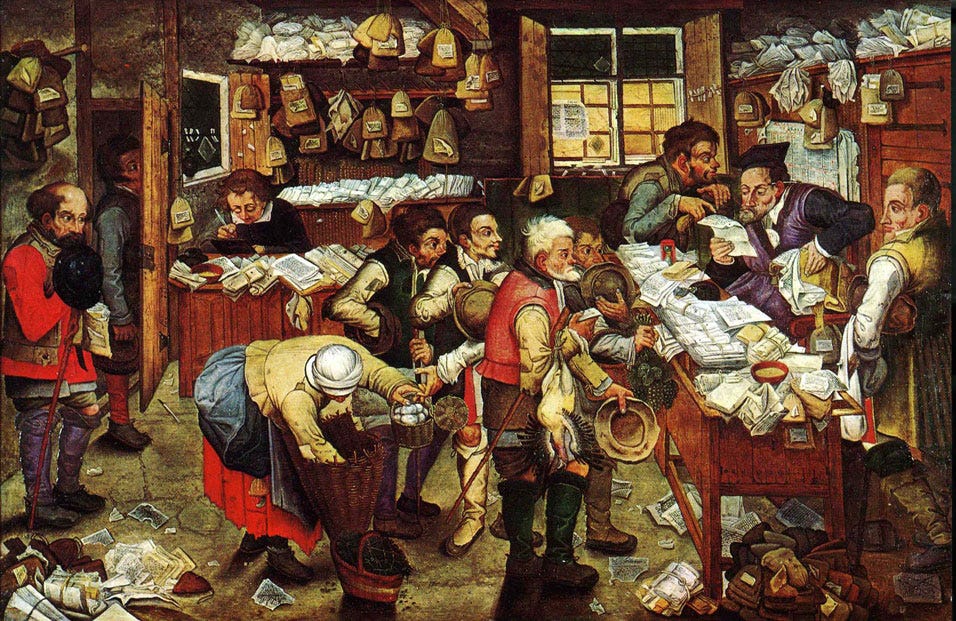
About the texts: Certainly more contentious than His teaching on almsgiving is Christ’s teaching on paying taxes. Despite the clear message that we are not made for this life but for the next, that we are children of God and not children of the State, Jesus commands the people to pay their taxes and provides for his own. St. Paul then follows it up with a command not simply to pay taxes but to be subject to the temporal rulers since they are God’s own ministers and share in His authority to reward the good and punish the wicked.
—
Matthew 17:24–27
When they came to Capernaum, the collectors of the half-shekel tax went up to Peter and said, “Does not your teacher pay the tax?” He said, “Yes.” And when he came home, Jesus spoke to him first, saying, “What do you think, Simon? From whom do kings of the earth take toll or tribute? From their sons or from others?” And when he said, “From others,” Jesus said to him, “Then the sons are free. However, not to give offense to them, go to the sea and cast a hook, and take the first fish that comes up, and when you open its mouth you will find a shekel; take that and give it to them for me and for yourself.”
Matthew 22:15–22
Then the Pharisees went and took counsel how to entangle him in his talk. And they sent their disciples to him, along with the Herodians, saying, “Teacher, we know that you are true, and teach the way of God truthfully, and care for no man; for you do not regard the position of men. Tell us, then, what you think. Is it lawful to pay taxes to Caesar, or not?”
But Jesus, aware of their malice, said, “Why put me to the test, you hypocrites? Show me the money for the tax.” And they brought him a coin. And Jesus said to them, “Whose likeness and inscription is this?” They said, “Caesar’s.” Then he said to them, “Render therefore to Caesar the things that are Caesar’s, and to God the things that are God’s.” When they heard it, they marveled; and they left him and went away.
Romans 13:1–7
Let every person be subject to the governing authorities. For there is no authority except from God, and those that exist have been instituted by God. Therefore he who resists the authorities resists what God has appointed, and those who resist will incur judgment. For rulers are not a terror to good conduct, but to bad. Would you have no fear of him who is in authority? Then do what is good, and you will receive his approval, for he is God’s servant for your good. But if you do wrong, be afraid, for he does not bear the sword in vain; he is the servant of God to execute his wrath on the wrongdoer. Therefore one must be subject, not only to avoid God’s wrath but also for the sake of conscience. For the same reason you also pay taxes, for the authorities are ministers of God, attending to this very thing. Pay all of them their dues, taxes to whom taxes are due, revenue to whom revenue is due, respect to whom respect is due, honor to whom honor is due.
—
Taken from The Catholic Edition of the Revised Standard Version of the Bible, copyright © 1965, 1966 National Council of the Churches of Christ in the United States of America. Used by permission. All rights reserved worldwide.