

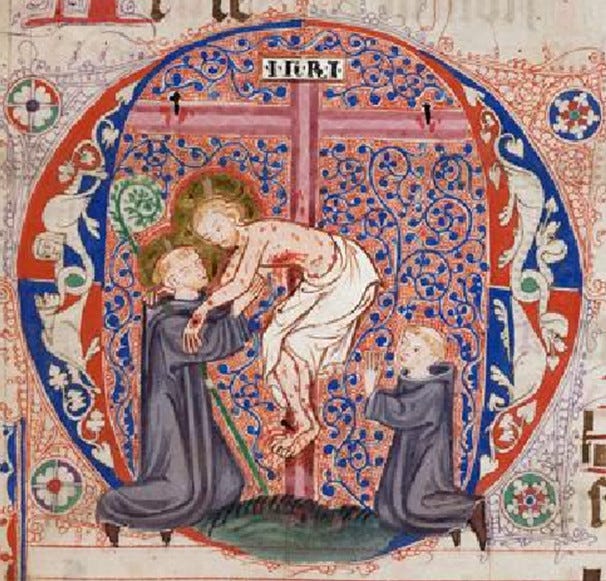
About the Author: Bernard of Clairvaux (1090–1153) was one of the earliest members of the Cistercian Order—an attempt at reforming the Benedictines by returning to the Rule of St. Benedict—and certainly its most famous. A skilled preacher and perhaps even a mystic, Bernard’s constant scriptural language and imagery has gained for him the title “last of the Fathers.” The present text is an excerpt from a longer work on the degrees of humility and pride, which draws extensively from St. Benedict’s Rule and the earlier monastic tradition. Here he details the descent of the monk into the depths of pride.
The first degree of pride is curiosity. This you may detect by the following signs. Look at that monk, whom you have hitherto supposed to be a sensible man. He has now taken to staring about him, whether he is standing up, walking about or sitting down. He thrusts his head forward, and pricks up his ears. From his outward movements you can clearly see the inward change that he has undergone. For it is the froward man who winketh with the eye, presseth with the foot, and speaketh with the finger (Pr 6:12), and from the unusual movements of his body is seen to have lately contracted disease of the soul — the careless sluggishness of which in self-examination makes it inquisitive about others. So since it takes no heed to itself it is sent out of doors to feed the kids. And as these are the types of sin, I may quite correctly give the title of ‘kids’ to the eyes and the ears, since as death comes into the world through sin, so does sin enter the mind through these apertures. The curious man, therefore, busies himself with feeding them, though he takes no trouble to ascertain the state in which he has left himself. Yet if, O man, you look carefully into yourself, it is indeed a wonder that you can ever look at anything else. You inquisitive fellow, listen to Solomon — you silly fellow, hearken to the wise man, as he says, With all watchfulness guard thy heart (Pr 6:23), in other words, keep all your senses on the watch to protect that which is the source of life. For whither, inquisitive man, will you retire from your own presence — to whom will you in the meantime intrust yourself? How dare you, who have sinned against heaven, lift up your eyes to the sky? Look down to the earth if you want to recognize yourself. It will show you what you are, for earth thou art, and to earth shalt thou go (Gn 3:9).
Now there are two reasons for which you may raise your eyes without being to blame for so doing — one is to seek, the other is to render, assistance. David raised his eyes to the mountains for the former, the Lord lifted His over the crowd for the latter purpose. The motive of the one was misfortune, that of the other was mercy, neither was to blame. If you likewise with due regard to place, time and occasion, look up when you or a brother are in distress, I not only do not blame you, I highly commend you. For misfortune allows the one action, mercy approves the other. But in different circumstances I should call you an imitator not of the Prophet nor of the Lord, but of Dina or of Eve, aye, verily, of Satan himself. For Dina when she went out to feed her kids, was snatched away from her father and her maidenhood was taken from her. O Dina, what need was there for thee to look on strange women? Was it necessary — did it serve any useful purpose — or was it done out of mere curiosity? Thy look may have no purpose, but it is not without purpose that men gaze on thee. There is curiosity in thy look, but more in the look that is turned on thee. Who could have supposed that thy curious carelessness or careless curiosity would afterwards prove to be not reckless but ruinous to thee, thy friends and thine enemies?
And thou, O Eve, wast placed in Paradise, that thou mightest work with thine husband and bestow thy care on him; and if thou hadst discharged thy duty, thou wouldst eventually have passed into a better sphere where there would have been no need for thee to be engaged in any work, or to be beset by any care. Leave was given to thee to eat of every tree in Paradise, except that one which is called the tree of knowledge of good and evil (Gn 2:9). For if the others are good and have a good savour, what need is there to eat of one which also has an evil savour? Not to be more wise than it behoveth to be wise (Rm 12:3) For to know evil is not knowledge but folly. So preserve what is given, await what is promised, avoid what is forbidden, lest thou lose what is allowed. Why lookest thou so eagerly for thy death ? Why dost thou so often cast in that direction those wandering eyes of thine? What pleasure hast thou in looking on that which thou mayest not eat? Perchance thou dost reply, ‘I stretch forth mine eyes not my hand. It is not looking but eating that is forbidden. May I not turn those eyes which God has placed under my control in any direction that I please?’ To which the Apostle shall answer, All things are lawful for me, but all things are not expedient (1 Cor 6:12). Although it may not be in itself a guilty act, it affords an incentive to sin. For if thy mind had not shown insufficient attention to its own condition, it would have had no time for idle curiosity. Although there may be no offence, there is an opportunity as well as a suggestion to offend and a reason for offending. For while thou art thinking of something else, the serpent creeps craftily into thine heart, and addresses thee in an alluring tone. He overcomes thy reason with his enticements, allays thy fear with falsehoods, and tells thee that thou art in no danger of death. He increases thy distress, as he stimulates thine appetite; he sharpens curiosity and strengthens desire. At length he offers what is forbidden and takes away what is allowed. He presents thee with fruit and deprives thee of Paradise. Thou takest poison: thou wilt perish thyself and wilt bring forth children who will perish. Thou hast sacrificed salvation, without losing the power to give birth. We are born, we die and thus we are born only to die, because we are dead before we are born.
And as for thee, ‘pattern of perfection’ (Ez 28:12–13), thou wast placed not in Paradise, but in Eden the garden of God. What more couldst thou reasonably desire? Filled with wisdom, and exalted in honour, thou shouldst have expected nothing higher and worked for nothing stronger than thyself. Remain where thou art, lest thou fall from thy position, if thou walkest among things that are too great and wonderful for thee. But why dost thou sometimes turn round and look to the north? I see thee, I already detect thee peering too inquisitively into the unknown heights above thee, I will place sayest thou, my throne towards the north (Is 14:13). The other dwellers in heaven are standing, whilst thou alone dost desire to sit, and dost thereby disturb the harmony of the brethren, the peace of the whole heavenly community, and, so far as it lies in thy power to do so, the tranquillity of the Trinity. Does this curiosity carry thee so far, thou wretched being, that with unrivalled presumption thou dost not scruple to give offence to the citizens and to do injury to the king? Thousands of thousands minister to him and ten times a hundred thousand stand before him (Dn 7:10), where no one is allowed to sit, but He alone who sitteth upon the cherubims (Ps 80[79]:1) and receiveth the ministrations of others. And dost thou — how shall I put it — claiming a wider outlook, a more incisive scrutiny and a freer entrance than that of the others, place a seat for thyself in heaven, that thou mayest be on a level with the Most High? What is thine object — on what dost thou rely? Thou fool, estimate thy powers, think of the result, consider the process. Dost thou presume on the knowledge or on the ignorance — on the willingness or on the reluctance — of the Most High? But how can He whose purpose is all good, and whose knowledge is unlimited, either consent to or be unaware of, thine evil design? Dost thou think that though He undoubtedly knows and disapproves it, He is unable to prevent it? But unless indeed thou art doubtful whether thou art a created being, I cannot suppose that thou canst doubt the omnipotence, omniscience and excellence of thy Creator, seeing that He was able to create thee out of nothing, and, knowing what thou wouldst turn out to be, willed to make thee the powerful being that thou art. When therefore thou thinkest that God will tolerate that of which He disapproves and has the power to prohibit, do I perchance see in thee the completion — aye, and the origin — of that idea which after thee and because of thee is constantly held by those like thee on earth, and which is embodied in the common saying, ‘An usurper keeps reckless followers?’ Is thine eye evil because he is good (Mt 20:15)? This wicked presumption of thine on His benevolence has produced in thee an insolent disregard of His knowledge, and a daring defiance of His power. For this, and nothing less than this, thou unholy one, is thy train of thought. This is the wickedness that thou dost devise on thy bed, and sayest ‘thinkest thou that the Creator will destroy His own work? I am well aware that no thought of mine escapes God, because He is God, nor does any such thought please Him, because He is good. Nor can I escape His hand — if He so wishes — because He is mighty. But need this be a cause of dread to me? For if through His goodness He can have no pleasure in evil done by me — how much less can He derive it from evil action of His own? I should call it evil on my part to wish to oppose His will — and on His part to avenge Himself. He therefore cannot wish to take vengeance for any crime, since He neither will nor can part with His inherent goodness.’ It is thyself — thou wretch, alone that thou deceivest, not God. Thou deceivest thyself, I repeat, and thy wickedness lies to thyself not to God. Thou dost indeed act deceitfully, but He detects thy motive. Thus thou deceivest thyself not God. And since in return for His great goodness, thou dost contemplate great evil towards Him, thy wickedness naturally leads thee to hate Him. For what can be more unjust than that the Creator should be scorned by thee for the very reason for which He most deserves thy love? What can be more outrageous than that when thou hast no doubt that the power of God shown in thy creation, could be used for thy destruction, thou dost yet rely on His abundant kindness, and that this should lead thee to hope that He will be unwilling to exercise His vindictive power? Wilt thou repay good with evil and love with hatred (Ps 109[108]:5)?
Now I say that this malice is deserving, not of passing indignation but of abiding wrath. For it is thy desire and hope to be on an equality with the most gracious and most high Lord, although that is not His wish. Thou desirest that He shall have always before His eyes the distressing sight of thine unwelcome presence, and thou thinkest that though He is able to cast thee down, He will not do so, but that He will prefer Himself to suffer than to allow thee to perish. It is undoubtedly in His power to overthrow thee, if such be His will — but in thine opinion His kindness will not allow Him to entertain such a wish. If He be such as thou supposest Him to be, it is clear that thy conduct in not loving Him is so much the baser. And if He does allow action to be taken against Himself rather than take action against thee — how great must be thy malice in having no consideration for Him who disregards Himself in sparing thee? But it is inconceivable that He who is perfect can fail to be both kind and just. It is not as though kindness and justice cannot exist together. Kindness is really better when it is just than when it is slack — nay more, kindness without justice is not a virtue. It therefore appears that thou remainest ungrateful for the loving-kindness of God whereby thou wast created without exertion on thy part, but thou fearest not His justice of which thou hast had no experience, and dost therefore audaciously incur guilt for which thou dost falsely promise thyself impunity. Now mark that thou wilt find Him whom thou hast known to be kind, to be also righteous, and thou wilt thyself fall into the ditch which thou hast dug for thy Creator. Thy design seems to be to inflict on Him an injury which He is able to avoid if He wishes to do so — a wish which thou thinkest that He cannot entertain, as He will not be wanting in that kindness which has led Him never within thine experience to punish anybody. The righteous God will most justly retaliate by punishing thee, since He neither can nor ought to allow such a slight on His goodness to remain unpunished. He may, However, so moderate the severity of His sentence that, if thou art willing to return to reason, He will not refuse thee pardon. But such is thy hardness and impenitent heart (Rm 2:5), that thou art incapable of such a wish, and therefore canst not escape the penalty.
But now listen to the accusation against thee. Heaven, saith He, is my throne and the earth my footstool (Is 66:1). He did not say ‘east’ or ‘west’, or any one region in the heaven, but the whole heaven is my throne. Thou must not therefore seat thyself in a portion of the heaven, since He has chosen the whole of it for Himself. Thou canst not place thyself on earth, for it is His footstool. For the earth is a solid body, on which is seated the Church, founded on a strong rock. What wilt thou do ? Driven out of heaven, thou canst not remain on earth. Choose then for thyself a place in the air, not for session but for flight, so that thou, who didst attempt to shatter the security of eternity, shall pay the penalty of thine own unrest. For, whilst thou art driven to and fro between Heaven and earth, the Lord is seated on a throne high and elevated (Is 6:1) and the whole earth is full of His majesty — so that thou canst find no place except in the air. For the Seraphim with their wings of contemplation fly from the throne to the footstool, and from the footstool to the throne, while with their other wings they cover the head and feet of the Lord. And I think that they are purposely so placed that, as the access to Paradise was barred against sinful men by the Cherubim, so also shall a limit be set to thy curiosity by the Seraphim. The result will be that thou wilt no longer, with more impudence than prudence, investigate the secrets of heaven, nor wilt thou discover the mysteries of the Church on earth, but shalt find a home only in the hearts of the proud, who neither deign to live on earth like other men, nor fly like the angels to heaven. But although His head is hidden from thee in heaven and His feet on earth, thou mayest as it were be allowed to see — and to envy — some part of what lies between, whilst thou art suspended in the air, and dost behold the angels descending and ascending past thee, though thou art altogether ignorant of what they hear in heaven or tell on earth.
O Lucifer, thou who didst rise in the morning, surely a bearer no longer of light, but of night — aye, even of death — thy proper course was from the east to the south, and dost thou invert the order and perversely tend towards the north? In proportion to thy haste to rise is the rapidity of thy decline and fall. Yet, thou curious one, I should wish to investigate more closely the object of thy curiosity. I will place, sayest thou, my throne towards the north. And as thou art a spirit, I think that neither ‘north’ nor ‘throne’ is to be understood in a local or literal sense. For, I suppose that by ‘the north’ is meant evil men, and by ‘my throne’ thy control over them. For in the foreknowledge of God, thou hast from thy chosen proximity to Him, a clearer insight into the future than had others; and as these were neither enlightened by any ray of wisdom, nor warmed by the love of the spirit, thou didst find in them as it were thine opportunity. Thus didst thou establish thy rule over them, so that thou mightest pour into them some of thy clever cunning, and influence them with thy wicked warmth; so that as the Most High controlled all the sons of obedience by His wisdom and His goodness, thou mightest govern these by thy cunning wickedness and wicked cunning, and in this respect thou mightest resemble Him. But I am surprised that, since in God’s foreknowledge thou didst foresee thy rule, thou didst not in like manner foresee thy ruin. For if thou didst foresee it, what madness it was to be so wickedly eager for dominion as to prefer rule and wretchedness to submission and happiness. Or was it not better for thee to be a partner in those regions of light than ruler of those dark places? But it is more likely that thou didst not look forward — either for the reason which I gave above — that in thy reliance on the kindness of God thou didst say in thine heart, He will not require it (Ps 10:13), and didst therefore wickedly offend Him, or because when thou didst see thy rule, the beam of pride at once rose up in thine eye — which through its interference was unable to discern its danger.
In like manner Joseph did not foresee his sale though he had foreseen his promotion — and this although the sale was to precede the promotion. I should not from this conclude that the great patriarch was guilty of pride, but that his experience proves that those who possess the spirit of prophecy must not be supposed to have foreseen nothing because they did not foresee everything. Some one may, perhaps, maintain that the fact that this youth recorded his dreams — of whose symbolic significance he was at the time unaware — was a mark of self-sufficiency. I still think that this should be ascribed to their symbolic character or to his boyish innocence, rather than to conceit. And if there were such conceit, he was able to atone for it by his subsequent painful experiences. For revelations of a character pleasing to themselves are sometimes made to certain persons, and though such knowledge must inevitably engender conceit in the human mind, the prediction may; nevertheless be fulfilled — albeit in such a way that the vanity which has caused even a slight delight in the importance of the revelation shall not be unpunished. For a physician uses not only ointment but fire and iron, with which he cuts out or cauterizes everything which is useless for the treatment of the wound, so that there may be no obstacle to the remedial working of the ointment. In like manner does God as the physician of souls, prescribe and administer to a soul of such a disposition, temptations and troubles in order that, chastened and humbled, it may turn joy into sorrow, and think the revelation a delusion. The result is that vanity disappears, though the truth of the revelation is not impaired. Thus Paul’s tendency to self-exaltation is checked by his thorn in the flesh, while he is himself uplifted by repeated revelations. Thus want of faith in Zacharias is punished by loss of speech, yet the declaration of the angel that the truth would be made clear during his lifetime is unaltered. Thus again, by honour and dishonour (2 Cor 6:8) do the saints make progress, though among the special gifts which each receives, they are only too well aware of the existence in them of that vanity which is common to mankind; so that while they know themselves to be the possessors of supernatural favour, they may ever remember whom they truly are.
But what about revelations to mere curiosity? I took the opportunity of dealing with these in a digression, when I tried to show that the wicked angel before his fall was allowed to foresee that dominion which he afterwards acquired over wicked men, but not to anticipate his own condemnation. That is a matter about which questions of small moment may be raised which it is easier to ask than to answer, and of which the sum and substance is but this — that he fell from the truth because his idle speculation led him to unlawful desire and thus to presumptuous aspiration.
Curiosity therefore rightly claims the first place among the degrees of pride, and is thus revealed as the beginning of all sin. But unless this is suppressed very speedily it will soon develop into a careless frame of mind which constitutes the second degree.
For the monk who is careless about himself and unduly inquisitive about other people, looks up to some as his betters and looks down upon others as his inferiors — in some he sees cause for envy, while others are the objects of his scorn. It thus happens that his mind, enervated by his habit of staring about him, is oppressed by no anxiety on its own account, now through pride soars to the heights and then sinks through envy to the depths. He shows at one moment a sulky acquiescence in his own wickedness, at another a childish delight in his excellence. In the former he exhibits his weakness, in the latter his vanity, in both his pride; for it is love of his own excellence that gives him distress when others surpass him, and joy when he surpasses them. This unbalanced disposition shows itself in speech sometimes brief and bitter, sometimes full and feeble, alternately jocose and doleful, and always silly. Compare if you please these two earliest degrees of pride with the two highest degrees of humility, and see if the last one of these latter does not repress curiosity, and the one before it levity. You will find the same contrast if the other degrees are similarly compared. But now let us go on to the study of the third degree — without, however, falling into it.
It is characteristic of the proud that they always look out for pleasure and shun sadness, in accordance with the saying: The heart of fools is where there is mirth (Eccles 7:5). So it is that the monk who has already descended two degrees of pride and through inquisitiveness has arrived at levity, when he sees the joy for which he is always on the look out constantly interrupted by the distress which he feels at the sight of good in others, chafes under the sense of humiliation and takes refuge in a suggestion of unreal comfort. Henceforth he restrains his inquisitiveness on that side on which his own worthlessness and his neighbour’s excellence are shown to him, and turns his whole attention to the other side. He may thus mark only too carefully those things in which he seems to be the better man, and may hide those in which others surpass him, and so may put away all thought of sorrow and remain always merry. It thus happens that silly merriment soon gains sole possession of the man whom joy and sorrow alternately claim.
I set this before you as the third degree of pride; now note the marks by which you may detect it, either in yourself or in anyone else. You seldom or ever hear a man of this kind groan, or see him shed tears. You will think, if you consider, that his faults are either forgotten or forgiven. His gestures are those of a buffoon, his look that of a coxcomb, his step that of a dandy. He is always making jokes, and never loses a chance of laughing. He cuts out of his mind all discreditable and therefore distressing recollections, and concentrates his mental vision on his real or pretended merits. As he thinks of nothing but what is pleasant without considering whether it is lawful, he can neither restrain laughter nor hide his unseasonable merriment. A bladder swells when it is full of wind, but if a small hole is pricked in it and it is squeezed, it creaks as it collapses, and the air does not rush out at once, but is gradually expelled and gives out frequent intermittent sounds. In like manner when a monk has filled his mind with vapid and vulgar thoughts, the flood of folly which cannot, owing to the rule of silence, find full and free vent, is thrown but from his narrow jaws in guffaws of laughter. He constantly hides his face as if ashamed, compresses his lips, and clenches his teeth. He laughs loudly without meaning to do so, and even against his will. And when he has stopped his mouth with his fists he is frequently heard to sneeze.
But when vanity increases, and the bladder begins to be inflated, it becomes necessary to loosen the belt and allow a larger outlet for the air, otherwise the bladder will burst. So the monk who is unable to discharge his superabundant store of unseemly merriment by laughter or by gesture, breaks forth with the words of Elihu, My belly is as new wine which wanteth vent, which bursteth the new vessels (Jb 32:19). He must speak out or break down. For he is full of matter to speak of, and the spirit of his bowels constraineth him (Jb 5:18). He hungers and thirsts for hearers, at whom he may throw his banalities, to whom he may pour out his feelings, and let them know what a fine fellow he is. But when he has found his opportunity of speaking — if the conversation turns on literary matters, old and new points are brought forward; he airs his ideas in loud and lofty tone. He interrupts his questioner and answers before he is asked. He himself puts the question and gives the answer, nor does he even allow the person to whom he is talking to finish his remarks. When the striking of the silence gong puts a stop to conversation, he complains that a full hour is not a sufficient allowance, and asks for indulgence that he may go on with his gossip after the time for it is over — not to add to the knowledge of any one else, but to boast of his own. He has the power but not the purpose of giving useful information. His care is not to teach you or to learn from you things which he does not know, but that the extent of his learning may be made known. If the subject under discussion is religion, he is forward with his vision and his dreams. He upholds fasting, prescribes vigils, and maintains the paramount importance of prayer. He enlarges at great length but with excessive conceit on patience, humility and all the virtues in turn, with the intention that you on hearing him should say, Out of the abundance of the heart the mouth speaketh (Mt 12:34–35), and that a good man out of his good treasure bringing forth good things. If the talk turns on light subjects he becomes more loquacious, because he is on more familiar ground. If you hear the torrent of his conceit you may say that his mouth is a fount of such buffoonery as to move even strict and sober monks to light laughter. To put it shortly, mark his swagger in his chatter. In this you have the name and description of the fourth degree of pride. Remember the description and avoid the reality. With this warning, go on to the fifth degree which I call eccentricity.
A man who prides himself on being better than his fellow-men thinks it a disgrace if he does not do something more than they do, whereby his superiority may be apparent. Therefore the general rule of the monastery and the example of its senior members are not enough for him. Yet His anxiety is not to be, but to be seen to be better than they. His effort is not to lead a better life but visibly to surpass others, so that he may be able to say, I am not as the rest of men (Lk 18:11). He takes more credit to himself for having once gone without a meal while others were having theirs, than he does in having shared in a fast of seven days. One little private prayer of his own seems to him more commendable than the recitation of all the Psalms set for an entire night. At mealtime he has a habit of casting his eyes all round the tables, and if he sees anyone eating less than himself, he is annoyed at being outdone. He begins severely to cut down the amount of food which he had hitherto recognized as his necessary ration, because he is more afraid of loss of credit than of the pangs of hunger. If he catches sight of anyone more shrunken and sallow than himself, he cannot rest under what he considers to be a disgrace. And, since he cannot see his own face and the aspect under which he presents himself to onlookers, he examines his hands and arms which he can see, beats his breast, taps his shoulders and loins, and from the more or less attenuated condition of his limbs forms an opinion as to the paleness or colour of his face. But while active in all his private devotions, he is indolent in public worship. He keeps vigil while in bed, and goes to sleep in his stall. He sleeps all night while others are chanting the early Psalms. When the vigil is over, and the other monks are resting in the cloister, he alone lingers in the oratory. He coughs and spits, and the ears of those sitting outside are filled with the sighs and groans from his corner. By his silly and singular action he has established a high reputation with his more simple brethren, who quite approve what they see of his doings, though they do not detect their motive, and, by the commendation which they bestow on him, they aid and abet the wretched man’s mistake.
He believes what he hears, praises his own action, and pays no attention to the motive. He welcomes a favourable opinion and forgets its purpose. And he who in everything else puts more trust in himself than in other men, attaches more weight to the opinions of others about him than to his own. So not only does he think that he exhibits superior religion on account of his verbal profession or special display of piety, but in his inmost heart he considers himself more holy than any one else. And if he knows that he is praised for anything, he ascribes it, not to the ignorance or the kindliness of the person who commends him, but, with much conceit, to his own deserts. So after eccentricity, conceit has made good its claim to be the sixth degree. After it, audacity shows itself — and in it the seventh degree consists.
For if a man thinks himself superior to others, is it likely that he will not push himself in front of them? He is the first to take his seat at meetings, the first to intervene in debate. He comes forward without invitation, and with no introduction but his own; he re-opens questions that have been settled, and goes again over work that has been done. He considers that nothing that he has not himself designed and carried out, has been properly organized or satisfactorily executed. He criticises those who sit in judgment, and tells them what their decisions should be. If, when the time comes for the appointment of a Prior, he is not promoted to the office, he is certain that his Abbot is either jealous or mistaken. But if some less important duty is assigned to him, he is displeased and contemptuous, for, as he feels himself qualified for greater work, he thinks that he ought not to be employed in smaller matters. But it is inconceivable that a man who, with more rashness than readiness, is very anxious to undertake all sorts of work, should not sometimes make mistakes. And it is the duty of the Abbot to reprove such an one for his error. But how will he confess his fault, if he neither thinks himself, nor will allow others to think him, worthy of censure? Therefore when his fault is pointed out to him, it is not removed but grows worse. So if, when he is reproved, you see him incline his heart to wicked words, you may know that he has sunk to the eighth degree, which is called defence of wrong-doing.
There are many ways in which defence is made for sin. A man either says ‘I did it not’ or ‘I no doubt did it, but I acted rightly in so doing’, or ‘I may have acted wrongly but not to a serious extent,’ or, ‘If I was seriously wrong, I had no bad intention’. If, however, he, like Adam and Eve, is proved to be guilty, he attempts to excuse himself on the ground that he was tempted by some one else. But if a man unblushingly defends even open sins, will he ever humbly disclose to the Abbot the hidden evil thoughts which come into his mind?
But although defences of this kind are considered so wrong that they are called by the Prophet evil words (Ps 141[140]:4), a false and perverse confession is much more dangerous than even a brazen and stubborn defence. For there are some who, when they are reproved for rather conspicuous offences, and know that no excuse which they may offer will be accepted, have recourse to a more cunning form of defence — they reply by a deceitful confession. For there is, as it is written, one that humbleth himself wickedly and his interior is full of deceit (Ecclus 19:23). The countenance is downcast — the body is prostrate. They exact from themselves, if they are able to do so, some tears. They interrupt their speech by sighs and intersperse their words with groans. A man of this description not only offers no excuse for the offences with which he is charged, but himself even exaggerates his guilt. He does this that you, when you hear him make a further accusation against himself of some impossible or inconceivable crime, may be disposed to disbelieve even that of which you thought him guilty — and thus, from the fact that he makes a confession which you fully believe to be false, some doubt may be thrown on that which you held to be almost certain. And when these men make a statement the acceptance of which they do not desire, by their confession they excuse, and by their disclosures they conceal, their fault. Their confession sounds praiseworthy in the mouth, but wickedness is hidden in the heart; so that he who hears may think that the confession is made with more humility than accuracy, and may apply to them that Scriptural saying, The righteous man at the beginning of his speech is his own accuser (Pr 18:17). For in the sight of men they would rather be thought wanting in truthfulness than in humility — while in the sight of God they are lacking in both. But if their guilt is so clear that by no subterfuge can it be entirely concealed, they nevertheless adopt the tone, though not the spirit of repentance, and by this means remove the mark, though not the reality of their guilt, as they make up for ignoring an open offence by the credit of a public confession.
A fine sort of humility is this, in which pride seeks to array itself, that it may not lose caste! But this double-dealing is soon detected by the Abbot, unless he is to some extent imposed upon by this haughty humility, and thus induced to pass over the fault or postpone the penalty. The furnace trieth the potter’s vessels (Ecclus 27:6), and distress reveals the real penitent. For the man who is truly penitent does not shrink from the trouble of repentance. Whatever is prescribed to him on account of the fault which he detests, he accepts with submissive and silent acquiescence. And if through this very obedience unexpected hardships arise, and he thereby sustains injuries that were not intended, he does not give up, so that lie may show that lie has his place in the fourth degree of humility. But he whose confession is unreal, when he is confronted with a slight rebuke, or trifling penalty, is unable either to feign humility or to conceal his dissimulation. He murmurs, gnashes his teeth and loses his temper, and it becomes clear that, so far from standing in the fourth degree of humility, he has fallen into the ninth degree of pride, which from the above description of it, may well be called sham confession. How great, think you, must be the proud man’s consternation when his deceit is detected, his pardon forfeited, and his fault not condoned? He is at last found out and condemned by all — and the general indignation is all the greater when men see how erroneous was their former judgment of him. It is then the duty of the Abbot to be less ready to pardon him, because the forgiveness of one would be an offence to all.
Unless by a merciful intervention of Providence this man quietly accepts the unanimous verdict — a thing which it is very difficult for such persons to do — he soon becomes shameless and defiant, and more hopelessly degenerate, and sinks through rebellion into the tenth degree, so that he who had hitherto by his conceit treated his brethren with veiled discourtesy, now by his disobedience shows open contempt for authority. For it should be observed that all the degrees — which I have divided into twelve — may be arranged in three groups; in the first six there is disrespect to the brethren, in the four that follow defiance of authority, while the last two show complete contempt for God. And it should also be noted that, just as the first two degrees in the ascending scale of humility must be attained before entering the community so the last downward steps in pride, which are their counterpart, cannot be taken whilst in it. That the first two degrees must be previously passed, the language of the Rule makes clear. For it says that ‘The third degree is that anyone for love of God should submit with entire obedience to his superior’ (Rule, 7). Therefore if this submission, which beyond doubt is made when the novice enters the convent, is assigned to the third degree, the necessary presumption is that the two preceding degrees have been passed. Therefore when a monk scorns alike the harmony of the brethren and the decision of his ruler, what more can he do in the monastery except cause scandal?
So after the tenth degree — which has been described as ‘rebellion’ — the man is at once caught in the eleventh. He then enters those paths which are attractive to men, at the end of which (unless God shall perchance have interposed some barrier for his protection) he will be plunged into the nethermost hell — that is into contempt of God. For the wicked man when he is come into the depth of evils, contemneth (Pr 18:3). The eleventh degree may be called freedom to sin, since in it a monk, who sees that he has now neither a ruler to fear nor brethren to respect, can safely and freely give full play to his own desires, which shame as well as fear prevented him from doing while in the monastery. But although he no longer dreads his brethren or his Abbot, he has not yet lost all awe of God. Reason, some faint echo of which still remains, places this check upon his inclination, and it is not without some hesitation that he enters on his sinful course, and, like a man who is trying to ford a stream, steps rather than runs into the torrent of vice.
But when, by the awful judgment of God, his first offences have been unpunished, the pleasure that he has derived from them is freely repeated, and its repetition engrosses him. Lust is quickened, reason lulled, and habit becomes bondage. The wretched man is drawn into the abyss of evil, made prisoner to the despotic rule of vice, and so overwhelmed by the whirlpool of his carnal desires that he forgets alike his own reason and the fear of God, and says madly in his heart, There is no God (Ps 13:1). He now, without scruple, puts pleasure in the place of law, his mind, his hands and his feet are no longer forbidden to consider, execute and pursue courses that are unlawful; but whatever comes to his heart, his mouth or his hand, he designs, discusses and carries out, with evil intent, idle utterance, and sinful action. Just as a righteous man, when he has risen through all the degrees, is able by his habitual goodness to run eagerly and easily to life; so does the wicked man, who has gone down through the same degrees, in consequence of his evil practice emancipated from the rule of reason and unrestrained by the bridle of fear, hasten undaunted to his death. There are some in the middle who are wearied and worried — who, alternately tortured by the fear of hell, and hindered by longstanding habit, find the descent or ascent hard work. The first one and the last one alone move quickly and without hindrance. The latter hastens to death — the former to life — the one more speedily, the other with greater care. Love makes the one eager, lust renders the other inert. The affection of the one, the indifference of the other make both insensible to toil. So in the one perfect love, in the other consummate wickedness drives out fear. Loyalty gives confidence to the one, blindness does the same for the other. So the twelfth degree may be called the habit of sinning, because in it the fear of God is lost, and its place is taken by scorn.
From Saint Bernard, The Twelve Degrees of Humility and Pride, trans. Barton R.V. Mills (London: Society for Promoting Christian Knowledge, 1929), 55–87.