

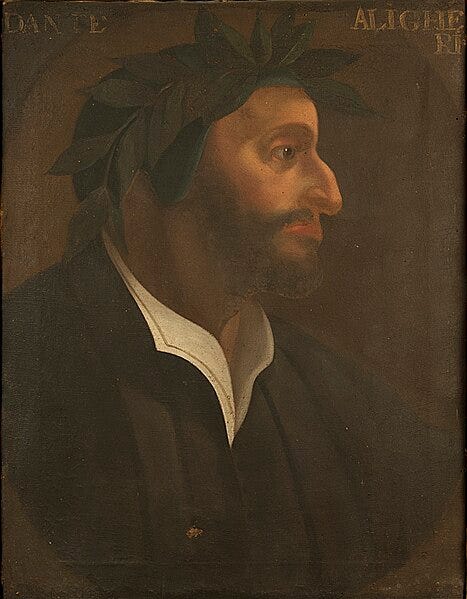
About the text: Dante Alighieri (c. 1265-1321) was the first to write extensively in an Italian dialect and is therefore considered the father of Italian literature and a precursor of the Italian Renaissance. Deeply indebted to his early contemporary Thomas Aquinas both philosophically and theologically, Dante’s Divine Comedy follows in the tradition of Vergil, who serves as his guide through hell and purgatory. In cantos X through XII, Dante is led through the first circle of Mount Purgatory where he meets those being cleansed of pride by carrying great stones up the mountain.
Canto X
When we had crossed the threshold of the door
Which the perverted love of souls disuses,
Because it makes the crooked way seem straight,
Re-echoing I heard it closed again;
And if I had turned back mine eyes upon it,
What for my failing had been fit excuse?
We mounted upward through a rifted rock,
Which undulated to this side and that,
Even as a wave receding and advancing.
“Here it behoves us use a little art,”
Began my Leader, “to adapt ourselves
Now here, now there, to the receding side.”
And this our footsteps so infrequent made,
That sooner had the moon’s decreasing disk
Regained its bed to sink again to rest,
Than we were forth from out that needle’s eye;
But when we free and in the open were,
There where the mountain backward piles itself,
I wearied out, and both of us uncertain
About our way, we stopped upon a plain
More desolate than roads across the deserts.
From where its margin borders on the void,
To foot of the high bank that ever rises,
A human body three times told would measure;
And far as eye of mine could wing its flight,
Now on the left, and on the right flank now,
The same this cornice did appear to me.
Thereon our feet had not been moved as yet,
When I perceived the embankment round about,
Which all right of ascent had interdicted,
To be of marble white, and so adorned
With sculptures, that not only Polycletus,
But Nature’s self, had there been put to shame.
The Angel, who came down to earth with tidings
Of peace, that had been wept for many a year,
And opened Heaven from its long interdict,
In front of us appeared so truthfully
There sculptured in a gracious attitude,
He did not seem an image that is silent.
One would have sworn that he was saying, “Ave;”
For she was there in effigy portrayed
Who turned the key to ope the exalted love,
And in her mien this language had impressed,
“Ecce ancilla Dei,” as distinctly
As any figure stamps itself in wax.
“Keep not thy mind upon one place alone,”
The gentle Master said, who had me standing
Upon that side where people have their hearts;
Whereat I moved mine eyes, and I beheld
In rear of Mary, and upon that side
Where he was standing who conducted me,
Another story on the rock imposed;
Wherefore I passed Virgilius and drew near,
So that before mine eyes it might be set.
There sculptured in the self-same marble were
The cart and oxen, drawing the holy ark,
Wherefore one dreads an office not appointed.
People appeared in front, and all of them
In seven choirs divided, of two senses
Made one say “No,” the other, “Yes, they sing.”
Likewise unto the smoke of the frankincense,
Which there was imaged forth, the eyes and nose
Were in the yes and no discordant made.
Preceded there the vessel benedight,
Dancing with girded loins, the humble Psalmist,
And more and less than King was he in this.
Opposite, represented at the window
Of a great palace, Michal looked upon him,
Even as a woman scornful and afflicted.
I moved my feet from where I had been standing,
To examine near at hand another story,
Which after Michal glimmered white upon me.
There the high glory of the Roman Prince
Was chronicled, whose great beneficence
Moved Gregory to his great victory;
’Tis of the Emperor Trajan I am speaking;
And a poor widow at his bridle stood,
In attitude of weeping and of grief.
Around about him seemed it thronged and full
Of cavaliers, and the eagles in the gold
Above them visibly in the wind were moving.
The wretched woman in the midst of these
Seemed to be saying: “Give me vengeance, Lord,
For my dead son, for whom my heart is breaking.”
And he to answer her: “Now wait until
I shall return.” And she: “My Lord,” like one
In whom grief is impatient, “shouldst thou not
Return?” And he: “Who shall be where I am
Will give it thee.” And she: “Good deed of others
What boots it thee, if thou neglect thine own?”
Whence he: “Now comfort thee, for it behoves me
That I discharge my duty ere I move;
Justice so wills, and pity doth retain me.”
He who on no new thing has ever looked
Was the creator of this visible language,
Novel to us, for here it is not found.
While I delighted me in contemplating
The images of such humility,
And dear to look on for their Maker’s sake,
“Behold, upon this side, but rare they make
Their steps,” the Poet murmured, “many people;
These will direct us to the lofty stairs.”
Mine eyes, that in beholding were intent
To see new things, of which they curious are,
In turning round towards him were not slow.
But still I wish not, Reader, thou shouldst swerve
From thy good purposes, because thou hearest
How God ordaineth that the debt be paid;
Attend not to the fashion of the torment,
Think of what follows; think that at the worst
It cannot reach beyond the mighty sentence.
“Master,” began I, “that which I behold
Moving towards us seems to me not persons,
And what I know not, so in sight I waver.”
And he to me: “The grievous quality
Of this their torment bows them so to earth,
That my own eyes at first contended with it;
But look there fixedly, and disentangle
By sight what cometh underneath those stones;
Already canst thou see how each is stricken.”
O ye proud Christians! wretched, weary ones!
Who, in the vision of the mind infirm
Confidence have in your backsliding steps,
Do ye not comprehend that we are worms,
Born to bring forth the angelic butterfly
That flieth unto judgment without screen?
Why floats aloft your spirit high in air?
Like are ye unto insects undeveloped,
Even as the worm in whom formation fails!
As to sustain a ceiling or a roof,
In place of corbel, oftentimes a figure
Is seen to join its knees unto its breast,
Which makes of the unreal real anguish
Arise in him who sees it, fashioned thus
Beheld I those, when I had ta’en good heed.
True is it, they were more or less bent down,
According as they more or less were laden;
And he who had most patience in his looks
Weeping did seem to say, “I can no more!”
Canto XI
“Our Father, thou who dwellest in the heavens,
Not circumscribed, but from the greater love
Thou bearest to the first effects on high,
Praised be thy name and thine omnipotence
By every creature, as befitting is
To render thanks to thy sweet effluence.
Come unto us the peace of thy dominion,
For unto it we cannot of ourselves,
If it come not, with all our intellect.
Even as thine own Angels of their will
Make sacrifice to thee, Hosanna singing,
So may all men make sacrifice of theirs.
Give unto us this day our daily manna,
Withouten which in this rough wilderness
Backward goes he who toils most to advance.
And even as we the trespass we have suffered
Pardon in one another, pardon thou
Benignly, and regard not our desert.
Our virtue, which is easily o’ercome,
Put not to proof with the old Adversary,
But thou from him who spurs it so, deliver.
This last petition verily, dear Lord,
Not for ourselves is made, who need it not,
But for their sake who have remained behind us.”
Thus for themselves and us good furtherance
Those shades imploring, went beneath a weight
Like unto that of which we sometimes dream,
Unequally in anguish round and round
And weary all, upon that foremost cornice,
Purging away the smoke-stains of the world.
If there good words are always said for us,
What may not here be said and done for them,
By those who have a good root to their will?
Well may we help them wash away the marks
That hence they carried, so that clean and light
They may ascend unto the starry wheels!
“Ah! so may pity and justice you disburden
Soon, that ye may have power to move the wing,
That shall uplift you after your desire,
Show us on which hand tow’rd the stairs the way
Is shortest, and if more than one the passes,
Point us out that which least abruptly falls;
For he who cometh with me, through the burden
Of Adam’s flesh wherewith he is invested,
Against his will is chary of his climbing.”
The words of theirs which they returned to those
That he whom I was following had spoken,
It was not manifest from whom they came,
But it was said: “To the right hand come with us
Along the bank, and ye shall find a pass
Possible for living person to ascend.
And were I not impeded by the stone,
Which this proud neck of mine doth subjugate,
Whence I am forced to hold my visage down,
Him, who still lives and does not name himself,
Would I regard, to see if I may know him
And make him piteous unto this burden.
A Latian was I, and born of a great Tuscan;
Guglielmo Aldobrandeschi was my father;
I know not if his name were ever with you.
The ancient blood and deeds of gallantry
Of my progenitors so arrogant made me
That, thinking not upon the common mother,
All men I held in scorn to such extent
I died therefor, as know the Sienese,
And every child in Campagnatico.
I am Omberto; and not to me alone
Has pride done harm, but all my kith and kin
Has with it dragged into adversity.
And here must I this burden bear for it
Till God be satisfied, since I did not
Among the living, here among the dead.”
Listening I downward bent my countenance;
And one of them, not this one who was speaking,
Twisted himself beneath the weight that cramps him,
And looked at me, and knew me, and called out,
Keeping his eyes laboriously fixed
On me, who all bowed down was going with them.
“O,” asked I him, “art thou not Oderisi,
Agobbio’s honour, and honour of that art
Which is in Paris called illuminating?”
“Brother,” said he, “more laughing are the leaves
Touched by the brush of Franco Bolognese;
All his the honour now, and mine in part.
In sooth I had not been so courteous
While I was living, for the great desire
Of excellence, on which my heart was bent.
Here of such pride is paid the forfeiture;
And yet I should not be here, were it not
That, having power to sin, I turned to God.
O thou vain glory of the human powers,
How little green upon thy summit lingers,
If’t be not followed by an age of grossness!
In painting Cimabue thought that he
Should hold the field, now Giotto has the cry,
So that the other’s fame is growing dim.
So has one Guido from the other taken
The glory of our tongue, and he perchance
Is born, who from the nest shall chase them both.
Naught is this mundane rumour but a breath
Of wind, that comes now this way and now that,
And changes name, because it changes side.
What fame shalt thou have more, if old peel off
From thee thy flesh, than if thou hadst been dead
Before thou left the ‘pappo’ and the ‘dindi,’
Ere pass a thousand years? which is a shorter
Space to the eterne, than twinkling of an eye
Unto the circle that in heaven wheels slowest.
With him, who takes so little of the road
In front of me, all Tuscany resounded;
And now he scarce is lisped of in Siena,
Where he was lord, what time was overthrown
The Florentine delirium, that superb
Was at that day as now ’tis prostitute.
Your reputation is the colour of grass
Which comes and goes, and that discolours it
By which it issues green from out the earth.”
And I: “Thy true speech fills my heart with good
Humility, and great tumour thou assuagest;
But who is he, of whom just now thou spakest?”
“That,” he replied, “is Provenzan Salvani,
And he is here because he had presumed
To bring Siena all into his hands.
He has gone thus, and goeth without rest
E’er since he died; such money renders back
In payment he who is on earth too daring.”
And I: “If every spirit who awaits
The verge of life before that he repent,
Remains below there and ascends not hither,
(Unless good orison shall him bestead,)
Until as much time as he lived be passed,
How was the coming granted him in largess?”
“When he in greatest splendour lived,” said he,
“Freely upon the Campo of Siena,
All shame being laid aside, he placed himself;
And there to draw his friend from the duress
Which in the prison-house of Charles he suffered,
He brought himself to tremble in each vein.
I say no more, and know that I speak darkly;
Yet little time shall pass before thy neighbours
Will so demean themselves that thou canst gloss it.
This action has released him from those confines.”
Canto XII
Abreast, like oxen going in a yoke,
I with that heavy-laden soul went on,
As long as the sweet pedagogue permitted;
But when he said, “Leave him, and onward pass,
For here ’tis good that with the sail and oars,
As much as may be, each push on his barque;”
Upright, as walking wills it, I redressed
My person, notwithstanding that my thoughts
Remained within me downcast and abashed.
I had moved on, and followed willingly
The footsteps of my Master, and we both
Already showed how light of foot we were,
When unto me he said: “Cast down thine eyes;
’Twere well for thee, to alleviate the way,
To look upon the bed beneath thy feet.”
As, that some memory may exist of them,
Above the buried dead their tombs in earth
Bear sculptured on them what they were before;
Whence often there we weep for them afresh,
From pricking of remembrance, which alone
To the compassionate doth set its spur;
So saw I there, but of a better semblance
In point of artifice, with figures covered
Whate’er as pathway from the mount projects.
I saw that one who was created noble
More than all other creatures, down from heaven
Flaming with lightnings fall upon one side.
I saw Briareus smitten by the dart
Celestial, lying on the other side,
Heavy upon the earth by mortal frost.
I saw Thymbraeus, Pallas saw, and Mars,
Still clad in armour round about their father,
Gaze at the scattered members of the giants.
I saw, at foot of his great labour, Nimrod,
As if bewildered, looking at the people
Who had been proud with him in Sennaar.
O Niobe! with what afflicted eyes
Thee I beheld upon the pathway traced,
Between thy seven and seven children slain!
O Saul! how fallen upon thy proper sword
Didst thou appear there lifeless in Gilboa,
That felt thereafter neither rain nor dew!
O mad Arachne! so I thee beheld
E’en then half spider, sad upon the shreds
Of fabric wrought in evil hour for thee!
O Rehoboam! no more seems to threaten
Thine image there; but full of consternation
A chariot bears it off, when none pursues!
Displayed moreo’er the adamantine pavement
How unto his own mother made Alcmaeon
Costly appear the luckless ornament;
Displayed how his own sons did throw themselves
Upon Sennacherib within the temple,
And how, he being dead, they left him there;
Displayed the ruin and the cruel carnage
That Tomyris wrought, when she to Cyrus said,
“Blood didst thou thirst for, and with blood I glut thee!”
Displayed how routed fled the Assyrians
After that Holofernes had been slain,
And likewise the remainder of that slaughter.
I saw there Troy in ashes and in caverns;
O Ilion! thee, how abject and debased,
Displayed the image that is there discerned!
Whoe’er of pencil master was or stile,
That could portray the shades and traits which there
Would cause each subtile genius to admire?
Dead seemed the dead, the living seemed alive;
Better than I saw not who saw the truth,
All that I trod upon while bowed I went.
Now wax ye proud, and on with looks uplifted,
Ye sons of Eve, and bow not down your faces
So that ye may behold your evil ways!
More of the mount by us was now encompassed,
And far more spent the circuit of the sun,
Than had the mind preoccupied imagined,
When he, who ever watchful in advance
Was going on, began: “Lift up thy head,
’Tis no more time to go thus meditating.
Lo there an Angel who is making haste
To come towards us; lo, returning is
From service of the day the sixth handmaiden.
With reverence thine acts and looks adorn,
So that he may delight to speed us upward;
Think that this day will never dawn again.”
I was familiar with his admonition
Ever to lose no time; so on this theme
He could not unto me speak covertly.
Towards us came the being beautiful
Vested in white, and in his countenance
Such as appears the tremulous morning star.
His arms he opened, and opened then his wings;
“Come,” said he, “near at hand here are the steps,
And easy from henceforth is the ascent.”
At this announcement few are they who come!
O human creatures, born to soar aloft,
Why fall ye thus before a little wind?
He led us on to where the rock was cleft;
There smote upon my forehead with his wings,
Then a safe passage promised unto me.
As on the right hand, to ascend the mount
Where seated is the church that lordeth it
O’er the well-guided, above Rubaconte,
The bold abruptness of the ascent is broken
By stairways that were made there in the age
When still were safe the ledger and the stave,
E’en thus attempered is the bank which falls
Sheer downward from the second circle there;
But on this, side and that the high rock graze.
As we were turning thitherward our persons,
“Beati pauperes spiritu,” voices
Sang in such wise that speech could tell it not.
Ah me! how different are these entrances
From the Infernal! for with anthems here
One enters, and below with wild laments.
We now were hunting up the sacred stairs,
And it appeared to me by far more easy
Than on the plain it had appeared before.
Whence I: “My Master, say, what heavy thing
Has been uplifted from me, so that hardly
Aught of fatigue is felt by me in walking?”
He answered: “When the P’s which have remained
Still on thy face almost obliterate
Shall wholly, as the first is, be erased,
Thy feet will be so vanquished by good will,
That not alone they shall not feel fatigue,
But urging up will be to them delight.”
Then did I even as they do who are going
With something on the head to them unknown,
Unless the signs of others make them doubt,
Wherefore the hand to ascertain is helpful,
And seeks and finds, and doth fulfill the office
Which cannot be accomplished by the sight;
And with the fingers of the right hand spread
I found but six the letters, that had carved
Upon my temples he who bore the keys;
Upon beholding which my Leader smiled.
From The Divine Comedy of Dante Alighieri, translated by Henry Wadsworth Longfellow