

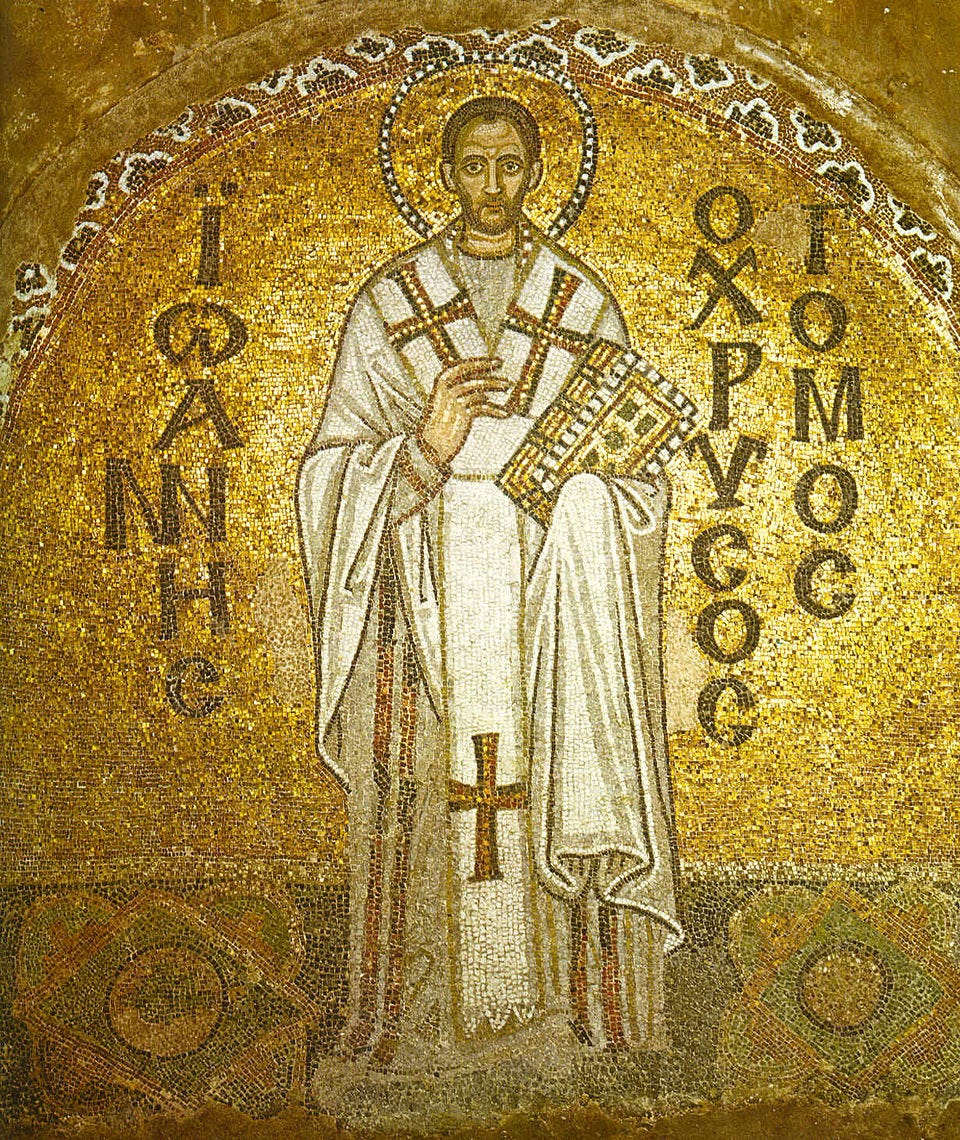
About the text: John Chrysostom (c. 347–407) — so surnamed for his erudite preaching, spent many years as a monk in the Syrian desert meditating on and memorising the New Testament. As Patriarch of Constantinople, those meditations took on flesh in the numerous sermons preached on nearly every book of the New Testament. The first sermon presented here addresses Christ’s model of humility in taking on a human nature—we’ve left out the second half of the sermon since it addresses avarice and the reality of hell rather than humility. The second sermon in turn focuses on Christ’s example in washing the feet not simply of his disciples but of the traitor Judas; so also should we humble ourselves but also do good to those who betray us.
Sermon 6 on Philippians
“Have this mind in you, which was also in Christ Jesus: who, being in the form of God, counted it not a prize to be on an equality with God, but emptied Himself, taking the form of a servant, being made in the likeness of men; and being found in fashion as a man, He humbled Himself, becoming obedient even unto death, yea, the death of the cross.” (Phil 2:5–8)
Our Lord Jesus Christ, when exhorting His disciples to great actions, places before them Himself, and the Father, and the Prophets, as examples; as when He says, “For thus they did unto the Prophets which were before you” (Mt 5:12; Lk 6:23); and again, “If they persecuted Me, they will also persecute you” (Jn 15:20); and, “Learn of me, for I am meek” (Mt 11:29); and again, “Be merciful, as your Father which is in heaven is merciful” (Lk 6:36). This too the blessed Paul did; in exhorting them to humility, he brought forward Christ. And he does so not here only, but also when he discourses of love towards the poor, he speaks in this wise. “For you know the grace of our Lord Jesus Christ, that though He was rich, yet for your sakes He became poor” (2 Cor 8:9). Nothing rouses a great and philosophic soul to the performance of good works, so much as learning that in this it is likened to God. What encouragement is equal to this? None. This Paul well knowing, when he would exhort them to humility, first beseeches and supplicates them, then to awe them he says, “That ye stand fast in one Spirit”; he says also, that it “is for them an evident token of perdition, but of your salvation” (Phil 1:27–28). And last of all he says this, “Have this mind in you, which was also in Christ Jesus, who, being in the form of God, counted it not a prize to be on an equality with God, but emptied Himself, taking upon Him the form of a servant” (Phil 2:5–7). Attend, I entreat you, and rouse yourselves. For as a sharp two-edged sword, wheresoever it falls, though it be among ten thousand phalanxes, easily cuts through and destroys, because it is sharp on every side, and nought can bear its edge; so are the words of the Spirit (Heb 4:12; Rv 1:16). For by these words he has laid low the followers of Arius of Alexandria, of Paul of Samosata, of Marcellus the Galatian, of Sabellius the Libyan, of Marcion that was of Pontus, of Valentinus, of Manes, of Apollinarius of Laodicea, of Photinus, of Sophronius, and, in one word, all the heresies. Rouse yourselves then to behold so great a spectacle, so many armies falling by one stroke, lest the pleasure of such a sight should escape you. For if when chariots contend in the horse race there is nothing so pleasing as when one of them dashes against and overthrows whole chariots with their drivers, and after throwing down many with the charioteers that stood thereon, drives by alone towards the goal, and the end of the course, and amid the applause and clamor which rises on all sides to heaven, with coursers winged as it were by that joy and that applause, sweeps over the whole ground; how much greater will the pleasure be here, when by the grace of God we overthrow at once and in a body the combinations and devilish machinations of all these heresies together with their charioteers?
And if it seem good to you, we will first arrange the heresies themselves in order. Would you have them in the order of their impiety, or of their dates? In the order of time, for it is difficult to judge of the order of their impiety. First then let Sabellius the Libyan come forward. What does he assert? That the Father, Son, and Holy Spirit, are mere names given to one Person. Marcion of Pontus says, that God the Creator of all things is not good, nor the Father of the good Christ, but another righteous one, and that he did not take flesh for us. Marcellus, and Photinus, and Sophronius assert, that the Word is an energy, and that it was this energy that dwelt in Him who was of the seed of David, and not a personal substance.
Arius confesses indeed the Son, but only in word; he says that He is a creature, and much inferior to the Father. And others say that He has not a soul. Do you see the chariots standing? See then their fall, how he overthrows them all together, and with a single stroke. How? “Have the same mind in you,” he says, “which was in Christ Jesus, who being in the form of God, counted it not a prize to be on an equality with God.” And Paul of Samosata has fallen, and Marcellus, and Sabellius. For he says, “Being in the form of God.” If “in the form” how do you say, O wicked one, that He took His origin from Mary, and was not before? And how do you say that He was an energy? For it is written, “The form of God took the form of a servant.” “The form of a servant,” is it the energy of a servant, or the nature of a servant? By all means, I fancy, the nature of a servant. Thus too the form of God, is the nature of God, and therefore not an energy. Behold also Marcellus of Galatia, Sophronius and Photinus have fallen.
Behold Sabellius too. It is written, “He counted it not a prize to be on an equality with God.” Now equality is not predicated, where there is but one person, for that which is equal has somewhat to which it is equal. Do you see not the substance of two Persons, and not empty names without things? Do you not hear the eternal pre-existence of the Only-begotten?
Lastly, What shall we say against Arius, who asserts the Son is of a different substance? Tell me now, what means, “He took the form of a servant”? It means, He became man. Wherefore “being in the form of God,” He was God. For one “form” and another “form” is named; if the one be true, the other is also. “The form of a servant” means, Man by nature, wherefore “the form of God” means, God by nature. And he not only bears record of this, but of His equality too, as John also does, that he is no way inferior to the Father, for he says, “He thought it not a thing to seize, to be equal with God.” Now what is their wise reasoning? Nay, say they, he proves the very contrary; for he says, that, “being in the form of God, He seized not equality with God.” How if He were God, how was He able “to seize upon it”? And is not this without meaning? Who would say that one, being a man, seized not on being a man? For how would any one seize on that which he is? No, say they, but he means that being a little God, He seized not upon being equal to the great God, Who was greater than He. Is there a great and a little God? And do ye bring in the doctrines of the Greeks upon those of the Church? With them there is a great and a little God. If it be so with you, I know not. For you will find it nowhere in the Scriptures: there you will find a great God throughout, a little one nowhere. If He were little, how would he also be God? If man is not little and great, but one nature, and if that which is not of this one nature is not man, how can there be a little God and a great one?
He who is not of that nature is not God. For He is everywhere called great in Scripture; “Great is the Lord, and highly to be praised” (Ps 48:1). This is said of the Son also, for it always calls Him Lord. “You are great, and doest wondrous things. You are God alone” (Ps 86:10). And again, “Great is our Lord, and great is His power, and of His greatness there is no end” (Ps 145:3).
But the Son, he says, is little. But it is thou that sayest this, for the Scripture says the contrary: as of the Father, so it speaks of the Son; for listen to Paul, saying, “Looking for the blessed hope, and appearing of the glory of our great God” (Tit 2:13). But can he have said “appearing” of the Father? Nay, that he may the more convince you, he has added with reference to the appearing “of the great God.” Is it then not said of the Father? By no means. For the sequel suffers it not which says, “The appearing of our great God and Saviour Jesus Christ.” See, the Son is great also. How then do you speak of small and great?
Listen to the Prophet too, calling him “The Messenger of great counsel” (Is 9:6). “The Messenger of great counsel,” is He not great Himself? “The mighty God,” is He small and not great? What mean then these shameless and reckless men when they say, that being little He is a God? I repeat ofttimes what they say, that you may the more avoid them. He being a lesser God seized not for Himself to be like the greater God! Tell me now (but think not that these words are mine), if he were little, as they say, and far inferior to the Father in power, how could He possibly have seized to Himself equality with God? For an inferior nature could not seize for himself admission into that which is great; for example, a man could not seize on becoming equal to an angel in nature; a horse could not, though he wished it, seize on being equal to a man in nature. But besides all that, I will say this too. What does Paul wish to establish by this example? Surely, to lead the Philippians to humility. To what purpose then did he bring forward this example? For no one who would exhort to humility speaks thus; “Be thou humble, and think less of yourself than of your equals in honor, for such an one who is a slave has not risen against his master; do thou imitate him.” This, any one would say, is not humility, but arrogance. Learn ye what humility is, you who have a devilish pride! What then is humility? To be lowly minded. And he is lowly minded who humbles himself, not he who is lowly by necessity. To explain what I say; and do ye attend; he who is lowly minded, when he has it in his power to be high minded, is humble, but he who is so because he is not able to be high minded, is no longer humble. For instance, If a King subjects himself to his own officer, he is humble, for he descends from his high estate; but if an officer does so, he will not be lowly minded; for how? He has not humbled himself from any high estate. It is not possible to show humble-mindedness except it be in our power to do otherwise. For if it is necessary for us to be humble even against our will, that excellency comes not from the spirit or the will, but from necessity. This virtue is called humble-mindedness, because it is the humbling of the mind.
If he who has it not in his power to snatch at another’s goods, continues in the possession of his own; should we praise him, think you, for his justice? I trow not, and why? The praise of free choice is taken away by the necessity. If he, who has it not in his power to usurp and be a king, remains a private citizen, should we praise him for his quietness? I trow not. The same rule applies here. For praise, O you most senseless ones, is not given for abstaining from these things, but for the performance of good deeds; for the former is free indeed from blame, but partakes not yet of praise, while eulogy of the other is meet. Observe accordingly that Christ gives praise on this principle, when He says, “Come, you blessed of My Father, inherit the kingdom prepared for you from the foundation of the world. For I was an hungered, and you gave Me meat; I was thirsty, and you gave Me drink” (Mt 25:34–35). He did not say, Because you have not been covetous, because you have not robbed; these are slight things; but because “ye saw Me an hungered, and fed Me.” Who ever praised either his friends or his enemies in this sort? No one ever praised even Paul. Why say Paul? No one ever praised even a common man, as thou dost praise Christ, because he did not take that rule which was not his due. To admire for such things as this, is to give evidence of much evil. And why? Because with evil men this is a matter of praise, as of one that steals, if he steal no more; but it is otherwise among good men (Eph 4:28). Because a man has not seized on a rule and an honor which was not his due, is he praiseworthy? What folly is this?
Attend, I entreat you, for the reasoning is long. Again, who would ever exhort to humility from such grounds as this? Examples ought to be much greater than the subject, to which we are exhorting, for no one will be moved by what is foreign to the subject. For instance, when Christ would lead us to do good to our enemies, He brought a great example, even that of His Father, “For He makes His sun to rise on the evil and the good, and sends rain on the just and the unjust” (Mt 5:45). When He would lead to endurance of wrong He brought an example, “Learn of Me, for I am meek and lowly in heart” (Mt 11:29). And again, “If I your Lord and Master do these things, how much more should ye” (Jn 13:14)? Do you see how these examples are not distant, for there is no need they should be so distant, for indeed we also do these things, especially as in this case the example is not even near. And how? If He be a servant, He is inferior, and subject to Him that is greater; but this is not lowliness of mind. It was requisite to show the contrary, namely, that the greater person subjected himself to the lesser. But since he found not this distinction in the case of God, between greater and lesser, he made at least an equality. Now if the Son were inferior, this were not a sufficient example to lead us to humility. And why? Because it is not humility, for the lesser not to rise against the greater, not to snatch at rule, and to be “obedient unto death.”
Again, consider what he says after the example, “In lowliness of mind, each counting others better than themselves” (Phil 2:3). He says, “counting,” for as you are one in substance, and in the honor which comes of God, it follows that the matter is one of estimation. Now in the case of those who are greater and lesser, he would not have said “counting,” but honor them that are better than yourselves, as he says in another place, “Obey them that have the rule over you, and submit to them” (Heb 13:17). In that instance subjection is the result of the nature of the case, in this of our own judgment. “In lowliness of mind,” he says, “each counting others better than themselves,” as Christ also did.
Thus are their explanations overthrown. It remains that I speak of our own after I have first spoken of theirs summarily. When exhorting to lowliness of mind, Paul would never have brought forward a lesser one, as obedient to a greater. If he were exhorting servants to obey their masters, he might have done so with propriety, but when exhorting the free to obey the free, to what purpose could he bring forward the subjection of a servant to a master? Of a lesser to a greater? He says not, “Let the lesser be subject to the greater,” but you who are of equal honor with each other be ye subject, “each counting others better than themselves.” Why then did he not bring forward even the obedience of the wife, and say, As the wife obeys her husband, so do ye also obey. Now if he did not bring forward that state in which there is equality and liberty, since in that the subjection is but slight, how much less would he have brought forward the subjection of a slave? I said above, that no one so praises a man for abstaining from evil, nor even mentions him at all; no one who desires to praise a man for continence would say, he has not committed adultery, but, he has abstained from his own wife; for we do not consider abstinence from evil as a matter of praise at all, it would be ridiculous.
I said that the “form of a servant” was a true form, and nothing less. Therefore “the form of God” also is perfect, and no less. Why says he not, “being made in the form of God,” but “being in the form of God”? This is the same as the saying, “I am that I am” (Ex 3:14). “Form” implies unchangeableness, so far as it is form. It is not possible that things of one substance should have the form of another, as no man has the form of an angel, neither has a beast the form of a man. How then should the Son?
Now in our own case, since we men are of a compound nature, form pertains to the body, but in the case of a simple and altogether uncompounded nature it is of the substance. But if you contend that he speaks not of the Father, because the word is used without the article, in many places this is meant, though the word be used without the article. Why say I, in many places? For in this very place he says, “He counted it not a prize to be on an equality with God,” using the word without the article, though speaking of God the Father.
I would add our own explanation, but I fear that I shall overwhelm your minds. Meanwhile remember what has been said for their refutation; meanwhile let us root out the thorns, and then we will scatter the good seed after that the thorns have been rooted out, and a little rest has been given to the land; that when rid of all the evil thence contracted, it may receive the divine seed with full virtue.
Sermon 71 on John’s Gospel
“And He took His garments, and having sat down again, said to them, Know ye what I have done to you?” (Jn 13:1) And what follows.
1. A grievous thing, beloved, a grievous thing it is to come to the depths of wickedness; for then the soul becomes hard to be restored. Wherefore we should use every exertion not to be taken at all; since it is easier not to fall in, than having fallen to recover one’s self. Observe, for instance, when Judas had thrown himself into sin, how great assistance he enjoyed, yet not even so was he raised. Christ said to him, “One of you is a devil” (Jn 6:71); He said, “Not all believe” (Jn 6:65); He said, “I speak not of all,” and, “I know whom I have chosen” (Jn 13:18); and not one of these sayings does he feel. Now when He had washed their feet, and taken His garments, and sat down, He said, “Know ye what I have done unto you?” He no longer addresses Himself to Peter only, but to them all.
“You call Me Lord and Master, and you say well, for so I am” (Jn 13:13).
“You call Me.” He takes to Him their judgment, and then that the words may not be thought to be words of their kindness, He adds, “for so I am.” By introducing a saying of theirs, He makes it not offensive, and by confirming it Himself when introduced from them, unsuspected. “For so I am,” He says. Do you see how when He converses with the disciples, He speaks revealing more what belongs unto Himself? As He says, “Call no man master on earth, for One is your guide” (Mt 23:8–9), so also, “And call no man father upon earth.” But the “one” and “one” is spoken not of the Father only, but of Himself also. For had He spoken excluding Himself, how says He, “That ye may become the children of the light”? And again, if He called the Father only, “Master,” how says He, “For so I am”; and again, “For one is your Guide, even Christ” (Jn 12:26)?
“If I then,” He says, “your Lord and Master have washed your feet, you ought also to wash one another’s feet. For I have given you an example, that you should do as I have done to you.” (Jn 13:14–15)
And yet it is not the same thing, for He is Lord and Master, but you are fellow-servants one of another. What means then the “as”? “With the same zeal.” For on this account He takes instances from greater actions that we may, if so be, perform the less. Thus schoolmasters write the letters for children very beautifully, that they may come to imitate them though but in an inferior manner. Where now are they who spit on their fellow-servants? Where now they who demand honors? Christ washed the feet of the traitor, the sacrilegious, the thief, and that close to the time of the betrayal, and incurable as he was, made him a partaker of His table; and are you highminded, and do you draw up your eyebrows? “Let us then wash one another’s feet,” says some one, “then we must wash those of our domestics.” And what great thing if we do wash even those of our domestics? In our case “slave” and “free” is a difference of words; but there an actual reality. For by nature He was Lord and we servants, yet even this He refused not at this time to do. But now it is matter for contentment if we do not treat free men as bondmen, as slaves bought with money. And what shall we say in that day, if after receiving proofs of such forbearance, we ourselves do not imitate them at all, but take the contrary part, being in diametrical opposition, lifted up, and not discharging the debt? For God has made us debtors one to another, having first so done Himself, and has made us debtors of a less amount. For He was our Lord, but we do it, if we do it at all, to our fellow-servants, a thing which He Himself implied by saying, “If I then your Lord and Master — so also do ye.” It would indeed naturally have followed to say, “How much more should ye servants,” but He left this to the conscience of the hearers.
2. But why has He done this “now”? They were for the future to enjoy, some greater, some less honor. In order then that they may not exalt themselves one above the other, and say as they did before, “Who is the greatest” (Mt 18:1), nor be angry one against the other, He takes down the high thoughts of them all, by saying, that “although you may be very great, you ought to have no high thoughts towards your brother.” And He mentioned not the greater action, that “if I have washed the feet of the traitor, what great matter if you one another’s?” but having exemplified this by deeds, He then left it to the judgment of the spectators. Therefore He said, “Whosoever shall do and teach, the same shall be called great” (Mt 5:19); for this is “to teach” a thing, actually to do it. What pride should not this remove? What kind of folly and insolence should it not annihilate! He who sits upon the Cherubim washed the feet of the traitor, and do you, O man, you that are earth and ashes and cinders and dust, do you exalt yourself, and are you highminded? And how great a hell would you not deserve? If then you desire a high state of mind, come, I will show you the way to it; for thou dost not even know what it is. The man then who gives heed to the present things as being great, is of a mean soul; so that there can neither be humility without greatness of soul, nor conceit except from littleness of soul. For as little children are eager for trifles, gaping upon balls and hoops and dice, but cannot even form an idea of important matters; so in this case, one who is truly wise, will deem present things as nothing, (so that he will neither choose to acquire them himself, nor to receive them from others;) but he who is not of such a character will be affected in a contrary way, intent upon cobwebs and shadows and dreams of things less substantial than these.
“Verily I say unto you, the servant is not greater than his lord, neither he that is sent greater than he that sent him. If you know these things, happy are you if you do them. I speak not of you all — but that the Scripture may be fulfilled, He that eats bread with Me has lifted up his heel against Me.” (Jn 13:16–18)
What He said before, this He says here also, to shame them; “For if the servant is not greater than his master, nor he that is sent greater than him that sent him, and these things have been done by Me, much more ought they to be done by you.” Then, lest any one should say, “Why now do You say these things? Do we not already know them?” He adds this very thing, “I speak not to you as not knowing, but that by your actions ye may show forth the things spoken of.” For “to know,” belongs to all; but “to do,” not to all. On this account He said, “Blessed are you if you do them”; and on this account I continually and ever say the same to you, although ye know it, that I may set you on the work. Since even Jews “know,” but yet they are not “blessed”; for they do not what they know.
“I speak not,” He says, “of you all.” O what forbearance! Not yet does He convict the traitor, but veils the matter, hence giving him room for repentance. He convicts and yet does not convict him when He says thus, “He that eats bread with Me has lifted up his heel against Me.” It seems to me that the, “The servant is not greater than his lord,” was uttered for this purpose also, that if any persons should at any time suffer harm either from domestics or from any of the meaner sort, they should not be offended; looking to the instance of Judas, who having enjoyed ten thousand good things, repaid his Benefactor with the contrary. On this account He added, “He that eats bread with Me,” and letting pass all the rest, He has put that which was most fitted to restrain and shame him; “he who was fed by Me,” He says, “and who shared My table.” And He spoke the words, to instruct them to benefit those who did evil to them, even though such persons should continue incurable.
But having said, “I speak not of you all,” in order not to attach fear to more than one, He at last separates the traitor, speaking thus; “He that eats bread with Me.” For the, “not of you all,” does not direct the words to any single one, therefore He added, “He that eats bread with Me”; showing to that wretched one that He was not seized in ignorance, but even with full knowledge; a thing which of itself was most of all fitted to restrain him. And He said not, “betrays Me,” but, “has lifted up his heel against Me,” desiring to represent the deceit, the treachery, the secrecy of the plot.
3. These things are written that we bear not malice towards those who injure us; but rebuke them and weep for them; for the fit subjects of weeping are not they who suffer, but they who do the wrong. The grasping man, the false accuser, and whoever works any other evil thing, do themselves the greatest injury, and us the greatest good, if we do not avenge ourselves. Such a case as this: some one has robbed you; have you given thanks for the injury, and glorified God? By that thanksgiving you have gained ten thousand rewards, just as he has gathered for himself fire unspeakable. But if any one say, “How then, if I ‘could’ not defend myself against him who wronged me, being weaker?” I would say this, that you could have put into action the being discontented, the being impatient, (for these things are in our power,) the praying against him, who grieved you, the uttering ten thousand curses against him, the speaking ill of him to every one. He therefore who has not done these things shall even be rewarded for not defending himself, since it is clear that even if he had had the power, he would not have done it. The injured man uses any weapon that comes to hand, when, being little of soul, he defends himself against one who has injured him, by curses, by abuse, by plotting. Do thou then not only not do these things, but even pray for him; for if you do them not, but will even pray for him, you have become like God. For, “pray,” it says, “for them, that despitefully use you — that you may be like your Father which is in Heaven” (Mt 5:44–45). Do you see how we are the greatest gainers from the insolence of others? Nothing so delights God, as the not returning evil for evil? But what say I? Not returning evil for evil? Surely we are enjoined to return the opposite, benefits, prayers. Wherefore Christ also repaid him who was about to betray Him with everything opposite. He washed his feet, convicted him secretly, rebuked him sparingly, tended him, allowed him to share His table and His kiss, and not even by these was he made better; nevertheless he continued doing his own part.
But come, let us teach you even from the example of servants, and to make the lesson stronger those in the Old Testament, that you may know that we have no ground of defense when we remember a wrong. Will you then that I tell you of Moses, or shall we go yet farther back? For the more ancient the instances that can be pointed out, the more are we surpassed. “Why so?” Because virtue was then more difficult. Those men had no written precepts, no patterns of living, but their nature fought, unarmed, by itself, and was forced to float in all directions unballasted. Wherefore also when praising Noah, God called him not simply perfect, but added, “in his generation” (Gn 7:1); signifying, “at that time,” when there were many hindrances, since many others shone after him, yet will he have nothing less than they; for in his own time he was perfect. Who then before Moses was patient? The blessed and noble Joseph, who having shone by his chastity, shone no less by his long suffering. He was sold when he had done no wrong, but was waiting on others, and serving, and performing all the duties of domestics. They brought against him an evil accusation, and he did not defend himself, though he had his father on his side. Nay, he even went to carry food to them in the desert, and when he found them not, he did not despair or turn back, (yet he had an excuse for doing so had he chosen,) but remained near the wild beasts and those savage men, preserving the feeling of a true brother. Again, when he dwelt in the prison house, and was asked the cause, he spoke no evil of them, but only, “I have done nothing,” and, “I was stolen out of the land of the Hebrews”; and after this again, when he was made lord, he nourished them, and delivered them from ten thousand dangers. If we be sober, the wickedness of our neighbor is not strong enough to cast us out of our own virtue. But those others were not like him; they both stripped him, and endeavored to kill him, and reproach him with his dream, though they had even received their meat from him, and planned to deprive him of life and of liberty. And they ate, and cared not for their brother lying naked in the pit. What could be worse than such brutality? Were they not worse than any number of murderers? And after this, having drawn him up, they gave him over to ten thousand deaths, selling him to barbarian and savage men, who were on their journey to barbarians. Yet he, when he became ruler, not only remitted them their punishment, but even acquitted them, as far at least as relating to himself, of their sin, calling what had been done a dispensation of God, not any wickedness of theirs; and the things which he did against them he did not as remembering evil, but in all these he dissembled, for his brother’s sake. After this, when he saw them clinging to him, he straightway threw away the mask, and wept aloud, and embraced them, as though he had received the greatest benefits, he, who formerly was made away with by them, and he brought them all down into Egypt, and repaid them with ten thousand benefits. What excuse then shall we have, if after the Law, and after grace, and after the addition of so much heavenly wisdom, we do not even strive to rival him who lived before grace and before the Law? Who shall deliver us from punishment? For there is nothing, there is nothing more grievous than the remembrance of injuries. And this the man has showed that owed ten thousand talents; from whom payment was at one time not demanded, at another time again demanded; not demanded, because of the lovingkindness of God; but demanded, because of his own wickedness, and because of his malice toward his fellow-servant. Knowing all which things, let us forgive our neighbors their trespasses, and repay them by deeds of an opposite kind, that we too may obtain mercy from God, through the grace and lovingkindness of our Lord Jesus Christ, to whom be glory and dominion for ever and ever. Amen.
“Homily 6 on Philippians,” translated by John A. Broadus in Nicene and Post-Nicene Fathers, series 1, vol. 13 (1889); “Homily 71 on John’s Gospel,” translated by Charles Marriott in Nicene and Post-Nicene Fathers, series 1, vol. 14 (1889).