

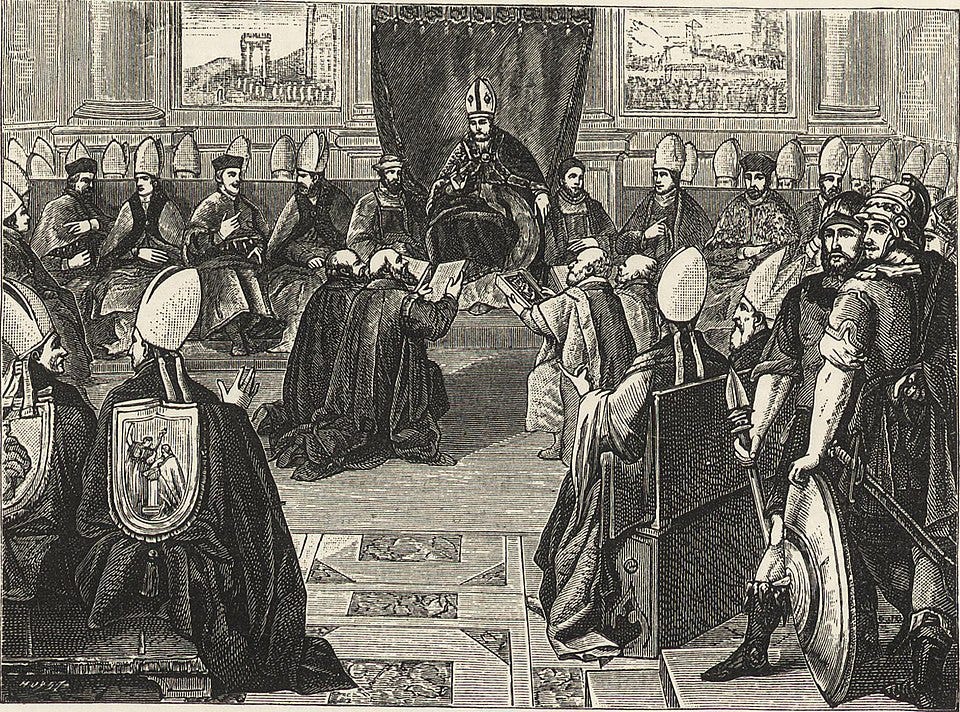
About the text: Just as the Prophets spoke out constantly against the usurious Israelites, popes and councils of the Middle Ages consistently condemned the crime of usury among Christians. Here we present two canons condemning the practice, one from Lateran III in 1179 and the other from the Council of Vienne in 1311–12. The former was called to condemn the Cathar heresy and reform the discipline of the Church whereas the latter was called early in the Avignon Papacy mainly to condemn the Templars. Despite the rather different intended outcomes, both councils came out firmly against the practice of usury.
—
Canon 25 of the Third Lateran Council
Because in almost all places the crime of usury has become so prevalent that many, neglecting other business, practise usury as if it were lawful, and do not pay any attention to how the pages of both Testaments condemn it, we have therefore decreed that manifest usurers shall neither be admitted to communion at the altar, nor shall they receive Christian burial if they die in this sin, and that no one shall accept their offerings. But whoever has accepted them or has given them over to Christian burial, shall be compelled to return what he has received, and shall remain suspended from the execution of his office until he has satisfied the judgment of the diocesan bishop.
Canon 29 of the Council of Vienne
It has come to us from a serious insinuation that certain local communities, in an offense to God and their neighbour and against divine and human rights alike, approve the depravity of usury. By their statutes, sometimes confirmed by oath, not only do they allow usury to be exacted and paid, but they knowingly compel debtors to pay it. And according to the restraint of their statutes, they impose heavy burdens, usually on those who request the usurious loans, and by using other things besides these various pretexts and elaborate frauds, they prevent the return of the same.
We, therefore, wishing to counteract these pernicious ventures, have decreed, with the sacred approval of the council, that whichever authorities, captains, rectors, consuls, judges, councillors, or any other officials of the communities themselves shall presume to make, write, or dictate statutes of this kind in the future, or to knowingly judge that usury is to be paid or that, when it is demanded, it is not to be fully and freely restored, shall incur the sentence of excommunication. And they shall incur the same sentence unless they have erased the statutes of this kind hitherto issued from the books of the communities themselves, if they have power over this, within three months, or if they have in any way presumed to observe the statutes or customs themselves, having their effect.
Moreover, because moneylenders so often enter into usurious contracts secretly and fraudulently that they can hardly be convicted of usurious wickedness, we decree that, when it comes to usury, the books of their accounts shall be compelled by ecclesiastical censure to be opened. Indeed, if anyone falls into such error as to stubbornly insist that practising usury is not a sin, we decree that he should be punished as a heretic; furthermore, we strictly enjoin the local ordinary and inquisitors of heresy that they not fail to proceed against those whom they find defamed or suspected of such error as against those defamed or suspected of heresy.