

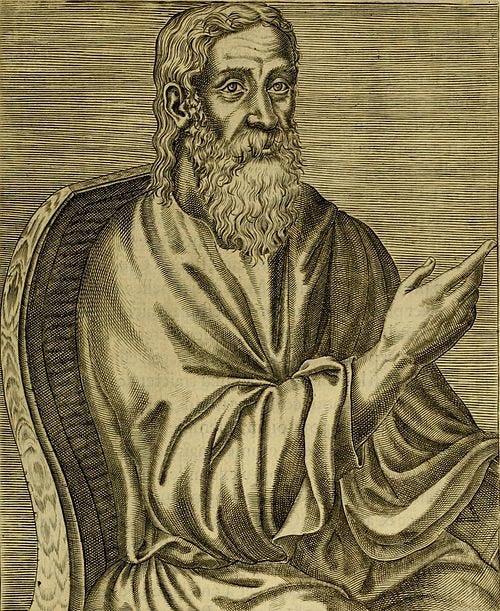
About the Author: St. Clement of Alexandria (c. 150–215) was the founder of the Alexandrian catechetical school, an early adopter of Platonist philosophy in expounding the Catholic faith, and the teacher of Origen. In this work, Clement shows what kind of rich man can be saved—to wit, one who is not bound by love of money but one who repents of avarice out of love for God. For this there is always hope.
—
I. Those who bestow laudatory addresses on the rich appear to me to be rightly judged not only flatterers and base, in vehemently pretending that things which are disagreeable give them pleasure, but also godless and treacherous; godless, because neglecting to praise and glorify God, who is alone perfect and good, “of whom are all things, and by whom are all things, and for whom are all things” (Rm 11:36), they invest with divine honours men wallowing in an execrable and abominable life, and, what is the principal thing, liable on this account to the judgment of God; and treacherous, because, although wealth is of itself sufficient to puff up and corrupt the souls of its possessors, and to turn them from the path by which salvation is to be attained, they stupefy them still more, by inflating the minds of the rich with the pleasures of extravagant praises, and by making them utterly despise all things except wealth, on account of which they are admired; bringing, as the saying is, fire to fire, pouring pride on pride, and adding conceit to wealth, a heavier burden to that which by nature is a weight, from which somewhat ought rather to be removed and taken away as being a dangerous and deadly disease. For to him who exalts and magnifies himself, the change and downfall to a low condition succeeds in turn, as the divine word teaches. For it appears to me to be far kinder, than basely to flatter the rich and praise them for what is bad, to aid them in working out their salvation in every possible way; asking this of God, who surely and sweetly bestows such things on His own children; and thus by the grace of the Saviour healing their souls, enlightening them and leading them to the attainment of the truth; and whosoever obtains this and distinguishes himself in good works shall gain the prize of everlasting life. Now prayer that runs its course till the last day of life needs a strong and tranquil soul; and the conduct of life needs a good and righteous disposition, reaching out towards all the commandments of the Saviour.
II. Perhaps the reason of salvation appearing more difficult to the rich than to poor men, is not single but manifold. For some, merely hearing, and that in an off-hand way, the utterance of the Saviour, “that it is easier for a camel to go through the eye of a needle than for a rich man to enter into the kingdom of heaven” (Mt 19:24), despair of themselves as not destined to live, surrender all to the world, cling to the present life as if it alone was left to them, and so diverge more from the way to the life to come, no longer inquiring either whom the Lord and Master calls rich, or how that which is impossible to man becomes possible to God. But others rightly and adequately comprehend this, but attaching slight importance to the works which tend to salvation, do not make the requisite preparation for attaining to the objects of their hope. And I affirm both of these things of the rich who have learned both the Saviour’s power and His glorious salvation. With those who are ignorant of the truth I have little concern.
III. Those then who are actuated by a love of the truth and love of their brethren, and neither are rudely insolent towards such rich as are called, nor, on the other hand, cringe to them for their own avaricious ends, must first by the word relieve them of their groundless despair, and show with the requisite explanation of the oracles of the Lord that the inheritance of the kingdom of heaven is not quite cut off from them if they obey the commandments; then admonish them that they entertain a causeless fear, and that the Lord gladly receives them, provided they are willing; and then, in addition, exhibit and teach how and by what deeds and dispositions they shall win the objects of hope, inasmuch as it is neither out of their reach, nor, on the other hand, attained without effort; but, as is the case with athletes—to compare things small and perishing with things great and immortal—let the man who is endowed with worldly wealth reckon that this depends on himself. For among those, one man, because he despaired of being able to conquer and gain crowns, did not give in his name for the contest; while another, whose mind was inspired with this hope, and yet did not submit to the appropriate labours, and diet, and exercises, remained uncrowned, and was balked in his expectations. So also let not the man that has been invested with worldly wealth proclaim himself excluded at the outset from the Saviour’s lists, provided he is a believer and one who contemplates the greatness of God’s philanthropy; nor let him, on the other hand, expect to grasp the crowns of immortality without struggle and effort, continuing untrained, and without contest. But let him go and put himself under the Word as his trainer, and Christ the President of the contest; and for his prescribed food and drink let him have the New Testament of the Lord; and for exercises, the commandments; and for elegance and ornament, the fair dispositions, love, faith, hope, knowledge of the truth, gentleness, meekness, pity, gravity: so that, when by the last trumpet the signal shall be given for the race and departure hence, as from the stadium of life, he may with a good conscience present himself victorious before the Judge who confers the rewards, confessedly worthy of the Fatherland on high, to which he returns with crowns and the acclamations of angels.
IV. May the Saviour then grant to us that, having begun the subject from this point, we may contribute to the brethren what is true, and suitable, and saving, first touching the hope itself, and, second, touching the access to the hope. He indeed grants to those who beg, and teaches those who ask, and dissipates ignorance and dispels despair, by introducing again the same words about the rich, which become their own interpreters and infallible expounders. For there is nothing like listening again to the very same statements, which till now in the Gospels were distressing you, hearing them as you did without examination, and erroneously through puerility: “And going forth into the way, one approached and kneeled, saying, Good Master, what good thing shall I do that I may inherit everlasting life? And Jesus says, Why do you call Me good? There is none good but one, that is, God. You know the commandments. Do not commit adultery, Do not kill, Do not steal, Do not bear false witness, Defraud not, Honour your father and your mother. And he answering says to Him, All these have I observed. And Jesus, looking upon him, loved him, and said, One thing you lack. If you would be perfect, sell what you have and give to the poor, and you shall have treasure in heaven: and come, follow Me. And he was sad at that saying, and went away grieved: for he was rich, having great possessions. And Jesus looked round about, and says to His disciples, How hardly shall they that have riches enter into the kingdom of God! And the disciples were astonished at His words. But Jesus answers again, and says unto them, Children, how hard is it for them that trust in riches to enter into the kingdom of God! More easily shall a camel enter through the eye of a needle than a rich man into the kingdom of God. And they were astonished out of measure, and said, Who then can be saved? And He, looking upon them, said, What is impossible with men is possible with God. For with God all things are possible. Peter began to say to Him, Lo, we have left all and followed You. And Jesus answered and said, Verily I say unto you, Whosoever shall leave what is his own, parents, and brethren, and possessions, for My sake and the Gospel’s, shall receive an hundred-fold now in this world, lands, and possessions, and house, and brethren, with persecutions; and in the world to come is life everlasting. But many that are first shall be last, and the last first.”
. . .
VI. Our Lord and Saviour was asked pleasantly a question most appropriate for Him—the Life respecting life, the Saviour respecting salvation, the Teacher respecting the chief doctrines taught, the Truth respecting the true immortality, the Word respecting the word of the Father, the Perfect respecting the perfect rest, the Immortal respecting the sure immortality. He was asked respecting those things on account of which He descended, which He inculcates, which He teaches, which He offers, in order to show the essence of the Gospel, that it is the gift of eternal life. For He foresaw as God, both what He would be asked, and what each one would answer Him. For who should do this more than the Prophet of prophets, and the Lord of every prophetic spirit? And having been called “good,” and taking the starting note from this first expression, He commences His teaching with this, turning the pupil to God, the good, and first and only dispenser of eternal life, which the Son, who received it of Him, gives to us.
. . .
VIII. He then who would live the true life is enjoined first to know Him “whom no one knows, except the Son reveal Him” (Mt 11:27). Next is to be learned the greatness of the Saviour after Him, and the newness of grace; for, according to the apostle, “the law was given by Moses, grace and truth came by Jesus Christ” (Jn 1:17); and the gifts granted through a faithful servant are not equal to those bestowed by the true Son. If then the law of Moses had been sufficient to confer eternal life, it were to no purpose for the Saviour Himself to come and suffer for us, accomplishing the course of human life from His birth to His cross; and to no purpose for him who had done all the commandments of the law from his youth to fall on his knees and beg from another immortality. For he had not only fulfilled the law, but had begun to do so from his very earliest youth. For what is there great or pre-eminently illustrious in an old age which is unproductive of faults? But if one in juvenile frolicsomeness and the fire of youth shows a mature judgment older than his years, this is a champion admirable and distinguished, and hoary pre-eminently in mind.
But, nevertheless, this man being such, is perfectly persuaded that nothing is wanting to him as far as respects righteousness, but that he is entirely destitute of life. Wherefore he asks it from Him who alone is able to give it. And with reference to the law, he carries confidence; but the Son of God he addresses in supplication. He is transferred from faith to faith. As perilously tossing and occupying a dangerous anchorage in the law, he makes for the Saviour to find a haven.
IX. Jesus, accordingly, does not charge him with not having fulfilled all things out of the law, but loves him, and fondly welcomes his obedience in what he had learned; but says that he is not perfect as respects eternal life, inasmuch as he had not fulfilled what is perfect, and that he is a doer indeed of the law, but idle at the true life. Those things, indeed, are good. Who denies it? For “the commandment is holy” (Rm 7:12), as far as a sort of training with fear and preparatory discipline goes, leading as it did to the culmination of legislation and to grace (Gal 3:24). But Christ is the fulfilment “of the law for righteousness to every one that believes”; and not as a slave making slaves, but sons, and brethren, and fellow-heirs, who perform the Father’s will.
X. “If you will be perfect” (Mt 19:21). Consequently he was not yet perfect. For nothing is more perfect than what is perfect. And divinely the expression “if you will” showed the self-determination of the soul holding converse with Him. For choice depended on the man as being free; but the gift on God as the Lord. And He gives to those who are willing and are exceedingly earnest, and ask, that so their salvation may become their own. For God compels not (for compulsion is repugnant to God), but supplies to those who seek, and bestows on those who ask, and opens to those who knock. If you will, then, if you really will, and art not deceiving yourself, acquire what you lack. One thing is lacking you—the one thing which abides, the good, that which is now above the law, which the law gives not, which the law contains not, which is the prerogative of those who live. He forsooth who had fulfilled all the demands of the law from his youth, and had gloried in what was magnificent, was not able to complete the whole with this one thing which was specially required by the Saviour, so as to receive the eternal life which he desired. But he departed displeased, vexed at the commandment of the life, on account of which he supplicated. For he did not truly wish life, as he averred, but aimed at the mere reputation of the good choice. And he was capable of busying himself about many things; but the one thing, the work of life, he was powerless, and disinclined, and unable to accomplish. Such also was what the Lord said to Martha, who was occupied with many things, and distracted and troubled with serving; while she blamed her sister, because, leaving serving, she set herself at His feet, devoting her time to learning: “You are troubled about many things, but Mary has chosen the good part, which shall not be taken away from her” (Lk 10:41–42). So also He bade him leave his busy life, and cleave to One and adhere to the grace of Him who offered everlasting life.
XI. What then was it which persuaded him to flight, and made him depart from the Master, from the entreaty, the hope, the life, previously pursued with ardour?—“Sell your possessions.” And what is this? He does not, as some conceive off-hand, bid him throw away the substance he possessed, and abandon his property; but bids him banish from his soul his notions about wealth, his excitement and morbid feeling about it, the anxieties, which are the thorns of existence, which choke the seed of life. For it is no great thing or desirable to be destitute of wealth, if without a special object—not except on account of life. For thus those who have nothing at all, but are destitute, and beggars for their daily bread, the poor dispersed on the streets, who know not God and God’s righteousness, simply on account of their extreme want and destitution of subsistence, and lack even of the smallest things, were most blessed and most dear to God, and sole possessors of everlasting life.
Nor was the renunciation of wealth and the bestowment of it on the poor or needy a new thing; for many did so before the Saviour’s advent—some because of the leisure thereby obtained for learning, and on account of a dead wisdom; and others for empty fame and vainglory, as the Anaxagorases, the Democriti, and the Crateses.
XII. Why then command as new, as divine, as alone life-giving, what did not save those of former days? And what peculiar thing is it that the new creature the Son of God intimates and teaches? It is not the outward act which others have done, but something else indicated by it, greater, more godlike, more perfect, the stripping off of the passions from the soul itself and from the disposition, and the cutting up by the roots and casting out of what is alien to the mind. For this is the lesson peculiar to the believer, and the instruction worthy of the Saviour. For those who formerly despised external things relinquished and squandered their property, but the passions of the soul, I believe, they intensified. For they indulged in arrogance, pretension, and vainglory, and in contempt of the rest of mankind, as if they had done something superhuman. How then would the Saviour have enjoined on those destined to live for ever what was injurious and hurtful with reference to the life which He promised? For although such is the case, one, after ridding himself of the burden of wealth, may none the less have still the lust and desire for money innate and living; and may have abandoned the use of it, but being at once destitute of and desiring what he spent, may doubly grieve both on account of the absence of attendance, and the presence of regret. For it is impossible and inconceivable that those in want of the necessaries of life should not be harassed in mind, and hindered from better things in the endeavour to provide them somehow, and from some source.
XIII. And how much more beneficial the opposite case, for a man, through possessing a competency, both not himself to be in straits about money, and also to give assistance to those to whom it is requisite so to do! For if no one had anything, what room would be left among men for giving? And how can this dogma fail to be found plainly opposed to and conflicting with many other excellent teachings of the Lord? “Make to yourselves friends of the mammon of unrighteousness, that when you fail, they may receive you into the everlasting habitations” (Lk 16:9). “Acquire treasures in heaven, where neither moth nor rust destroys, nor thieves break through” (Mt 6:19). How could one give food to the hungry, and drink to the thirsty, clothe the naked, and shelter the houseless, for not doing which He threatens with fire and the outer darkness, if each man first divested himself of all these things? Nay, He bids Zaccheus and Matthew, the rich tax-gathers, entertain Him hospitably. And He does not bid them part with their property, but, applying the just and removing the unjust judgment, He subjoins, “Today salvation has come to this house, forasmuch as he also is a son of Abraham.” He so praises the use of property as to enjoin, along with this addition, the giving a share of it, to give drink to the thirsty, bread to the hungry, to take the houseless in, and clothe the naked. But if it is not possible to supply those needs without substance, and He bids people abandon their substance, what else would the Lord be doing than exhorting to give and not to give the same things, to feed and not to feed, to take in and to shut out, to share and not to share? Which were the most irrational of all things.
XIV. Riches, then, which benefit also our neighbours, are not to be thrown away. For they are possessions, inasmuch as they are possessed, and goods, inasmuch as they are useful and provided by God for the use of men; and they lie to our hand, and are put under our power, as material and instruments which are for good use to those who know the instrument. If you use it skilfully, it is skilful; if you are deficient in skill, it is affected by your want of skill, being itself destitute of blame. Such an instrument is wealth. Are you able to make a right use of it? It is subservient to righteousness. Does one make a wrong use of it? It is, on the other hand, a minister of wrong. For its nature is to be subservient, not to rule. That then which of itself has neither good nor evil, being blameless, ought not to be blamed; but that which has the power of using it well and ill, by reason of its possessing voluntary choice. And this is the mind and judgment of man, which has freedom in itself and self-determination in the treatment of what is assigned to it. So let no man destroy wealth, rather than the passions of the soul, which are incompatible with the better use of wealth. So that, becoming virtuous and good, he may be able to make a good use of these riches. The renunciation, then, and selling of all possessions, is to be understood as spoken of the passions of the soul.
XV. I would then say this. Since some things are within and some without the soul, and if the soul make a good use of them, they also are reputed good, but if a bad, bad—whether does He who commands us to alienate our possessions repudiate those things, after the removal of which the passions still remain, or those rather, on the removal of which wealth even becomes beneficial? If therefore he who casts away worldly wealth can still be rich in the passions, even though the material for their gratification is absent—for the disposition produces its own effects, and strangles the reason, and presses it down and inflames it with its inbred lusts—it is then of no advantage to him to be poor in purse while he is rich in passions. For it is not what ought to be cast away that he has cast away, but what is indifferent; and he has deprived himself of what is serviceable, but set on fire the innate fuel of evil through want of the external means of gratification. We must therefore renounce those possessions that are injurious, not those that are capable of being serviceable, if one knows the right use of them. And what is managed with wisdom, and sobriety, and piety, is profitable; and what is hurtful must be cast away. But things external hurt not. So then the Lord introduces the use of external things, bidding us put away not the means of subsistence, but what uses them badly. And these are the infirmities and passions of the soul.
XVI. The presence of wealth in these is deadly to all, the loss of it salutary. Of which, making the soul pure—that is, poor and bare—we must hear the Saviour speaking thus, “Come, follow Me.” For to the pure in heart He now becomes the way. But into the impure soul the grace of God finds no entrance. And that soul is unclean which is rich in lusts, and is in the throes of many worldly affections. For he who holds possessions, and gold, and silver, and houses, as the gifts of God; and ministers from them to the God who gives them for the salvation of men; and knows that he possesses them more for the sake of the brethren than his own; and is superior to the possession of them, not the slave of the things he possesses; and does not carry them about in his soul, nor bind and circumscribe his life within them, but is ever labouring at some good and divine work, even should he be necessarily some time or other deprived of them, is able with cheerful mind to bear their removal equally with their abundance. This is he who is blessed by the Lord, and called poor in spirit, a meet heir of the kingdom of heaven, not one who could not live rich.
XVII. But he who carries his riches in his soul, and instead of God’s Spirit bears in his heart gold or land, and is always acquiring possessions without end, and is perpetually on the outlook for more, bending downwards and fettered in the toils of the world, being earth and destined to depart to earth—whence can he be able to desire and to mind the kingdom of heaven—a man who carries not a heart, but land or metal, who must perforce be found in the midst of the objects he has chosen? For where the mind of man is, there is also his treasure. The Lord acknowledges a twofold treasure—the good: “For the good man, out of the good treasure of his heart, brings forth good”; and the evil: for “the evil man, out of the evil treasure, brings forth evil: for out of the abundance of the heart the mouth speaks” (Mt 12:34–35). As then treasure is not one with Him, as also it is with us, that which gives the unexpected great gain in the finding, but also a second, which is profitless and undesirable, an evil acquisition, hurtful; so also there is a richness in good things, and a richness in bad things, since we know that riches and treasure are not by nature separated from each other. And the one sort of riches is to be possessed and acquired, and the other not to be possessed, but to be cast away.
In the same way spiritual poverty is blessed. Wherefore also Matthew added, “Blessed are the poor” (Mt 5:3). How? “In spirit.” And again, “Blessed are they that hunger and thirst after the righteousness of God” (Mt 5:6). Wherefore wretched are the contrary kind of poor, who have no part in God, and still less in human property, and have not tasted of the righteousness of God.
XVIII. So that the expression rich men that shall with difficulty enter into the kingdom, is to be apprehended in a scholarly way, not awkwardly, or rustically, or carnally. For if the expression is used thus, salvation does not depend on external things, whether they be many or few, small or great, or illustrious or obscure, or esteemed or disesteemed; but on the virtue of the soul, on faith, and hope, and love, and brotherliness, and knowledge, and meekness, and humility, and truth, the reward of which is salvation. For it is not on account of comeliness of body that any one shall live, or, on the other hand, perish. But he who uses the body given to him chastely and according to God, shall live; and he that destroys the temple of God shall be destroyed. An ugly man can be profligate, and a good-looking man temperate. Neither strength and great size of body makes alive, nor does any of the members destroy. But the soul which uses them provides the cause for each. Bear then, it is said, when struck on the face (Mt 5:39); which a man strong and in good health can obey. And again, a man who is feeble may transgress from refractoriness of temper. So also a poor and destitute man may be found intoxicated with lusts; and a man rich in worldly goods temperate, poor in indulgences, trustworthy, intelligent, pure, chastened.
If then it is the soul which, first and especially, is that which is to live, and if virtue springing up around it saves, and vice kills; then it is clearly manifest that by being poor in those things, by riches of which one destroys it, it is saved, and by being rich in those things, riches of which ruin it, it is killed. And let us no longer seek the cause of the issue elsewhere than in the state and disposition of the soul in respect of obedience to God and purity, and in respect of transgression of the commandments and accumulation of wickedness.
XIX. He then is truly and rightly rich who is rich in virtue, and is capable of making a holy and faithful use of any fortune; while he is spuriously rich who is rich, according to the flesh, and turns life into outward possession, which is transitory and perishing, and now belongs to one, now to another, and in the end to nobody at all. Again, in the same way there is a genuine poor man, and another counterfeit and falsely so called. He that is poor in spirit, and that is the right thing, and he that is poor in a worldly sense, which is a different thing. To him who is poor in worldly goods, but rich in vices, who is not poor in spirit and rich toward God, it is said, Abandon the alien possessions that are in your soul, that, becoming pure in heart, you may see God; which is another way of saying, Enter into the kingdom of heaven. And how may you abandon them? By selling them. What then? Are you to take money for effects, by effecting an exchange of riches, by turning your visible substance into money? Not at all. But by introducing, instead of what was formerly inherent in your soul, which you desire to save, other riches which deify and which minister everlasting life, dispositions in accordance with the command of God; for which there shall accrue to you endless reward and honour, and salvation, and everlasting immortality. It is thus that you rightly sell the possessions, many are superfluous, which shut the heavens against you by exchanging them for those which are able to save. Let the former be possessed by the carnal poor, who are destitute of the latter. But you, by receiving instead spiritual wealth, shall have now treasure in the heavens.
XX. The wealthy and legally correct man, not understanding these things figuratively, nor how the same man can be both poor and rich, and have wealth and not have it, and use the world and not use it, went away sad and downcast, leaving the state of life, which he was able merely to desire but not to attain, making for himself the difficult impossible. For it was difficult for the soul not to be seduced and ruined by the luxuries and flowery enchantments that beset remarkable wealth; but it was not impossible, even surrounded with it, for one to lay hold of salvation, provided he withdrew himself from material wealth—to that which is grasped by the mind and taught by God, and learned to use things indifferent rightly and properly, and so as to strive after eternal life. And the disciples even themselves were at first alarmed and amazed. Why were they so on hearing this? Was it that they themselves possessed much wealth? Nay, they had long ago left their very nets, and hooks, and rowing boats, which were their sole possessions. Why then do they say in consternation, “Who can be saved?” They had heard well and like disciples what was spoken in parable and obscurely by the Lord, and perceived the depth of the words. For they were sanguine of salvation on the ground of their want of wealth. But when they became conscious of not having yet wholly renounced the passions (for they were neophytes and recently selected by the Saviour), they were excessively astonished, and despaired of themselves no less than that rich man who clung so terribly to the wealth which he preferred to eternal life. It was therefore a fit subject for all fear on the disciples’ part; if both he that possesses wealth and he that is teeming with passions were the rich, and these alike shall be expelled from the heavens. For salvation is the privilege of pure and passionless souls.
XXI. But the Lord replies, “Because what is impossible with men is possible with God.” This again is full of great wisdom. For a man by himself working and toiling at freedom from passion achieves nothing. But if he plainly shows himself very desirous and earnest about this, he attains it by the addition of the power of God. For God conspires with willing souls. But if they abandon their eagerness, the spirit which is bestowed by God is also restrained. For to save the unwilling is the part of one exercising compulsion; but to save the willing, that of one showing grace. Nor does the kingdom of heaven belong to sleepers and sluggards, “but the violent take it by force.” For this alone is commendable violence, to force God, and take life from God by force. And He, knowing those who persevere firmly, or rather violently, yields and grants. For God delights in being vanquished in such things.
Therefore on hearing those words, the blessed Peter, the chosen, the pre-eminent, the first of the disciples, for whom alone and Himself the Saviour paid tribute (Mt 17:27), quickly seized and comprehended the saying. And what does he say? “Lo, we have left all and followed You.” Now if by all he means his own property, he boasts of leaving four oboli perhaps in all, and forgets to show the kingdom of heaven to be their recompense. But if, casting away what we were now speaking of, the old mental possessions and soul diseases, they follow in the Master’s footsteps, this now joins them to those who are to be enrolled in the heavens. For it is thus that one truly follows the Saviour, by aiming at sinlessness and at His perfection, and adorning and composing the soul before it as a mirror, and arranging everything in all respects similarly.
. . .
XXXIX. If one should escape the superfluity of riches, and the difficulty they interpose in the way of life, and be able to enjoy the eternal good things; but should happen, either from ignorance or involuntary circumstances, after the seal and redemption, to fall into sins or transgressions so as to be quite carried away; such a man is entirely rejected by God. For to every one who has turned to God in truth, and with his whole heart, the doors are open, and the thrice-glad Father receives His truly repentant son. And true repentance is to be no longer bound in the same sins for which He denounced death against Himself, but to eradicate them completely from the soul. For on their extirpation God takes up His abode again in you. For it is said there is great and exceeding joy and festival in the heavens with the Father and the angels when one sinner turns and repents (Lk 15:10). Wherefore also He cries, “I will have mercy, and not sacrifice” (Hos 6:6; Mt 9:13). “I desire not the death, but the repentance of the sinner” (Ez 18:23). “Though your sins be as scarlet wool, I will make them white as snow; though they be blacker than darkness, I will wash and make them like white wool” (Is 1:18). For it is in the power of God alone to grant the forgiveness of sins, and not to impute transgressions; since also the Lord commands us each day to forgive the repenting brethren (Mt 6:14). “And if we, being evil, know to give good gifts” (Lk 11:13), much more is it the nature of the Father of mercies, the good Father of all consolation, much pitying, very merciful, to be long-suffering, to wait for those who have turned. And to turn is really to cease from our sins, and to look no longer behind.
XL. Forgiveness of past sins, then, God gives; but of future, each one gives to himself. And this is to repent, to condemn the past deeds, and beg oblivion of them from the Father, who only of all is able to undo what is done, by mercy proceeding from Him, and to blot out former sins by the dew of the Spirit. “For by the state in which I find you will I judge,” also, is what in each case the end of all cries aloud. So that even in the case of one who has done the greatest good deeds in his life, but at the end has run headlong into wickedness, all his former pains are profitless to him, since at the catastrophe of the drama he has given up his part; while it is possible for the man who formerly led a bad and dissolute life, on afterwards repenting, to overcome in the time after repentance the evil conduct of a long time. But it needs great carefulness, just as bodies that have suffered by protracted disease need regimen and special attention. Thief, do you wish to get forgiveness? steal no more. Adulterer, burn no more. Fornicator, live for the future chastely. You who have robbed, give back, and give back more than you took. False witness, practice truth. Perjurer, swear no more, and extirpate the rest of the passions, wrath, lust, grief, fear; that you may be found at the end to have previously in this world been reconciled to the adversary. It is then probably impossible all at once to eradicate inbred passions; but by God’s power and human intercession, and the help of brethren, and sincere repentance, and constant care, they are corrected.
XLI. Wherefore it is by all means necessary for you, who art pompous, and powerful, and rich, to set over yourself some man of God as a trainer and governor. Reverence, though it be but one man; fear, though it be but one man. Give yourself to hearing, though it be but one speaking freely, using harshness, and at the same time healing. For it is good for the eyes not to continue always wanton, but to weep and smart sometimes, for greater health. So also nothing is more pernicious to the soul than uninterrupted pleasure. For it is blinded by melting away, if it remain unmoved by bold speech. Fear this man when angry; be pained at his groaning; and reverence him when making his anger to cease; and anticipate him when he is deprecating punishment. Let him pass many sleepless nights for you, interceding for you with God, influencing the Father with the magic of familiar litanies. For He does not hold out against His children when they beg His pity. And for you he will pray purely, held in high honour as an angel of God, and grieved not by you, but for you. This is sincere repentance. “God is not mocked” (Gal 6:7), nor does He give heed to vain words. For He alone searches the marrow and reins of the heart, and hears those that are in the fire, and listens to those who supplicate in the whale’s belly; and is near to all who believe, and far from the ungodly if they repent not.
XLII. And that you may be still more confident, that repenting thus truly there remains for you a sure hope of salvation, listen to a tale, which is not a tale but a narrative, handed down and committed to the custody of memory, about the Apostle John. For when, on the tyrant’s death, he returned to Ephesus from the isle of Patmos, he went away, being invited, to the contiguous territories of the nations, here to appoint bishops, there to set in order whole Churches, there to ordain such as were marked out by the Spirit.
Having come to one of the cities not far off, and having put the brethren to rest in other matters, at last, looking to the bishop appointed, and seeing a youth, powerful in body, comely in appearance, and ardent, said, “This youth I commit to you in all earnestness, in the presence of the Church, and with Christ as witness.” And on his accepting and promising all, he gave the same injunction and testimony. And he set out for Ephesus. And the presbyter taking home the youth committed to him, reared, kept, cherished, and finally baptized him. After this he relaxed his stricter care and guardianship, under the idea that the seal of the Lord he had set on him was a complete protection to him. But on his obtaining premature freedom, some youths of his age, idle, dissolute, and adepts in evil courses, corrupt him. First they entice him by many costly entertainments; then afterwards by night issuing forth for highway robbery, they take him along with them. Then they dared to execute together something greater. And he by degrees got accustomed; and from greatness of nature, when he had gone aside from the right path, and like a hard-mouthed and powerful horse, had taken the bit between his teeth, rushed with all the more force down into the depths. And having entirely despaired of salvation in God, he no longer meditated what was insignificant, but having perpetrated some great exploit, now that he was once lost, he made up his mind to a like fate with the rest. Taking them and forming a band of robbers, he was the prompt captain of the bandits, the fiercest, the bloodiest, the cruelest.
Time passed, and some necessity having emerged, they send again for John. He, when he had settled the other matters on account of which he came, said, “Come now, O bishop, restore to us the deposit which I and the Saviour committed to you in the face of the Church over which you preside, as witness.” The other was at first confounded, thinking that it was a false charge about money which he did not get; and he could neither believe the allegation regarding what he had not, nor disbelieve John. But when he said “I demand the young man, and the soul of the brother,” the old man, groaning deeply, and bursting into tears, said, “He is dead.” “How and what kind of death?” “He is dead,” he said, “to God. For he turned wicked and abandoned, and at last a robber; and now he has taken possession of the mountain in front of the church, along with a band like him.” Rending, therefore, his clothes, and striking his head with great lamentation, the apostle said, “It was a fine guard of a brother’s soul I left! But let a horse be brought me, and let some one be my guide on the way.” He rode away, just as he was, straight from the church. On coming to the place, he is arrested by the robbers’ outpost; neither fleeing nor entreating, but crying, “It was for this I came. Lead me to your captain;” who meanwhile was waiting, all armed as he was. But when he recognized John as he advanced, he turned, ashamed, to flight. The other followed with all his might, forgetting his age, crying, “Why, my son, do you flee from me, your father, unarmed, old? Son, pity me. Fear not; you have still hope of life. I will give account to Christ for you. If need be, I will willingly endure your death, as the Lord did death for us. For you I will surrender my life. Stand, believe; Christ has sent me.”
And he, when he heard, first stood, looking down; then threw down his arms, then trembled and wept bitterly. And on the old man approaching, he embraced him, speaking for himself with lamentations as he could, and baptized a second time with tears, concealing only his right hand. The other pledging, and assuring him on oath that he would find forgiveness for himself from the Saviour, beseeching and falling on his knees, and kissing his right hand itself, as now purified by repentance, led him back to the church. Then by supplicating with copious prayers, and striving along with him in continual fastings, and subduing his mind by various utterances of words, did not depart, as they say, till he restored him to the Church, presenting in him a great example of true repentance and a great token of regeneration, a trophy of the resurrection for which we hope; when at the end of the world, the angels, radiant with joy, hymning and opening the heavens, shall receive into the celestial abodes those who truly repent; and before all, the Saviour Himself goes to meet them, welcoming them; holding forth the shadowless, ceaseless light; conducting them, to the Father’s bosom, to eternal life, to the kingdom of heaven.
Let one believe these things, and the disciples of God, and God, who is surety, the Prophecies, the Gospels, the Apostolic words; living in accordance with them, and lending his ears, and practising the deeds, he shall at his decease see the end and demonstration of the truths taught. For he who in this world welcomes the angel of penitence will not repent at the time that he leaves the body, nor be ashamed when he sees the Saviour approaching in His glory and with His army. He fears not the fire.
But if one chooses to continue and to sin perpetually in pleasures, and values indulgence here above eternal life, and turns away from the Saviour, who gives forgiveness; let him no more blame either God, or riches, or his having fallen, but his own soul, which voluntarily perishes. But to him who directs his eye to salvation and desires it, and asks with boldness and vehemence for its bestowal, the good Father who is in heaven will give the true purification and the changeless life. To whom, by His Son Jesus Christ, the Lord of the living and dead, and by the Holy Spirit, be glory, honour, power, eternal majesty, both now and ever, from generation to generation, and from eternity to eternity. Amen.
—
Translated by William Wilson, Ante-Nicene Fathers, vol 2 (1885).